The Invention of Tradition
Traditions younger than they look
Description
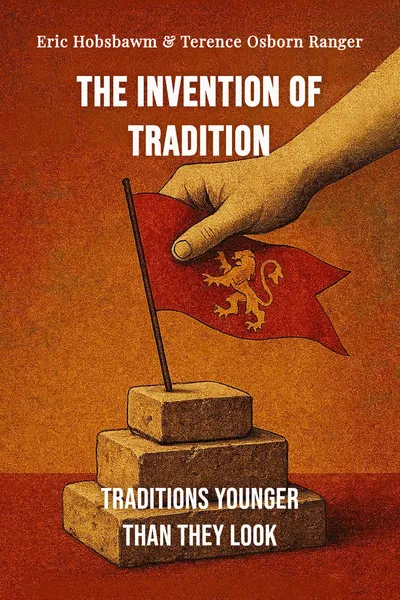
In 1983, a slim collection of essays edited by two Cambridge-trained historians, Eric Hobsbawm and Terence Ranger, argued something that sounded almost mischievous. Many of the traditions we treat as immemorial — the ones dressed in tartan, played on bagpipes, wrapped in ceremony — turn out to be surprisingly young. Not ancient at all. Manufactured, often, within living memory of the people who first performed them, then aged artificially to look as though they had always been there. The book was called The Invention of Tradition, and it did something quietly radical: it took the word invention, which we reserve for machines and patents, and applied it to the customs a society considers most sacred.
The examples were specific and, to a lot of readers, a little startling. The Scottish clan tartan, that emblem of Highland antiquity, largely took its familiar form in the eighteenth and nineteenth centuries. The pageantry of the British monarchy, which feels rooted in a thousand years of unbroken ritual, was in significant part staged and refined in the decades around 1900. Colonial administrators in Africa codified customs that had been far more fluid before they arrived. In each case, something new was presented as something old, and the presentation was the whole point.
The book was never really about tartan or crowns for their own sake. Hobsbawm and Ranger were after a mechanism — the process by which a society reaches back for a past it doesn't quite have, and builds one. Understanding that mechanism changes how we read almost every ceremony we take for granted.
The question we’re asking : Why do so many of our most solemn traditions turn out to be recent inventions, and what work were they built to do?What we’ll see : How customs get manufactured, aged to look ancient, and pressed into the service of belonging — told through the cases Hobsbawm and Ranger assembled.
Table of contents
01 Chapter 1 — The kilt was designed by an Englishman
The essay that gave the book its edge was Hugh Trevor-Roper's account of the Highland tradition, and its central claim was blunt. The whole apparatus of Scottish Highland identity — the kilt, the clan tartan, the bagpipe as national instrument — was, in its recognizable modern form, considerably more recent than the misty antiquity it advertised. The Highlanders had genuinely worn a belted plaid, a large draped garment. But the short, tailored kilt we picture today, Trevor-Roper argued, was refined in the early eighteenth century, and one version of the story credits an English Quaker industrialist, Thomas Rawlinson, who wanted a more practical garment for the workers at his ironworks.
The idea that each clan had its own distinctive tartan, worn for centuries as a family badge, was later still. It hardened into a system in the early nineteenth century, and the theatrical high point came in 1822, when the novelist Walter Scott choreographed a visit by King George IV to Edinburgh. The king appeared in Highland dress, complete with tartan, and the whole spectacle knit together a coherent, colorful, marketable Scottishness. Weaving firms were happy to supply the pattern books that assigned a tartan to every name.

02 Chapter 2 — How a custom gets manufactured
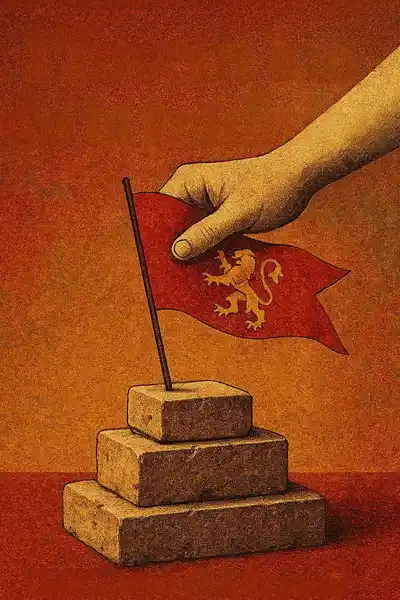
Hobsbawm opened the book by trying to be precise about what an invented tradition actually is, because the phrase invites easy misreading. He did not mean that these customs were fakes, or frauds foisted on a gullible public. He meant something more specific: a set of practices, usually governed by accepted rules, that seek to instill certain values by repetition, and that automatically imply continuity with a suitable past. The key word is imply. The continuity is often largely fictitious. The tradition attaches itself to a past, but it selects that past, and sometimes it manufactures it outright.
He drew a distinction that carries a lot of the argument. Custom, in the older sense, is what living societies actually do — flexible, adjusting itself as conditions change, the way a farming community shifts its practices with the seasons and the market. Invented tradition is different. It is deliberately fixed, formalized, ritualized. It resists change on purpose, because its whole value lies in seeming unchanging. A genuinely old habit adapts without noticing; an invented tradition freezes, precisely so that it can appear to have been frozen forever.
03 Chapter 3 — The nineteenth century, factory of pasts
The book's boldest argument is about concentration in time. If invented traditions were scattered evenly across history, they would be a curiosity. Instead, Hobsbawm argued, a remarkable number of the traditions Europeans treat as timeless were created in a compressed window — roughly the four or five decades before the First World War. This was the age of mass politics, of expanding electorates, of industrial cities filling with uprooted populations, of nation-states that suddenly needed millions of strangers to feel like one people. The old bonds of village and locality were dissolving. Something had to bind the new mass society together, and old-looking ritual was one of the tools reached for.
The British monarchy is his sharpest example, developed with David Cannadine's essay. Through much of the nineteenth century, royal ceremonial had often been shabby, badly organized, mocked in the press. It was in the decades around 1900 that the great public rituals — jubilees, coronations, state processions — were deliberately refined into the polished spectacles we now take as ancient. The pageantry that reads as a thousand years of unbroken majesty was, to a surprising degree, an achievement of modern stage-management, invented for an era of mass media that could broadcast it.
04 Chapter 4 — What a nation needs from its ancestors
Step back from the individual cases and the deeper claim comes into focus. Invented traditions are not a quirk of the sentimental or the deceitful. They are a response to a specific problem: how a society holds together when the old, organic sources of cohesion have worn away. Hobsbawm's insight is that the appearance of age is doing political work that acknowledged novelty simply cannot do. A brand-new rule can be argued with, repealed, resented as someone's imposition. A rule that seems to descend from the ancestors carries a different authority — it feels like inheritance rather than instruction, and inheritance is much harder to refuse.
This is why invented traditions almost never announce themselves as invented. The disguise is the function. The monarchy's pageantry works because it feels immemorial; disclose that it was staged in 1902 and some of its power leaks away. The Highland tartan binds a diaspora together because it feels ancestral, not because anyone believes it was assigned by a nineteenth-century weaving firm. The past, in these cases, is less a record of what happened than a resource for the present — selected, edited, and dressed up to legitimize an arrangement that people living now want to sustain.
05 Conclusion
The tartan, the crown, the codified custom — Hobsbawm and Ranger lined them up not to debunk them but to catch a society in the act of building its own past. Each case follows the same arc: a moment of creation, usually recent, usually traceable to particular people with particular motives, followed by a careful backdating that erases the moment of creation from memory. The invention works precisely to the degree that it stops looking like one. What survives is the feeling of age, which turns out to be manufacturable, and which turns out to be one of the most useful things a modern society can manufacture.
Related books