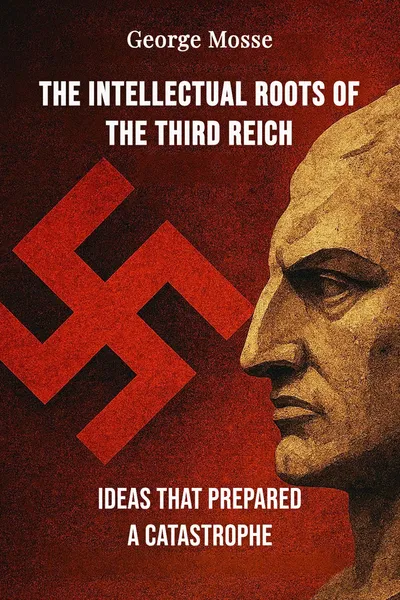
The Intellectual Roots of the Third Reich
Ideas that prepared a catastrophe
Description
George L. Mosse spent much of his career asking a question that sounds almost naive until you sit with it: how did a modern, literate, deeply cultured society talk itself into the Third Reich? Mosse, a German-Jewish historian who fled the country as a teenager and rebuilt his life in the United States, refused the easy answers. Hitler was not a bolt from a clear sky, and the men who cheered him were not simply duped by a demagogue with a good microphone. In the book that gives this piece its title, published in 1964, Mosse went looking for something slower and stranger — a mood, a vocabulary, a way of feeling about the nation that had been circulating in German culture for the better part of a century before anyone put on a brown shirt.
What he found was not a single evil thinker to blame. It was a whole atmosphere, an inheritance of poets, schoolteachers, pamphleteers, gymnastics clubs and popular novelists, most of them long dead by 1933 and few of them monstrous on the page. They wrote about roots, about landscape, about the mystical bond between a people and its soil. They were often sincere, sometimes gifted, and almost never imagining gas chambers. And yet, decade after decade, they laid down the images and the longings that a movement would later pick up and weaponize.
Mosse called this the intellectual history of an ideology rather than a conspiracy — a study of how respectable ideas curdle when the guardrails around them fall away. It is an uncomfortable book precisely because it does not let culture off the hook. It asks what happens when a nation prefers to feel its identity rather than argue about it.
The question we’re asking : How does a cultured society assemble, over decades, the ideas that make a catastrophe thinkable?What we’ll see : How a diffuse German longing hardened, generation by generation, into a language a movement could seize.
Table of contents
01Chapter 1 — The country that wanted to be a soul
Mosse begins earlier than most histories of Nazism dare to — in the nineteenth century, in the aftermath of German Romanticism, when a scattered collection of principalities was still trying to work out what it meant to be German at all. Unlike France or England, which had long-settled states and clear borders, the German lands came to nationhood late and anxiously. Unification arrived only in 1871, under Bismarck, and it was a political construction, cold and administrative. Many Germans wanted something warmer. They wanted the nation to be not a state but a soul.
This is the longing Mosse tracks. Against the machinery of modern government, a whole current of thought insisted that the true nation lived somewhere deeper — in language, in landscape, in the accumulated spirit of the dead and the unborn. The word that carried this feeling was Volk, and it never meant simply "people" in the counting-heads sense. It meant a people fused with its territory and its inner essence, a mystical unity you belonged to by blood and feeling rather than by citizenship or law.

02Chapter 2 — The Volk against the modern world
Once the nation is felt as a soul rooted in soil, a logic follows that the Volkish thinkers themselves did not always spell out but that Mosse traces relentlessly. If the true Germany is organic, ancient and pure, then whatever seems rootless, modern and cosmopolitan becomes its enemy. The city, finance, abstract reason, international trade, the shifting anonymous crowd — all of it reads as a threat to the deep community. And a particular figure comes to stand for that threat.
Mosse shows how the Jew was cast, across this literature, as the antithesis of the Volk: the eternal wanderer without soil, the embodiment of the money economy, the carrier of a corrosive modernity. This was not always the crude racial hatred of later decades. In many of these writers it arrived dressed as cultural criticism, as nostalgia, as a defense of the authentic against the artificial. But the structure was in place long before the racial theorists hardened it — a worldview that needed an outsider to define its inside.
03Chapter 3 — From metaphor to method
The hardest move in the whole story is the one from feeling to ideology — from a diffuse cultural mood into something a political movement could pick up and use. Mosse insists the Volkish thinkers did not build Nazism; most would have been appalled by it. But they had done the slow work of making certain conclusions feel natural, and that is what an ideology needs: not fresh invention but familiar material it can organize and sharpen.
As the nineteenth century turned into the twentieth, the mystical longings began to fuse with harder doctrines. Racial theory offered to turn the poetic notion of a pure Volk into something that claimed the authority of science, complete with hierarchies of peoples and pseudo-biological talk of blood. Social Darwinism supplied a language of struggle and survival. The intuition that the true community must be defended against contamination now had a vocabulary of measurement and elimination attached to it. The metaphor was quietly becoming a method.
04Chapter 4 — When ideas arrive without brakes
Step back from the German case and Mosse's book becomes an argument about how ideas actually do their damage — rarely by sudden invention, usually by long accumulation. Nothing in the Volkish tradition, taken on any given afternoon, looked like a program for genocide. A love of landscape, a distrust of soulless cities, a wish to belong to something larger and older than oneself: these are among the most human of impulses, and they can be perfectly harmless. What Mosse forces us to see is that impulses do not stay sealed in their original meaning. They combine, they harden, they get inherited by people the first authors never met.
The through-line of the whole book is the absence of brakes. In a healthy intellectual culture, an idea meets resistance — it is argued with, tested against evidence, checked by institutions, mocked, revised, held accountable. The Volkish current largely escaped that. It preferred feeling to argument, myth to analysis, intuition to proof, and it treated the desire to interrogate it as itself a symptom of modern corruption. An idea that cannot be questioned is an idea with the safety off.
05Conclusion
Mosse's achievement was to move the study of Nazism off the couch of individual psychology and onto the wider ground of culture. Hitler mattered, the Depression mattered, the failures of Weimar mattered — but beneath all of it ran a river of images and longings that had been flowing since well before anyone alive in 1933 was born. The Third Reich did not fall from the sky. It was assembled, slowly and largely respectably, out of poems about landscape, bestsellers about the German soul, and youth movements that sang around campfires about belonging.
Related books