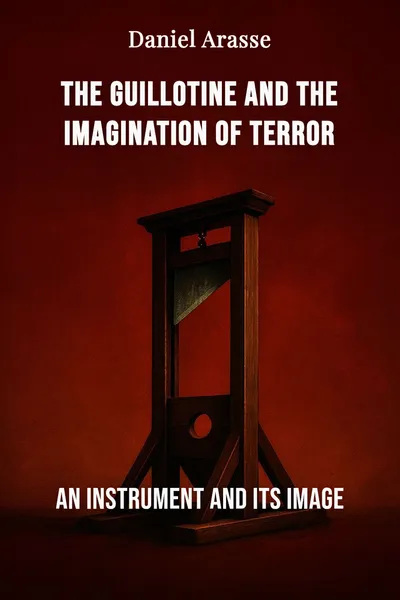
The Guillotine and the Imagination of Terror
An instrument and its image
Description
On a December day in 1789, a soft-spoken doctor named Joseph-Ignace Guillotin rose before the National Assembly and made a modest proposal: in the name of equality and humanity, every condemned person should die the same way, by a simple mechanical blade. He did not invent the machine that would carry his name — he resisted that association for the rest of his life, and his family later changed their surname to escape it. What he set in motion was something he never intended: an object that would become, within a few years, the face of an entire revolution.
This is the terrain of Daniel Arasse's book, and his move is a quiet one. Historians had long treated the guillotine as a fact — a machine, a count of victims, a political instrument of the Terror of 1793 and 1794. Arasse, an art historian, looks instead at what the thing meant to the people who built it, watched it, drew it, feared it and worshipped it. His guillotine is not only a mechanism. It is an image the age could not stop producing, and could never fully master.
The gap between those two guillotines — the engineered device and the thing in the collective imagination — is where the whole argument lives. A machine designed to make death rational, invisible, almost merciful, turned into the most vivid icon of modern political violence. Arasse wants to know how an instrument of reason became a figure of dread, and what that transformation reveals about the Revolution's own picture of itself.
The question we’re asking : How did a device built to make death humane and anonymous become the enduring image of revolutionary terror?What we’ll see : How the machine was conceived, how it reorganized the moment of death, the unease it provoked in those who watched, and what it reveals about an age struggling to picture its own violence.
Table of contents
01Chapter 1 — A machine proposed in the name of mercy
The guillotine was born, improbably enough, out of kindness — or at least out of the Enlightenment's version of it. Before the Revolution, French execution was a theatre of inequality. Nobles were beheaded by sword, a relatively clean death reserved for the well-born; commoners were hanged, broken on the wheel, or quartered, slow public ordeals meant to inscribe the law on the body. Guillotin's reform proposal of late 1789 attacked that hierarchy directly. One death for all, delivered by a mechanism, without regard for rank.
The logic was thoroughly of its moment. Equality demanded that the duke and the pickpocket meet the same end. Humanity demanded that the end be swift, free of the botched strokes that turned beheadings into butchery when a nervous or clumsy executioner missed. A machine solved both problems at once. It did not tire, did not flinch, did not aim badly. It made death a matter of physics rather than of a man's arm. Arasse reads this as the Enlightenment dream applied to the scaffold: reason substituted for cruelty, the apparatus replacing the hand.

02Chapter 2 — The blade that outran the body
The speed that was meant to be merciful turned out to be the guillotine's most disturbing quality. In the old executions, death had a duration. One could follow it, dread it, pray through it; the condemned and the crowd shared a stretch of time in which the outcome unfolded. The blade abolished that time. It fell faster than the eye could track, and the separation of head from body happened before anyone could register it as an event. Arasse argues that this instantaneity, intended as a gift, instead broke something in the way death could be understood.
The mechanism changed the choreography of the scaffold. The executioner, once the central figure — skilled, feared, almost an artist of death — became an operator. He no longer struck; he released a mechanism. The decisive gesture passed from the human hand to the machine, and with it went the whole drama of the executioner's competence or failure. Sanson, who had been a famous man, found himself tending an apparatus. Arasse reads this displacement as a loss as much as a progress: the human author of death receded, and the object took center stage.
03Chapter 3 — The strange silence of the severed head
Nothing haunted the revolutionary imagination more than the detached head. The guillotine did not merely kill; it produced an object — a head, separated, held up, looked at, and above all still legible as a face. Arasse lingers on this because it is where the machine's rationalism collided with something it could not contain. A face is a presence. To sever it cleanly and display it was to create an image that was neither clearly alive nor clearly dead, and the culture of the period did not know where to put it.
The anxiety crystallized in a question that circulated seriously at the time: did the severed head remain conscious? Physicians and curious observers debated whether a face might still see, hear, or feel for a moment after the blade fell. Reports accumulated — a blush, a grimace, eyes that seemed to turn toward a voice. Arasse does not treat these as medical curiosities but as symptoms. They express a refusal to accept that the instantaneous death was truly complete, a suspicion that the machine had produced not a clean ending but a suspended, uncertain state.
04Chapter 4 — What the Revolution could not picture
Step back from the scaffold and the guillotine becomes something larger in Arasse's hands: a self-portrait the Revolution made without quite meaning to. The age wanted to represent itself through noble abstractions — Liberty, Reason, the Nation, the Supreme Being — and it commissioned statues and festivals and allegorical paintings to do so. But the image that actually stuck, the one that fixed itself in memory across Europe and across two centuries, was not an allegory. It was a machine. The Revolution's ideals were hard to picture; its instrument was not.
This is the deeper point of reading the guillotine as image rather than only as device. The machine embodied the Revolution's principles with a literalness that no allegory could match. Equality: it treated every neck identically. Reason: it worked by mechanics, not passion. Impersonality: it erased the human hand. The guillotine was, in a sense, the perfect emblem of the abstract, universal, impartial order the Revolution dreamed of — which is precisely why it was so unbearable. It showed what those principles looked like when applied, without mercy, to a living body.
05Conclusion
Joseph-Ignace Guillotin had proposed a reform; he spent his later years trying to detach himself from its result, and died in 1814 still troubled by the name attached to him. His intentions had been Enlightenment intentions — equality before death, an end to cruelty, the substitution of a reliable mechanism for a fallible hand. The machine delivered all of that, exactly, and in delivering it produced the opposite of the discretion its designers imagined: an image so vivid it came to stand for the whole of the Terror.
Related books