The Furies
Revolution and the logic of terror
Description
In the summer of 1793, the French Revolution turned on its own promise. Four years earlier, the storming of the Bastille had carried a language of rights, reason, and universal citizenship. Now the guillotine worked daily in the Place de la Révolution, the Committee of Public Safety governed by emergency decree, and a country that had abolished the death penalty in principle was executing people at a pace that shocked even those who ran the machine. Historians have counted the dead, argued over the numbers, and named the period simply: the Terror. The question that has never gone away is how the one became the other.
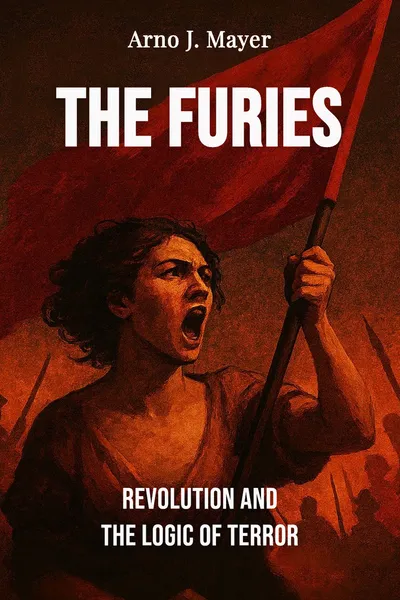
That question is usually answered with a villain. Robespierre, the incorruptible fanatic. Lenin, the cold engineer. The bloodthirsty ideologue who mistook slaughter for progress. It is a satisfying story, and it lets us keep revolution and terror in separate boxes — the dream over here, the nightmare over there, connected by a bad man. Arno J. Mayer, a historian who spent decades working on the French and Russian revolutions, found that story too clean. In The Furies, published in 2000, he set the two upheavals beside each other and asked what they shared, structurally, once the fighting started.
His answer refuses the comfort of the single monster. Terror, in Mayer's account, is not the private appetite of a faction but something that grows in the space between revolution and everything mobilized to crush it. That reframing changes what we are even looking at. It also implicates parties we usually leave standing innocently in the background.
The question we’re asking : How does revolutionary idealism become organized terror — and is the revolution alone responsible for the turn?What we’ll see : Two revolutions read against each other, and the argument that terror is bred in the collision between them and their enemies.
Table of contents
01 Chapter 1 — The word that hides more than it names
"Terror" is one of those words that feels like an explanation when it is really just a label. We reach for it to describe the guillotine, the Cheka, the mass executions, and having named the thing we assume we have understood it. Mayer's first move in The Furies is to slow that reflex down. He treats terror not as a synonym for cruelty or for the personality of a leader, but as a phase — a specific, recurring moment in the life of a great revolution, with its own logic and its own conditions.
The Furies of the title come from Greek tragedy: the avenging spirits who pursue those who spill kindred blood. Mayer chooses them deliberately. He is drawn to the tragic register rather than the moral one, because moralizing sorts everyone into guilty and innocent before the analysis even begins, and that sorting is exactly what he wants to suspend. A revolution, in his reading, is not a plan carried out by wicked people; it is an event that gets away from everyone involved, participants and opponents alike.

02 Chapter 2 — France and Russia, read side by side
Placed next to each other, France and Russia rhyme more than their politics would suggest. Both revolutions began with a burst of hope and a broad coalition. Both narrowed fast under pressure. In France, 1789 gave way within four years to the Committee of Public Safety and government by emergency. In Russia, the euphoria of October 1917 gave way to War Communism, the Cheka, and rule by decree. In each case the emergency apparatus was built as a temporary answer to a genuine threat, and in each case the temporary hardened into a system.
The threats were real, and Mayer insists on this against the tendency to treat revolutionary fear as paranoia. Revolutionary France was invaded on multiple fronts by a coalition of European monarchies, and whole regions — the Vendée above all — rose in armed revolt. Revolutionary Russia fell into a civil war that drew in foreign expeditionary forces and White armies across an enormous territory, with famine and economic collapse layered on top. In both, the new regime governed a shrinking, besieged core while enemies advanced from the edges.
03 Chapter 3 — Terror was never only the terrorists
Here the argument turns, and it turns uncomfortably. If terror grows out of the collision between a revolution and its enemies, then the enemies are part of the story, not spectators to it. Mayer's provocation is to bring counter-revolution back into the frame as a co-author of the violence rather than its innocent victim. The furies are unleashed by the clash — and it takes two to clash.
Consider the Vendée. The uprising against the revolutionary government was met with a repression so severe that it has been argued about as possible genocide ever since. But Mayer's point is not to tally which side killed more. It is that the revolt and the repression escalated together, each atrocity feeding the next, until a spiral formed that neither side controlled. The same dynamic runs through the Russian civil war: Red Terror and White Terror mirrored and amplified each other, and the famine and reprisals of that war killed on a scale that dwarfs the executions we usually file under "the revolution."
04 Chapter 4 — Why we keep asking the wrong question
Step back and the deeper claim of The Furies comes into view. We tend to ask of every revolution: why did it become so violent? Mayer suggests the question is malformed. It assumes a pure revolution that then went wrong, a dream that could have stayed a dream if only the wrong people hadn't taken over. His whole comparison is designed to show that no great revolution has ever unfolded in the clean laboratory that question imagines. It unfolds in war, and war is where the furies live.
The value of setting France and Russia side by side is exactly that it removes the alibi of personality and ideology. You cannot blame the Terror on Robespierre's character and also on Lenin's, because their characters were nothing alike, yet the outcomes converged. What converged was the situation: a total revolution confronting a total counter-revolution, at home and abroad, with survival on the line. Once that is the frame, the search for the founding villain looks like a way of avoiding the harder truth that violence was distributed across all parties to the conflict.
05 Conclusion
Return to the guillotine in the summer of 1793, and it looks different now. It is still an instrument of a revolution that had promised the opposite. But it no longer stands alone as the pure expression of an idea gone mad. Behind it are the invading coalition, the burning Vendée, the fear of a regime that believed, not without reason, that losing meant annihilation. The same could be said of the Cheka in a Russia torn by civil war. Mayer's comparison does not make the violence smaller; it makes its authorship wider.
Related books