

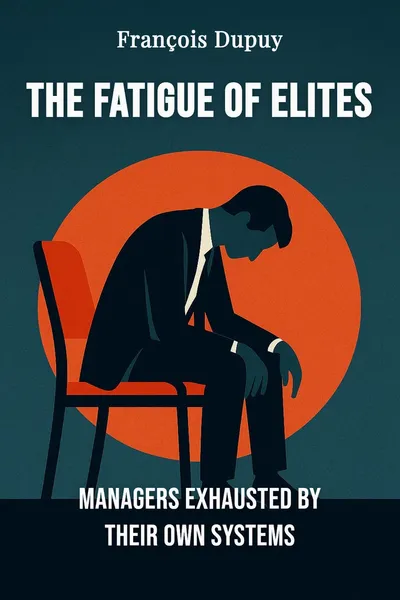
The Fatigue of Elites
Managers exhausted by their own systems
Description
There's a figure French sociologist François Dupuy keeps returning to: the mid-level manager in a big company who is not lazy, not incompetent, not overwhelmed by the work itself — and yet quietly exhausted. Not by long hours or difficult clients. By the machinery of the job. The reporting, the reviews, the dashboards, the meetings about meetings, the processes designed to make sure nothing goes wrong and that end up making sure very little gets done. Dupuy spent decades inside these organizations as a consultant and researcher, and in The Fatigue of Elites he turns that vantage point into an unsettling claim.
The claim is this: the people running large firms are being worn down not by their environment but by the systems they themselves put in place. Managers built processes to control risk, to standardize, to keep an eye on things they could no longer see directly. And those processes turned around and colonized their days. The tools meant to give control produced the opposite — a sense of running faster to stay in the same spot. Dupuy calls it a fatigue that is structural, not personal. It won't be fixed by a wellness app or a resilience seminar.
What makes the book bite is that it refuses the easy villains. No greedy shareholders, no toxic bosses, no lazy staff. Just a logic that made sense at every step and produced a whole that nobody wanted. Dupuy watched it happen from the inside, firm after firm, and his account reads less like a management book than like a diagnosis of how well-meaning organizations end up strangling the very people who steer them.
The question we’re asking : Why are the people who designed modern corporate systems the ones most exhausted by them?What we’ll see : How large firms replaced trust with control, and why Dupuy thinks the only way out runs through autonomy.
Table of contents
01 Chapter 1 — The people who built the machine can't run it
Start with the paradox at the heart of the book. The elites Dupuy writes about — senior and middle managers in large companies — are not victims of forces outside their control. They are, in a real sense, the architects. Over the past few decades they assembled a formidable apparatus of oversight: performance indicators, process manuals, compliance checks, planning cycles. Each piece was added for a good reason. And the sum of those reasons is a working life that feels, to the very people who built it, unlivable.
Dupuy's background matters here. He isn't a critic lobbing stones from outside; he spent years as a sociologist and consultant embedded in these firms, watching decisions get made. What he saw again and again was managers who could describe, in precise detail, everything that didn't work — the redundant reporting, the meetings that decided nothing — and who nonetheless kept the system running because each individual piece seemed necessary. Nobody chose the whole. The whole simply accumulated.

02 Chapter 2 — Rules against trust
The engine of all this, for Dupuy, is a slow substitution: rules replacing trust. In a smaller organization, or an older one, people cooperated because they knew each other, because reputation traveled, because a colleague who let you down paid a social price. That informal fabric did an enormous amount of coordinating work quietly. It was invisible, which is precisely why it was so easy to dismantle.
As firms grew larger and more dispersed, that fabric frayed, and management reached for a replacement it could see and measure: the rule. If we can't trust that the sales team will behave well, we'll write a procedure. If we can't rely on judgment, we'll specify the judgment in advance. Each rule was a patch over a place where trust used to be. Dupuy's point is that rules and trust are not simply interchangeable — a rule does less, and costs more, than the trust it stands in for.
03 Chapter 3 — Reporting as a way of life
If rules are the skeleton of the system, reporting is its bloodstream, and Dupuy gives it particular attention because it's where the fatigue becomes most physical. Reporting is the ritual by which the organization reassures itself that it knows what's happening. Numbers travel upward, get aggregated, arrive on a dashboard, and someone senior feels, briefly, that they have a grip on reality. The reassurance is the product. Whether the numbers describe anything true is almost secondary.
The trouble is that reporting is never free and rarely stable. Once a firm decides it needs visibility, the appetite grows. One report generates questions that require another report to answer. A metric that looks bad demands an explanation, which demands data, which demands someone to gather it. Managers describe spending large fractions of their week feeding the system information about work rather than doing it. The map begins to consume the territory.
04 Chapter 4 — When control becomes its own product
Step back from the individual manager and a larger picture emerges from Dupuy's account. The modern large firm has, without quite deciding to, made control its central preoccupation — not the products it sells, not the customers it serves, but the internal certainty that everything is being watched. Control stopped being a means and became something the organization pursues for its own sake, because in a world of dispersed operations and nervous shareholders, the appearance of control is what gets rewarded.
This is where Dupuy's diagnosis widens into something more than a complaint about paperwork. He is describing a shift in what organizations are for. A firm that spends its energy monitoring itself has less energy for anything else, and it grows increasingly detached from the reality it was built to act on. The elites aren't tired because they're weak. They're tired because they've been enlisted, full-time, into maintaining a fiction of mastery over a system too complex to master.
05 Conclusion
The exhausted manager Dupuy opens with is not a character who needs to sleep more or delegate better. He is a symptom. The reporting he drowns in, the rules he administers, the meetings that consume his afternoons — all of it was assembled, piece by reasonable piece, to solve the problem of not being able to trust and see everything at once. The solution turned out to cost more than the problem, and it fell heaviest on the people who installed it.
Related books











