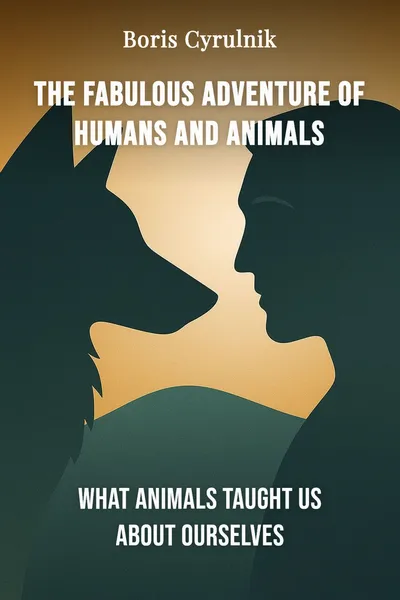
The Fabulous Adventure of Humans and Animals
What animals taught us about ourselves
Description
Boris Cyrulnik spent his early career watching animals the way other people watch the news: closely, patiently, without pretending to know in advance what he'd find. Before he became the psychiatrist most associated with the idea of resilience, he trained as an ethologist, someone who studies behavior in the field rather than the lab. And in The Fabulous Adventure of Humans and Animals, he turns that trained eye on a relationship we tend to take entirely for granted — the long, tangled, mutually transformative story of the species that domesticated dogs and the dogs that, in some quiet way, domesticated us right back.
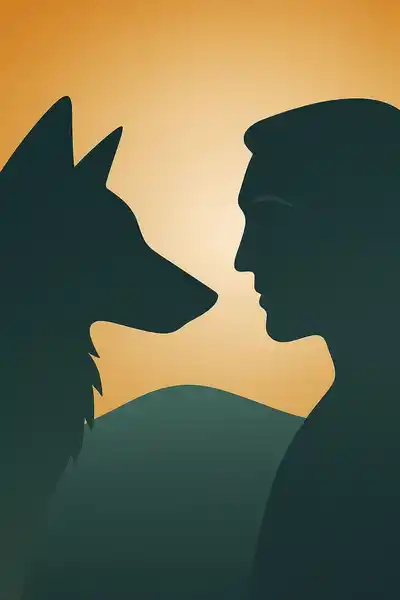
The book's wager is that we've been telling this story backwards. We like to imagine humans as the authors of the animal world, the ones who tamed, bred, named and trained. Cyrulnik keeps finding evidence that the traffic ran both directions. Living alongside horses, wolves, cats and cattle didn't just change the animals — it reshaped human attention, human emotion, and eventually the way we understand our own minds. The wolf that came closer to the fire was also teaching the human at the fire how to read a gaze.
What makes the argument more than a charming inventory of pets is where it lands. Cyrulnik draws on decades of ethology to suggest that the tie binding a child to a parent and a dog to its owner is built from the same materials. The bond, in other words, is older than our species and larger than it. That's a claim with consequences — for how we treat animals, and for how we understand what we thought was uniquely ours.
The question we’re asking : What did living alongside animals actually teach us about ourselves?What we’ll see : How an ethologist reads the human-animal bond, and where that reading finally leads.
Table of contents
01Chapter 1 — The zoologist who kept human company
Cyrulnik's path to this book is not an accident of curiosity. Long before he wrote about children surviving trauma, he was watching gulls, primates and domestic animals, learning the discipline of describing what a creature does rather than guessing what it feels. Ethology, the science founded in the mid-twentieth century by figures like Konrad Lorenz and Niko Tinbergen, insisted on that restraint. You don't ask whether the goose loves its mother. You watch what the goose does when the mother appears, and you build outward from there.
That training gives the book its texture. Cyrulnik moves through the shared history of humans and animals as someone who has actually crouched in the mud with a notebook, and it shows in how concretely he handles the material. He's interested in the moment, tens of thousands of years ago, when a wolf edged toward a human camp and neither party fled. He's interested in why some animals could tolerate our proximity and others never could, and what that tolerance selected for over generations.

02Chapter 2 — Reading behavior instead of imagining minds
The great temptation, when we love an animal, is to fill it with our own thoughts. The cat is plotting. The dog feels guilty. Cyrulnik is generous toward this impulse but firm about its limits, because his whole method depends on resisting it. Ethology asks a harder question than what the animal is thinking. It asks what the animal is doing, in what context, in response to what, and whether that pattern holds across many individuals. Meaning is built from behavior, not projected onto it.
This restraint turns out to be the opposite of cold. By refusing easy anthropomorphism, Cyrulnik ends up crediting animals with far more than sentiment does. He describes the precise ways a dog reads the tension in a shoulder, the way a horse registers a rider's fear through the reins, the way social mammals coordinate through signals so subtle we barely notice them. These aren't fantasies of a human soul trapped in fur. They're real capacities, documented in the field, and they're often more sophisticated than the stories we tell about them.
03Chapter 3 — The bond that shapes both ends of the leash
If there's a single idea holding the book together, it's that attachment is not a metaphor when we apply it across species. Cyrulnik leans on the framework developed by John Bowlby, who argued that the tie between infant and caregiver is a biological system, evolved to keep the vulnerable close to a source of safety. Bowlby built that theory partly by watching animals. Cyrulnik simply follows the logic all the way back out, showing how the same system operates between a person and the animal they live with.
What matters is that the bond runs in both directions and changes both members of it. A domesticated animal shaped by human presence becomes, in a real sense, a different creature than its wild cousin — more tolerant, more attentive, more dependent. But the human is transformed too. Caring for an animal recruits the same circuits of tenderness, vigilance and responsibility that caring for a child does. The leash has two ends, and neither one is unaffected by what happens along it.
04Chapter 4 — What a shared vulnerability tells us
Step back from the individual animals and a larger claim comes into focus. Cyrulnik's book is, in the end, an argument against human exceptionalism at its most flattering point: the belief that our capacity to love and to bond is what sets us apart. His whole career suggests the opposite. The attachment system is not a human invention that animals dimly echo. It's a deep biological inheritance that we happen to share with them, elaborated in our case but not invented by us.
That reframing does quiet work on the reader. If the bond is genuinely cross-species, then the line we draw between us and them stops being a wall and becomes a gradient. We are the animal that got very good at attachment, at reading gazes, at being soothed by presence and undone by loss. Those are the same tools that let a dog live at our feet and a horse trust a rider. What we've long treated as the signature of the human turns out to be the signature of the mammal, and maybe of much more.
05Conclusion
The wolf that crept toward the fire and the human who let it stay were beginning a conversation that has never quite ended. Cyrulnik's book follows that conversation from domestication to the modern living room, and it insists throughout that both parties were changed by it. We bred animals to read us, and in learning to be read, we learned something about the grammar of our own emotions. The ethologist's notebook and the psychiatrist's consulting room record the same discovery from opposite directions.
Related books