
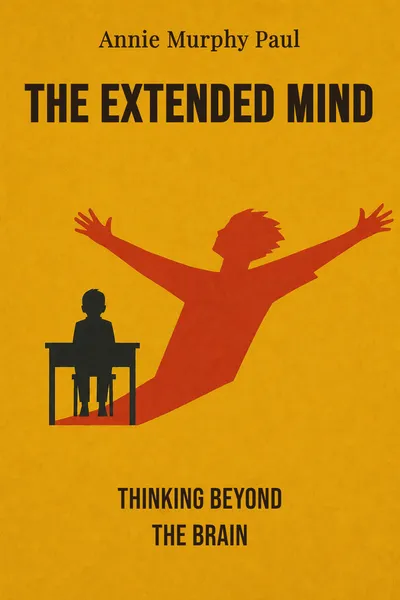
The Extended Mind
Thinking beyond the brain
Description
For most of the last century, the working image of intelligence has been a lonely one: a brain in a skull, processing symbols, running faster or slower depending on how well it was wired. Smart people had better hardware. The classroom, the office, the standardized test — all of it was built around the idea that thinking happens in one place, silently, between the ears. Annie Murphy Paul, a science writer who spent years covering learning and cognition, opens her 2021 book The Extended Mind by taking that assumption seriously enough to ask whether it's true. She concludes, across several hundred pages of research, that it mostly isn't.
The book gathers work from psychology, neuroscience, and cognitive science that has been accumulating quietly for decades — studies on gesture, on movement, on how surgeons and pilots and physicists actually solve hard problems. The pattern that emerges is consistent and a little unsettling for anyone who has been told to just concentrate harder. The people who think best aren't the ones with the most powerful internal processors. They're the ones who reach outward most skillfully — into their own bodies, into the spaces around them, into other people's heads. Thinking, on this account, is less like computation and more like a craft that uses tools.
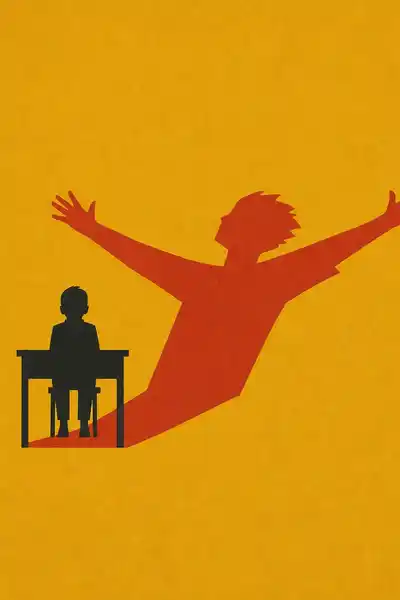
That reframing has consequences, because so much of how we learn and work is designed as if the brain-in-a-jar model were correct. We ask children to sit still. We build open offices that flatten the room into featureless neutral space. We treat collaboration as a distraction from the real cognitive labor happening privately in each individual mind. Paul's argument is that we have been fighting our own equipment.
The question we’re asking : If thinking isn't confined to the brain, where does it actually happen — and what have we been getting wrong about how minds work?What we’ll see : How the resources outside the skull — flesh, space, and other people — turn out to do far more of our thinking than we ever credited them for.
Table of contents
01Chapter 1 — The brain was never enough
The idea that cognition is confined to the brain has a respectable pedigree. It fit the computer metaphor that dominated cognitive science from the 1950s onward: the mind as software, the brain as hardware, inputs going in and outputs coming out. On that model, everything outside the skull is just raw data waiting to be processed. Intelligence is internal horsepower, and the rest of the world is the problem to be solved, never part of the solving.
Paul traces the cracks in this picture back to a small but stubborn body of research. In the 1990s, philosophers Andy Clark and David Chalmers published a short paper arguing that the mind doesn't stop at the boundary of the skin. Their famous example was a man with memory trouble who wrote everything in a notebook — the notebook, they argued, was doing the work a biological memory would do, so why not call it part of his mind? The claim sounded like a provocation. It turned out to describe how most of us function most of the time.

02Chapter 2 — Thinking with the body
The most immediate extension of the mind is the body it sits in, and Paul spends a good stretch of the book on the ways flesh does cognitive work. Take gesture. When people are allowed to move their hands while explaining something, they explain it better and remember it longer — and children given a math problem who gesture as they reason are more likely to grasp the underlying concept. The hands aren't decorating the thought; they appear to be part of producing it, offloading some of the mental burden onto motion.
Then there's movement itself. The old classroom instinct to keep bodies still turns out to be counterproductive. Research on physical activity shows that even light movement before or during learning sharpens attention and consolidates memory. Paul describes the difference between a person hunched motionless over a hard problem and one who paces, walks, or fidgets — the second is not procrastinating but thinking, using the body's rhythms to loosen a stuck mind. Charles Darwin famously wore a path into a gravel loop where he worked out his ideas on foot.
03Chapter 3 — The room does part of the work
Beyond the body lies the physical environment, and here Paul makes one of her more counterintuitive cases. We tend to think of our surroundings as backdrop — pleasant or unpleasant, but incidental to the real work. The research suggests the room is doing some of the thinking. Exposure to natural environments, even brief and even artificial ones, measurably restores depleted attention. A walk in a park, or a window onto trees, replenishes the focus that a stretch of concentrated effort burns through. Nature, on this account, isn't a reward for work done; it's part of the apparatus.
The sense of space matters too. Paul draws on studies of how people use physical room to think — spreading documents across a large table, standing back to take in a whole layout, walking through a problem laid out on the floor. Experts in fields from architecture to medicine externalize their thinking into space, treating the world as an extension of working memory rather than trying to hold everything in the head. When the room is bigger, the thought can be bigger.
04Chapter 4 — No one thinks alone
The last and largest extension of the mind is other people, and Paul's treatment of it reframes collaboration from a soft skill into a cognitive mechanism. We are built to think socially. Ideas we struggle to retain in the abstract become vivid the moment they're wrapped in a story about people, and information we can't hold alone gets distributed across a group without anyone quite noticing. A team that has worked together develops what researchers call transactive memory — an implicit map of who knows what — so that the group functions as a single extended mind with far more capacity than any member.
Imitation, often dismissed as unoriginal, turns out to be one of our most efficient learning tools; watching an expert and copying their moves transmits knowledge that words alone can't carry. So does teaching: explaining an idea to someone else forces a reorganization of one's own understanding, which is why the person who tutors often learns more than the person tutored. Arguing well, in a group that disagrees productively, tends to produce better reasoning than any individual would reach in solitude.
05Conclusion
The brain that opens the book — solitary, sealed, straining to concentrate — turns out to be a caricature we mistook for a portrait. What Paul assembles from decades of scattered research is a mind with porous edges, one that gestures its way toward clarity, paces out its stuck problems, spreads its thoughts across a table, and borrows freely from the people around it. The notebook in Clark and Chalmers's thought experiment was not a crutch for a failing memory; it was a glimpse of how ordinary cognition has always operated.