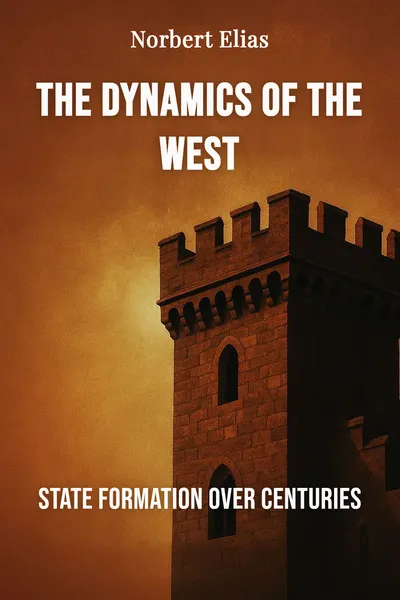
The Dynamics of the West
State formation over centuries
Description
Picture a minor lord somewhere in the Frankish lands around the year 1000. His holdings are a scatter of villages, his authority stops roughly where his horsemen can ride in a day, and the king in whose name he supposedly rules is a distant figure who cannot make him do much of anything. If a neighbour encroaches, he settles it himself — with a raid, a siege, a killing. Violence is not a breakdown of order here. It is the order. Fighting is how a warrior holds his ground, and holding ground is the whole of his standing in the world.
Fast-forward some eight centuries and that same social position has become almost unrecognisable. The descendant of that warrior no longer rides out to burn a rival's fields. He waits in an antechamber at Versailles, calculating how a bow or a badly chosen word might cost him a pension, a title, a place at the king's morning ceremony. The sword still hangs at his hip, but it has become decoration. Somewhere across those centuries, the right to use force drained out of thousands of hands and pooled into one. And as it did, something shifted inside people too.
Norbert Elias, writing in the 1930s, set out to explain exactly this — not as a moral story about civilisation triumphing over barbarism, but as a long, traceable process with a mechanism. His wager was that the way Europeans came to govern their own impulses cannot be understood apart from the way European states came to govern violence and money. The outer transformation and the inner one, he argued, are two sides of a single history.
The question we’re asking : How did the scattered warrior societies of medieval Europe become states that monopolised force and taxation — and what did that do to the people living inside them?What we’ll see : How a centuries-long competition among lords narrowed into a single centre of power, and how that centre reached all the way down into how individuals learned to hold themselves.
Table of contents
01Chapter 1 — The knight who had nowhere left to fight
Elias begins where the West is at its most fragmented. After the Carolingian empire came apart, power in western Europe dispersed downward into the hands of local warriors. Land was the only durable form of wealth, and the man who could defend a stretch of it — and seize more — was the man who counted. There was no standing state to appeal to, no police, no reliable court above the level of the sword. Elias is careful not to romanticise this world. It was violent because violence paid, and because nothing structural stood in its way.
What interested him was the dynamic buried inside this scatter of small powers. When many roughly equal lords compete for the same finite land, the competition does not stay even for long. Some win, absorb their neighbours, and grow. Fewer and larger units emerge, each now competing with fewer and larger rivals. Elias called this the elimination contest — a mechanism with a built-in direction. Each round of fighting reduces the number of players and enlarges the survivors, until the field narrows toward a handful, and eventually toward one.

02Chapter 2 — The two monopolies that fused
The centre that emerged from the elimination contest secured itself, Elias argued, by capturing two things and refusing to let them back out. The first is the one usually named: the monopoly of physical force. A ruler who alone may legitimately raise armies, punish, and wage war has removed the fundamental resource of his rivals. Private feud becomes crime; the sword passes from a right into a privilege the crown grants and withdraws. But Elias insists this monopoly could never have held on its own.
The second monopoly is money — specifically, the exclusive right to tax. Armies, fortresses, officials and courts are enormously expensive, and a ruler who cannot reliably extract revenue cannot sustain the force that keeps him dominant. Taxation is what turns a temporary battlefield victory into a standing apparatus. And the two monopolies feed each other in a tight loop: force secures the collection of taxes across the territory, and taxes pay for the force. Neither is stable alone. Bound together, they become almost self-reinforcing.
03Chapter 3 — The court as a machine for self-control
Having traced how force and money concentrated, Elias turns to the human consequence, and this is where his account becomes genuinely surprising. The concentration of power did not only rearrange institutions. It rearranged behaviour, and it did so most visibly in the royal court. Once the great nobles could no longer settle disputes by fighting, they were drawn — or forced — into the orbit of the ruler, where survival now depended on favour rather than on force.
The court, in Elias's reading, is a peculiar kind of pressure chamber. Hundreds of ambitious people, stripped of the right to strike each other, compete instead through manners, alliances, timing and reputation. A courtier who loses his temper, shows a raw impulse, or misreads a rival has damaged himself as surely as a defeated warrior once was. Success requires reading others constantly and, above all, watching oneself. Spontaneous aggression becomes a liability; foresight and restraint become the tools of advancement.
04Chapter 4 — Pacification as a long, unfinished arc
Step back from the courtiers and the tax rolls and a single long arc comes into view. What Elias describes is a slow pacification of social space, driven not by an improvement in human character but by the concentration of the means of violence into fewer and fewer hands. As feud gives way to law and the sword becomes the state's alone, ordinary life grows more predictable. And the more predictable the outer world, the more people can — and must — regulate themselves rather than defend themselves. Outward pacification and inward restraint rise together.
The strength of this account is that it refuses the flattering story the West tends to tell about itself. Europeans did not become gentler because they grew wise or virtuous. They came to restrain their impulses because the structures around them made restraint pay and made violence ruinous. Manners, sensibility, the horror of cruelty — Elias treats these not as achievements of the spirit but as the felt residue of an underlying redistribution of power. It is a deflating argument, and a clarifying one.
05Conclusion
Return to the two figures we began with — the raiding lord and the waiting courtier. Between them lies not a change of heart but a change of structure: the elimination contest that thinned a thousand small powers into one, the fusion of force and taxation that made that one power durable, and the pressure of the court that turned outward compulsion into inward habit. Elias's achievement was to hold all of this in a single frame, to show that the way Europeans learned to govern themselves and the way European states learned to govern violence are not two stories but one.
Related books