The Division of Labour in Society
Solidarity in a specialised world
Description
In 1893, a thirty-five-year-old Émile Durkheim submitted a doctoral thesis to the Sorbonne with an unglamorous title and an enormous ambition. He wanted to know what holds a modern society together. It was a strange question to ask out loud, because most people at the time assumed they already knew the answer, or assumed the answer didn't matter. The economists said self-interest did the work: individuals trading with each other, each chasing their own advantage, produced order as a side effect. The moralists said something was coming apart — that industrial life was corroding the old ties of village, church, and family, and leaving nothing in their place. Durkheim thought both were wrong, and he set out to prove it with a book that reads less like philosophy than like a natural history of the social bond.
His starting point was the most obvious feature of the modern world and the one nobody had thought to treat as a moral fact. Work had fragmented. Where a peasant once did nearly everything, a modern person does one narrow thing — sets one machine, files one kind of document, treats one part of the body — and depends on strangers for everything else. Adam Smith had celebrated this as an engine of productivity. Durkheim asked a different question entirely. What if the division of labour wasn't just economic? What if the thing that made us more productive was also, quietly, the thing that made us belong to one another?
That reframing is the whole book. Durkheim takes the fact that specialisation seems to isolate us and argues, patiently and against the grain, that it actually binds us — but by a wholly different mechanism than the one that bound our ancestors. To see it, he has to take apart the word solidarity and put it back together in a shape nobody had used before.
The question we’re asking : If specialisation makes us dependent on strangers, what kind of solidarity does a modern society actually run on?What we’ll see : How Durkheim reads the fragmentation of work as a new form of belonging — and where that reading meets its limit.
Table of contents
01Chapter 1 — The glue that isn't contract
Durkheim's first move is to clear the field of the answer everyone assumed was correct. The economists of his day held that modern society coheres through contract — free agreements between self-interested parties. You and I exchange because it suits us both, and the sum of all such exchanges is a functioning order. Durkheim finds this account not so much wrong as incomplete in a way that gives the whole game away. Every contract, he points out, rests on conditions the contracting parties did not agree to and could not enforce themselves.
When two people sign a deal, they rely on a vast background of shared understanding: that promises will be honoured, that fraud will be punished, that the words on the page mean what both take them to mean. None of this is in the contract. It is what Durkheim calls the non-contractual element of the contract — the moral and legal scaffolding that makes agreement possible in the first place. Self-interest can explain why I want to trade with you. It cannot explain why I trust that the trade will hold. Something prior to interest is already doing the work.

02Chapter 2 — When likeness held us together
The older form Durkheim calls mechanical solidarity, and the name is deliberately counterintuitive. It is mechanical not because it is cold but because it works by direct adhesion — people stick together the way like particles stick, through resemblance. In small, traditional societies, individuals are interchangeable in the ways that matter. They share the same beliefs, the same rituals, the same sense of what is sacred and what is forbidden. Durkheim gives this shared stock of belief a name that would echo through sociology: the collective conscience, the sum of feelings common to the average members of a community.
Where the collective conscience is strong, the individual barely exists as a distinct moral unit. To be a member of the group is to think its thoughts and want its wants. Deviance, in such a world, is not a private matter — it is an offence against the shared soul of the community, and the community reacts with the intensity of someone defending something sacred. This is why the law of these societies is overwhelmingly penal. Its logic is not to repair damage but to punish, and the punishment is fierce, expressive, often out of all proportion to the material harm.
03Chapter 3 — The bond that specialisation builds
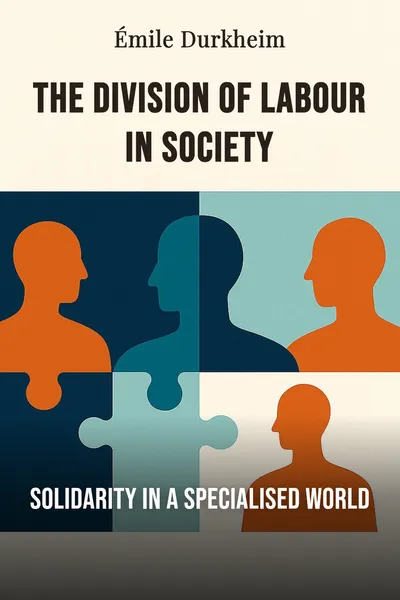
The answer is the book's central claim, and it turns the intuitive picture inside out. As societies grow denser and larger — more people in closer contact, competing for the same resources — Durkheim argues that they resolve the pressure not through conflict but through specialisation. Rather than a hundred people doing the same work and fighting over it, they differentiate. Each takes a niche, and in taking a niche, each becomes dependent on all the others for what they no longer produce themselves. This is organic solidarity, named after the body, where organs are radically unlike one another precisely because each does something the others cannot.
Here likeness no longer holds us together. Difference does. The baker needs the miller, the miller needs the farmer, the surgeon needs the pharmacist and the instrument-maker and a hundred trades she will never learn. Interdependence, not resemblance, becomes the mortar. And the collective conscience does not vanish, but it contracts — it thins out and grows more abstract, leaving room for individuals to differ from one another in ways that would have been unthinkable, even scandalous, under the older regime. Paradoxically, the more specialised we become, the more distinctly individual we are permitted to be, and the more tightly we are woven into a web of mutual need.
04Chapter 4 — What the division of labour asks of us
If the argument stopped there, it would be too tidy — a smooth handover from one solidarity to another, progress as painless growth. Durkheim does not let himself off so easily. In the later part of the book he turns to what he calls the abnormal forms, the cases where the division of labour fails to produce the solidarity it should. The most famous of these he names anomie, from the Greek for lawlessness: a condition in which specialisation has advanced but the moral and legal rules that should coordinate it have not yet caught up. People are interdependent in fact but not yet integrated in spirit. The organs exist; the nervous system connecting them does not.
This is where the book's diagnosis of his own century lands. The industrial crises, the antagonism of labour and capital, the sense of a society flying apart that the moralists mistook for the natural result of specialisation — Durkheim reads all of it not as the true face of organic solidarity but as its birth defect. The division of labour had raced ahead of the norms that were supposed to civilise it. Markets connected people who shared no rules of engagement. The transition from one form of solidarity to another had begun before the institutions that would complete it existed.
05Conclusion
The book that began as a doctoral thesis ends by having quietly redrawn the map. Durkheim took the most disenchanting feature of industrial life — the fragmentation of work into narrow, repetitive slivers — and argued that it carried, hidden inside it, a new principle of cohesion. We are no longer bound by being the same. We are bound by needing each other, and that need is written into the restitutive law, the contracts, the vast machinery of coordination that a specialised world runs on. Solidarity did not die when the village did. It changed its shape.
Related books