
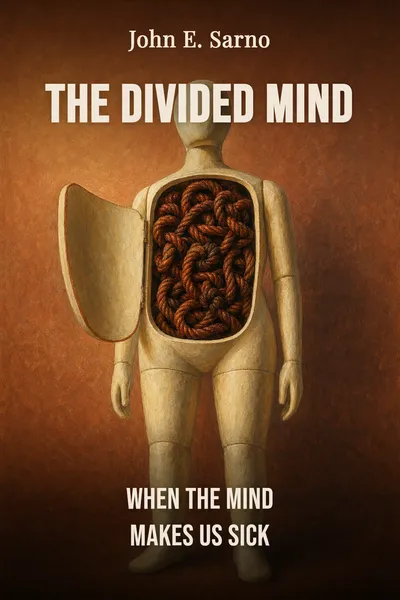
The Divided Mind
When the mind makes us sick
Description
For most of his career, John E. Sarno was a rehabilitation physician at what is now NYU Langone in New York, treating patients with chronic back pain. The standard story was mechanical: a herniated disc, a pinched nerve, a spine wearing out. Then Sarno noticed something that did not fit the story. Many patients whose scans showed dramatic structural damage had no pain at all, while others in agony had scans that looked essentially normal. The lesions and the suffering, it turned out, did not reliably line up. That mismatch became the crack through which he spent the rest of his life looking.
What he found on the other side unsettled him, because it pointed away from the body he had been trained to fix and toward the mind he had been trained to ignore. His patients, he came to believe, were not imagining their pain — it was as real as any fracture — but its origin lay in emotions they were never conscious of feeling. Rage, grief, and hurt that the mind had quietly buried were, he argued, being converted into physical symptoms. And when patients understood this, many of them got better without a single injection or operation.
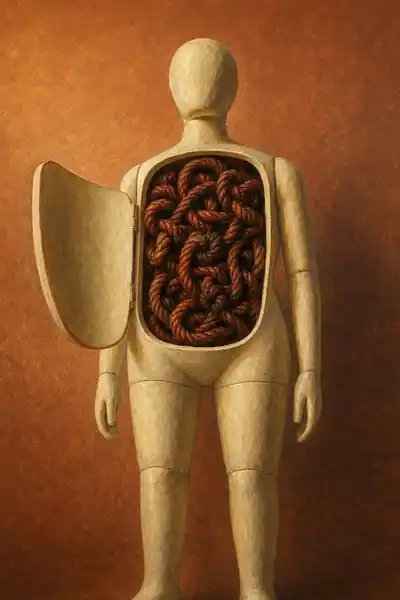
His final book, The Divided Mind, published in 2006, is the widest version of that argument. It reaches past the back to a whole spectrum of ailments medicine tends to file under "cause unknown," and it asks a question that makes the profession deeply uncomfortable.
The question we’re asking : Can emotions we've never consciously felt make the body genuinely, measurably sick — and why has medicine spent a century looking away?What we’ll see : How a back specialist ended up rewriting the map between feeling and illness, and why he thought understanding was the cure.
Table of contents
01Chapter 1 — The pain with no lesion
Sarno's turn began with an observation any radiologist could confirm and few doctors wanted to sit with. By the time people reach middle age, most spines show wear — bulging discs, arthritic changes, narrowing. On an image these look alarming, and for decades they were named as the culprit whenever someone's back gave out. But when researchers began scanning people with no pain whatsoever, they found the same herniations, the same degeneration, sitting there silently. The structure medicine blamed was present just as often in the comfortable as in the suffering.
This forced a hard question. If the disc isn't reliably the problem, what is? Sarno noticed patterns his mechanical training couldn't explain. Pain that migrated from the lower back to the neck to the shoulder as if chasing attention. Pain that flared during stressful weeks and eased on vacation. Pain that vanished the moment a patient was distracted by a real emergency. None of that behaves like a torn ligament. It behaves like something responsive to the state of a person's life.

02Chapter 2 — Freud's abandoned inheritance
The idea that hidden emotion can surface as bodily symptoms is not Sarno's invention, and he was careful to say so. It runs straight back to the origins of psychoanalysis. In late-nineteenth-century Vienna, Freud and his older colleague Josef Breuer treated patients — many of them women diagnosed with "hysteria" — whose paralyses, coughs, and pains had no organic cause anyone could find. Their landmark case, Anna O., described symptoms that eased when the patient spoke about buried memories. Out of such cases came the founding claim of the whole field: the unconscious is real, and it speaks through the body.
Sarno treats this as psychosomatic medicine's crucial and then squandered discovery. Freud named conversion — the process by which repressed emotional pain converts into physical form. Yet over the twentieth century medicine drifted away from it. Psychoanalysis turned inward toward theory and away from ordinary physical complaints, while the rest of medicine grew ever better at imaging, testing, and cutting. The more powerful the tools for finding lesions became, the less patience anyone had for an illness that left none. A diagnosis you could see on film felt solid; a diagnosis that lived in the patient's unspoken feelings felt like a confession of ignorance.
03Chapter 3 — The mind that hides to protect
At the heart of The Divided Mind is exactly what its title names: a mind at odds with itself. There is the conscious self — reasonable, ethical, wanting to be good, competent, and calm. And there is the unconscious, which Sarno saw as a reservoir of feelings the conscious self finds unacceptable: raw anger, childhood hurt, resentment toward people we're supposed to love, the fury of being overburdened. These feelings don't fit the person we believe ourselves to be, so they're pushed down and held there.
The pressure of that repression, Sarno argued, is what the body responds to. When buried rage threatens to break into awareness, the mind would rather generate a physical symptom than let the feeling surface. Pain in the back is more bearable, socially and psychologically, than admitting you're enraged at your child, your spouse, or your own aging. The symptom protects the self-image. It's a decoy that keeps a dangerous emotion offstage, and it works precisely because the sufferer never suspects the trade being made on their behalf.
04Chapter 4 — Why naming it heals
The strangest and most consequential part of Sarno's work is his claim about treatment, because it barely looks like treatment at all. He argued that once a patient genuinely understands the mechanism — that the pain is real but its purpose is distraction, that there is nothing structurally wrong that needs guarding — the symptom loses its reason to exist. Awareness dismantles the strategy. If the mind's trick only works while it stays hidden, seeing it clearly is the cure.
This is why he made so much of the fact that readers of his earlier books recovered without ever meeting him. People in chronic pain would read the explanation, recognize themselves, absorb that their spine was not the enemy, and find the pain fading over weeks. To conventional medicine this sounds impossible or like placebo dressed up. Sarno's response was that knowledge itself has healing power when the illness is made of concealment — that understanding is not a metaphor for getting better but the actual mechanism, because the symptom depends on the patient believing the wrong story about it.
05Conclusion
Sarno began with a puzzle almost too simple to notice — that scans of the suffering and scans of the comfortable often look the same — and followed it to a claim that unsettles the whole architecture of care. The body, he argued, keeps the mind's secrets, converting feelings we refuse to feel into pain we can't ignore. The Divided Mind gathers a lifetime of that argument, reaching from the back to the gut to the skin, and rooting it back in Freud's oldest and most neglected insight.