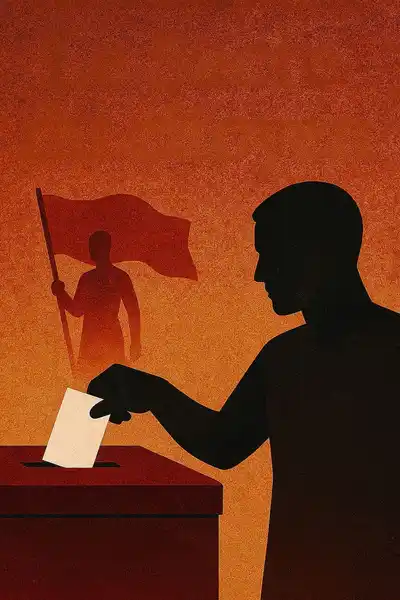
The Crowning of the Citizen
How universal suffrage arrived
Description
On a spring day in 1848, a French official could have told you exactly how many people were allowed to vote in the country: a little under 250,000, out of a population of some 35 million. To cast a ballot under the July Monarchy, a man had to pay a certain level of tax — enough to prove he owned something, that he had, as the phrase went, a stake in the order of things. Property was the ticket. Then, in a matter of weeks, the February revolution swept the count away and replaced it with a figure that had never before existed at national scale: nine million voters, every adult Frenchman, no tax required. Universal male suffrage had arrived, almost overnight, as if it had been waiting.
Except it had not been waiting, and it had not been simple. The historian Pierre Rosanvallon tells this story not as a triumphant march toward an obvious right, but as a long and strange argument France kept having with itself. Because the moment you decide that everyone votes, you have to answer a question that the tax threshold had quietly answered for you: what exactly is a voter? A property owner defending his interests? A rational mind weighing the common good? A body, a name on a list, a unit of one? The revolution gave the answer before anyone had worked out what it meant.
That is the puzzle worth sitting with. Universal suffrage was not the removal of a barrier so much as the invention of a new kind of person — the citizen as an abstraction, stripped of fortune, function and even, eventually, sex when women were finally admitted in 1944. France reached that abstraction earlier and more violently than almost anywhere else, then spent a century and a half unsure whether it believed in it.
The question we’re asking : How did France move from the vote as a property of the propertied to the vote as the mark of every citizen — and what did that transformation actually require?What we’ll see : A long French argument about who counts as a voter, and the abstract citizen that argument eventually crowned.
Table of contents
01Chapter 1 — The number that was supposed to end the argument
Before 1848, the French franchise ran on money. The Charter of 1814 and then the July Monarchy tied the right to vote to the cens, a tax threshold that a man had to clear to be enrolled. The logic was frank and unembarrassed: only those with property had the independence to vote freely, because only they were beholden to no one. The poor man, it was argued, would sell his voice or bend it to his landlord. Wealth was not a privilege here; it was presented as a qualification, a guarantee of judgment.
Rosanvallon shows how much intellectual work went into holding that line. The tax threshold was never really about revenue. It was a way of translating a social fact — you own things, you belong — into a political entitlement. To be a voter was to be visible as an interest, a solid presence in the country's economy. The system counted stakes, not heads. And it worked, in its way, for decades, precisely because it never had to say out loud that it excluded almost everyone.

02Chapter 2 — Universal, on paper
The word universal did a lot of quiet work in 1848. It sounded total, final, the last word in inclusion. But the France that adopted it kept drawing lines it preferred not to examine. Women were not part of the universal. Soldiers were often set apart. Domestic servants, whose dependence on a master was thought to compromise their freedom, hovered at the edge of eligibility. The universal, on inspection, meant every adult male Frenchman who was not disqualified by some form of subjection — which is to say, it carried forward the old worry about independence in a new vocabulary.
This is one of the sharpest threads in Rosanvallon's history: the same anxiety survived the revolution that was supposed to abolish it. Under the cens, independence had been measured by property. Under universal suffrage, it was measured by the absence of servitude. The vote still belonged to the man who answered to no one. What changed was not the underlying suspicion of the dependent voter but the yardstick used to detect him.
03Chapter 3 — The individual against the interest
To make universal suffrage coherent, France had to change what a voter fundamentally was. Under the cens, the voter had been an interest — a landowner, a merchant, a man with holdings to protect, present in politics as a fragment of the country's real economic body. The vote expressed a position in society. Rosanvallon argues that the move to universal suffrage required demolishing exactly that idea and replacing it with something far more radical: the voter as a pure individual, identical to every other, counted as one and only one.
This is the deep transformation the story is really about. The abstract citizen had to be manufactured. He was a man stripped of his fortune, his trade, his region, his particular weight in the world — reduced, for the single instant of the ballot, to a bare unit of political will. Two peasants and one banker no longer meant two small stakes and one large one; it meant three votes, flat and equal. The whole architecture of the old franchise, which had made society's inequalities visible in the electorate, was deliberately erased.
04Chapter 4 — Citizenship as a shared abstraction
Step back from the French sequence and a larger claim comes into view. Citizenship, in Rosanvallon's telling, is not a natural fact waiting to be recognized. It is an abstraction that had to be invented, and the invention was neither obvious nor stable. The long argument France conducted with itself — from the tax threshold through the sudden universal of 1848, the plebiscites of the Second Empire, the slow substance of the Third Republic, the belated admission of women — was the argument over whether a society could truly treat its members as equal political units when they were, in every concrete respect, unequal.
The French case matters because France pushed the abstraction to its logical edge earlier than most, and paid for it in instability. Where other nations widened the franchise by cautious stages, France declared the principle whole and then spent generations discovering what it had committed to. That order — principle first, meaning afterward — is what makes the story so revealing. It exposes the abstraction in the raw, before habit had smoothed it over and made universal suffrage feel like common sense rather than the strange bargain it actually is.
05Conclusion
The nine million voters of 1848 did not arrive because France had finally understood something obvious. They arrived because a revolution moved faster than the country's ideas about itself, and left behind a right that would take a century and a half to fully inhabit. The tax threshold had answered the question of what a voter is by pointing at property. Universal suffrage refused that answer and offered nothing solid in its place — nothing except the bare, abstract individual, equal to all the others precisely because everything real about him had been set aside.
Related books