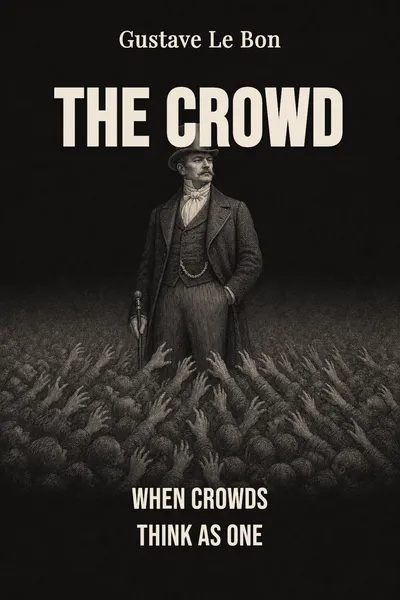
The Crowd
When crowds think as one
Description
In 1895, a French doctor turned amateur social theorist published a slim book with an outsized ambition. Gustave Le Bon had trained in medicine, dabbled in anthropology and physics, and was, by most accounts, a difficult and self-important man. But he had spent decades watching France convulse — the Revolution still echoing in the national memory, the bloody Commune of 1871 fresh in his own, the streets filling and emptying with a regularity that unsettled the respectable classes. Out of all that watching came Psychologie des foules, translated into English as The Crowd: A Study of the Popular Mind.
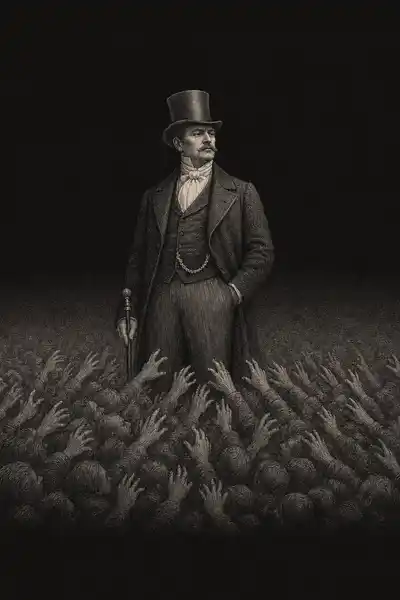
The claim at its center is unnerving and simple. When people gather in sufficient number and heat, Le Bon argued, something happens to them. They stop being individuals who reason, doubt and restrain themselves, and fuse into a single organism with a mind of its own — one that is impulsive, credulous, quick to rage and quicker to worship. The educated banker and the illiterate laborer, side by side in the same throng, become, in his words, more or less the same creature. Intelligence drops. Emotion soars. The person you were an hour ago is gone.
It is an uncomfortable thesis, and Le Bon meant it to be. He wrote for the men who governed, who feared, and who wanted to steer the masses rather than be swept away by them. More than a century on, we live surrounded by crowds he never imagined — timelines, comment sections, viral surges — and his old book keeps getting pulled off the shelf.
The question we’re asking : What happens to a person when they dissolve into a crowd, and why did one anxious Frenchman think it changed everything?What we’ll see : A physician's dark portrait of the collective mind, the mechanics he claimed drive it, and the long, troubling career his little book went on to have.
Table of contents
01 Chapter 1 — The man who watched a nation lose its head
Le Bon was not a neutral observer, and it helps to say so plainly. Born in 1841, he came of age in a France that seemed to lurch from upheaval to upheaval. He had lived through the humiliation of the Franco-Prussian War and the Paris Commune, when the city rose, governed itself for a few violent weeks, and was then crushed with tens of thousands dead. To a conservative bourgeois of his temperament, these were not moments of liberation but of contagion — proof that ordinary people, once assembled, could do things none of them would ever do alone.
That fear is the engine of the book. Le Bon believed his own century was becoming the century of crowds, that the old restraints of religion, aristocracy and tradition were giving way, and that whoever understood the psychology of the masses would hold the real power. He was not writing as a friend of the crowd. He was writing as a physician diagnosing a disease he thought was spreading, and offering, between the lines, a prescription for those who wished to manage it.

02 Chapter 2 — Three ingredients turn a gathering into a beast
A crowd, for Le Bon, is not simply a lot of people in one place. A packed train station is a collection of individuals, each pursuing private ends. A crowd, in his sense, forms only when those individuals turn toward a common feeling and fuse — when their separate personalities fade and a shared 'mental unity' takes hold. At that point, he insisted, a new being appears, and it obeys laws of its own that have almost nothing to do with the qualities of the people composing it.
He proposed three forces that bring this creature to life. The first is anonymity: buried in the mass, the individual feels an invincible power and sheds the sense of responsibility that normally holds him in check. No one is watching, no one is accountable, so the restraints simply drop away. The second is contagion — feelings and actions spread through a crowd, he wrote, as readily as a fever, each person catching the mood of the next until sentiment races around the whole body without anyone deciding it should.
03 Chapter 3 — What the crowd cannot do: think
If there is a single conviction at the heart of the book, it is this: the crowd cannot reason, and it never will. Le Bon was blunt about it. Whatever the intelligence of the individuals who compose it, a crowd operates well below the level of any of them. Put a hundred thoughtful people together in the grip of a shared emotion, and you do not get a hundred minds working in concert; you get one mind, and a crude one — governed by instinct, ruled by the moment, indifferent to contradiction.
This is why, in his account, arguments are useless on a crowd and images are everything. A crowd thinks in pictures, he wrote, and one image can set it marching where a thousand facts would leave it cold. It seizes on the simple and the absolute. Nuance evaporates; a proposition is either wholly true or wholly false, gloriously good or utterly evil. Whatever is repeated with enough force and frequency takes root as fact, not because it has been examined but because repetition itself does the work of proof.
04 Chapter 4 — The book that taught the twentieth century its worst trick
The strangest thing about The Crowd is not what it says but who listened. A short, opinionated volume by a self-taught French theorist became one of the most consequential books of its era — and much of its influence flowed into places its author might not have chosen. It was read, marked and used by men in the business of moving masses, and the twentieth century gave them ample opportunity.
The propagandists took it first. Edward Bernays, the pioneer of American public relations, drew openly on the idea that publics respond to suggestion and image rather than argument, and built an industry on it. Advertising absorbed the same lesson: sell the feeling and the picture, repeat the affirmation, and the reasoning consumer will follow the emotional one. Le Bon's crowd, herded by images it cannot resist, is the implicit customer of modern marketing. Whether or not the theory is sound, it has been acted upon at enormous scale.
05 Conclusion
Le Bon died in 1931, having lived to see the age of mass politics arrive in force. He remained convinced to the end that the crowd was a creature apart — impulsive, credulous, incapable of thought, waiting always for a strong voice to give it shape. Much of his science has aged badly, and later researchers have shown that crowds are far more varied, more capable and more human than his portrait allowed. The trance he borrowed from the hypnotists was never quite the thing he imagined.
Related books