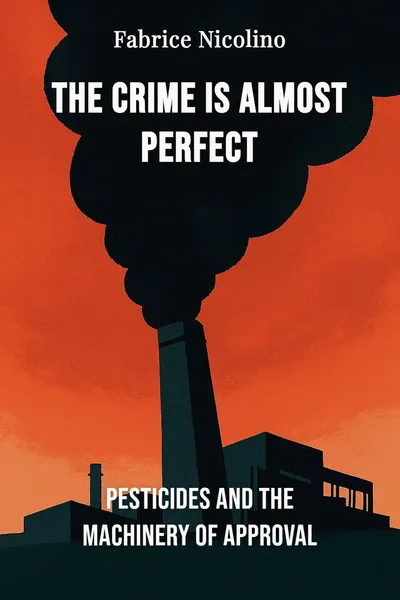
The Crime Is Almost Perfect
Pesticides and the machinery of approval
Description
There is a phrase Fabrice Nicolino keeps returning to in his 2019 book, and it does most of the work of the title. The crime is almost perfect — almost — because a perfect crime leaves no body, no motive, no trace. Here the bodies exist. The molecules exist, spread across fields, water tables and human blood in quantities no one seriously disputes. What is missing is the thing a crime usually needs to become a crime: someone who broke a rule. Everything Nicolino describes was done inside the law, stamped, filed, authorized. The pesticides on our plates arrived with their papers in order.
That is the unsettling core of the investigation. Nicolino, a French journalist who has written about the environment for decades, does not chase a rogue chemist or a corrupt minister caught with an envelope. He goes after something duller and far harder to indict: the machinery of approval itself. The committees, the safety thresholds, the toxicology tests, the acronyms that decide which substance may be sprayed on the wheat and which may not. He wants to know who built that machine, and whose interests it was built to serve.
His answer is not that a few bad actors slipped poison past the guards. It is that the guards, the standards and the science were shaped, from early on, by the very industry they were meant to restrain. The result is a system where a product can be simultaneously legal and dangerous, and where legality was never quite designed to mean safety in the first place.
The question we’re asking : How can a substance be both authorized and dangerous — and who arranged for those two things to stop meaning the same?What we’ll see : How a poison arrives fully licensed, and what the machinery that licenses it was actually built to protect.
Table of contents
01 Chapter 1 — A poison that arrives with papers in order
Nicolino starts from a fact most of us half-know and quickly file away: pesticides are everywhere. They turn up in rivers, in rain, in the umbilical cord blood of newborns, in the urine of people who have never touched a bottle of the stuff. In France alone, roughly 65,000 tons of active ingredients are sold each year, sprayed across the fields that feed the country. None of this is contraband. Every gram of it moved through a legal pipeline that begins with a company filing a dossier and ends with an official signature.
The book's first move is to sit with that strangeness. We tend to imagine that if a thing is harmful, someone must have done something wrong — cut a corner, hidden a study, bribed an inspector. Nicolino insists on the opposite. The harm and the legality coexist peacefully. The products that worry toxicologists are, for the most part, the products that passed. There is no smuggling ring to expose, no back door left open. The front door was wide, and the poison walked through it holding a permit.

02 Chapter 2 — The men who wrote the rules they would live under
To understand how the machine was built, Nicolino goes back to its architects, and his portraits are unforgiving. The regulatory apparatus for chemicals did not descend from neutral science. It was assembled in the twentieth century by a small circle of experts, industrialists and administrators who moved fluidly between the laboratories that made the molecules, the companies that sold them, and the committees that were supposed to judge them. The same names recur on both sides of the table.
He devotes particular attention to the figures who set the founding conventions of toxicology — the notion of an acceptable daily intake, the safety factors, the dose thresholds below which a substance is declared harmless. These are presented to the public as hard science, cold arithmetic. Nicolino shows them as negotiated conventions, built by people who had a direct stake in where the lines were drawn. A threshold is not discovered in nature. It is agreed upon in a room, and the composition of the room matters enormously.
03 Chapter 3 — What a market authorization actually measures
The heart of the investigation is the authorization itself — the moment a substance is cleared for the market. We imagine this as a verdict on safety: tested, proven harmless, approved. Nicolino spends chapter after chapter dismantling that image, and what emerges is a procedure far narrower and stranger than its reassuring label suggests.
Start with who runs the tests. The studies that support an authorization are, overwhelmingly, produced and paid for by the company seeking it. The manufacturer assembles the dossier, commissions the toxicology, and submits the results to the evaluating agency. The agency largely reviews what it is given. This inverts the intuition most of us hold: we assume the state investigates the product, when in practice the product's owner investigates it and the state grades the homework. A substance is presumed guilty of nothing and arrives with its own defense already written.
04 Chapter 4 — When the referee is paid by one team
Step back from the fields and the file cabinets, and the pesticide story becomes a case study in something political scientists have a name for: regulatory capture. It describes what happens when an agency created to police an industry gradually comes to serve it instead — not through bribery, usually, but through proximity, dependence, and the slow erosion of any outside perspective. Nicolino's investigation is, at bottom, an anatomy of capture in its most complete form.
The capture he describes is total because it operates at every joint. It captures the science, since the studies are industry-produced. It captures the expertise, since the evaluators come from and return to the firms. It captures the standards themselves, written with industry at the table. By the time a citizen encounters the system, there is no clean surface left to appeal to — no untouched authority standing outside the arrangement, ready to referee it. The referee, the rulebook and the scorekeeper are all, one way or another, on the payroll of one side.
05 Conclusion
Nicolino ends where he began, with the bodies that cannot become evidence. The farmers with Parkinson's and lymphoma, the vanishing bees, the residues in a newborn's blood — all of it real, all of it traceable, none of it prosecutable. The crime is almost perfect precisely because it was committed in advance, in the drafting of the standards, by people who ensured that everything downstream would be legal. There is no smoking gun, only a licensing system doing exactly what it was quietly built to do.
Related books