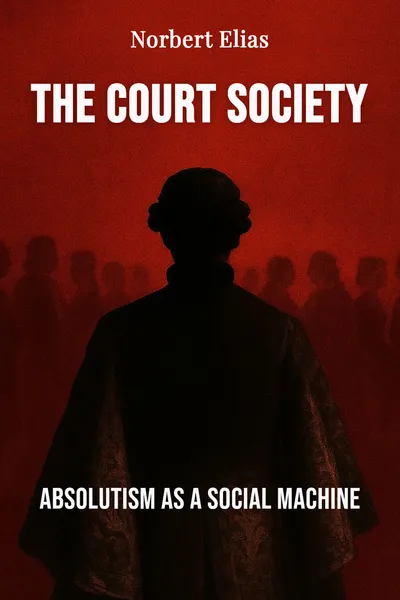
The Court Society
Absolutism as a social machine
Description
Around 1685, at Versailles, the question of who would hold the king's shirt at his morning dressing was a matter of real consequence. The ceremony was called the lever, and the right to pass the royal garment fell to whichever prince or duke ranked highest among those present. A visiting ambassador might spend weeks maneuvering for the privilege of handing Louis XIV a candlestick at bedtime. To an outsider this looks like theater, or vanity, or the sheer boredom of people with too much time. Norbert Elias, writing his study of the French court, saw something else entirely: a mechanism.
Elias was a German sociologist who drafted the book as his second doctoral thesis in the early 1930s, then set it aside for decades; it appeared in full only in 1969, when he was in his seventies. By then his reputation rested on The Civilizing Process, and this companion volume gave that argument a single, concentrated case. The court of Louis XIV was not a decorative backdrop to absolute power. It was the instrument of it — a social apparatus that turned the most dangerous men in France into rivals for a candlestick.
What Elias offers is a way of reading etiquette as force. The bows, the precedence disputes, the exact width of a chair's armrest granted by rank — none of it is trivial once we grasp what it was doing. It was keeping several hundred armed nobles fully occupied, financially ruined, and psychologically dependent, all without a single soldier being deployed against them.
The question we’re asking : How did an elaborate system of manners become the working engine of absolute monarchy?What we’ll see : How the daily life of the French court operated as a machine of constraint — and what it made of the people caught inside it.
Table of contents
01 Chapter 1 — A palace built to be seen in
To understand the court, Elias starts with the house. The great aristocratic residence was not a private home in any sense we would recognize. Its layout was public architecture, designed for reception, display, and the constant traffic of visitors whose rank determined how far into the building they were allowed to penetrate. The most intimate room was not the most hidden but the most contested: proximity to the master was the whole currency of the place. A nobleman's dwelling announced his standing to everyone who entered, and to fall short of what his rank demanded was a form of social death.
This produced a peculiar economics. A great lord could not save money the way a merchant could, because spending was not optional — it was the visible proof of who he was. He kept a household of dozens or hundreds, entertained lavishly, dressed to a standard set by those above him, and competed with his equals in a contest that had no natural ceiling. Elias calls this the ethos of rank consumption: expenditure governed not by income but by status. A duke who economized quietly was not prudent. He was announcing his own decline.

02 Chapter 2 — The tyranny of the small gesture
Once the nobles were gathered, the machine ran on etiquette. Elias is careful here, because it is easy to mistake court ceremony for empty formality. It was not empty. Every gesture was a measurement of rank, and because rank was the only thing that mattered, every gesture carried weight that we would reserve for money or law. Who entered a room first, who was permitted to sit and on what kind of seat, who was addressed with which honorific, who could keep a hat on in whose presence — these were not questions of politeness. They were the continuous, public accounting of everyone's exact position.
The famous ceremonies of the king's day — the lever in the morning, the coucher at night, the order of the meals — were the high liturgy of this system. But the same logic saturated ordinary life. A duchess would fight for months over whether she was entitled to a chair with a back or merely a stool in the queen's chamber, because the stool announced to the whole court that she stood a rung lower than she claimed. These disputes reached the king, who arbitrated them, and in arbitrating them reminded everyone that all rank flowed from him.
03 Chapter 3 — Reason at Versailles was survival
What did this do to the people inside it? Elias argues that court life demanded a very particular kind of intelligence, and cultivated it relentlessly. To survive at Versailles, a nobleman had to read others with constant precision: to interpret a cooling of the king's favor from the smallest sign, to calculate the shifting alliances around him, to know exactly how much warmth to show a rising man and how much coldness to a falling one. Misjudgment was expensive. A single lapse of composure could undo years of careful positioning.
This produced what Elias calls a specific rationality — not the rationality of the merchant, who calculates costs and returns, but the rationality of a person whose entire fortune depends on managing human relationships and appearances. The courtier learned to observe himself as carefully as he observed others, because his own face, his own tone, his own involuntary reactions were instruments that could betray him. The affect had to be governed. Spontaneity was a liability.
04 Chapter 4 — The self that court life invented
Here Elias widens the lens, and the court reveals what it was really manufacturing. The constant self-observation the courtier practiced, the governing of impulse, the habit of thinking ahead about the effect of one's own conduct — these did not stay at Versailles. They are, in Elias's larger argument, the very texture of what we now call a civilized personality. The pressures of court society drove the threshold of restraint inward, until control that had once been imposed from outside became a permanent internal apparatus, running automatically.
This is the through-line connecting this book to The Civilizing Process. Elias's boldest claim is that our inner life has a social history. The reserve we experience as simply being a mature adult — the check on anger, the management of what shows on our faces, the long-range foresight about consequences — is not a fixed feature of human nature. It was intensified and made habitual under specific social conditions, and the dense, competitive, inescapable world of the great court was one of the workshops where it was forged.
05 Conclusion
Return to the shirt at the lever. What looked, at the start, like the emptiest of rituals turns out to be the whole system in miniature: a king who rules by distributing meaningless honors that everyone has agreed to treat as everything, an assembly of powerful men reduced to competing for them, and a structure of interdependence so tight that no one inside can simply walk away. The etiquette was not decoration laid over power. It was the power, operating in the only medium available once open force had been taken off the table.
Related books