

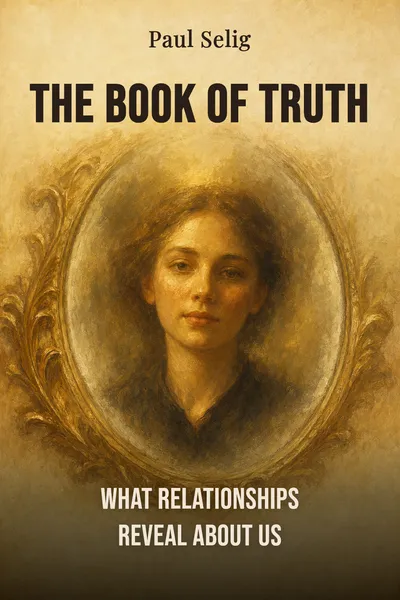
The Book of Truth
What relationships reveal about us
Description
On any given evening, Paul Selig sits with his eyes closed and speaks in a voice he insists is not entirely his own. What comes out, transcribed word for word, becomes a book. The Book of Truth, published in 2017 as the second volume of what Selig calls his Mastery Trilogy, arrived this way — dictated rather than composed, spoken by what the text names simply as the Guides. Selig, a Yale-trained writer who once directed the creative writing program at Goddard College, describes himself not as an author but as a receiver. The claim is either the most interesting or the most disqualifying thing about the book, depending on where you stand.
What the Guides want to talk about, this time, is us — specifically, the version of us that shows up in relationships. Not romance in the greeting-card sense, but the whole weather system of how we treat colleagues, strangers, family, the person who cut us off in traffic. The book's wager is that these encounters are not incidental to who we are. They are the evidence. Every time we decide someone is beneath us, or dangerous, or simply invisible, we are, according to the text, writing a sentence in a book we did not know we were keeping.
Selig's work reached a wider audience after a segment on ABC's Nightline treated him less as a curiosity than as a practitioner worth taking seriously, and the trilogy has held a devoted readership since. The material resists easy placement — it is not self-help, not scripture, not quite philosophy. It reads like instruction delivered by someone who assumes we already half-know what they are saying and have simply refused to admit it.
The question we’re asking : If our relationships are a record of who we actually are, what does The Book of Truth claim they reveal — and how does it propose we read them differently?What we’ll see : A channeled text, a radical claim about identity, and the uncomfortable idea that other people are the clearest mirror we have.
Table of contents
01Chapter 1 — The friend who dictates the book
Before anything else, The Book of Truth has to be understood as a strange object. Paul Selig does not write it in the way we usually mean writing. He enters a receptive state, and the text describes what follows as dictation from a set of non-physical Guides who speak through him. The prose keeps that seam visible on purpose. Passages arrive in the first-person plural of the Guides, then break off to comment on Selig himself — noting his hesitation, his fatigue, his resistance to a phrase he is being asked to transcribe. The reader watches the channeling happen rather than receiving a polished finished thing.
This is a deliberate choice, and it shapes how the ideas land. A tidy manuscript would invite us to argue with the author. A transcript that keeps showing its own stitching does something else — it presents the material as found rather than argued, overheard rather than pitched. Selig has been open that he can't fully explain the mechanism and doesn't especially try to. He was raised without much religious framework, spent years teaching writing, and stumbled into the practice in the 1980s through a spontaneous experience he never sought. The books came later, almost against his inclination.

02Chapter 2 — The Word, the True Self, and the lie we call "I"
The engine of the whole trilogy is a single reframing: the self we defend all day is not the real one. The Guides call the false version the personality structure — the accumulated bundle of fears, comparisons, and grudges we have come to treat as our identity. Underneath it sits what they name the True Self, and beneath even that, the Word, a term the book uses for the aspect of a person that is already aligned with the divine and never left it. The trouble, in this telling, is not that we are broken. It is that we have hypnotized ourselves into believing the smaller thing is all there is.
This matters for relationships because the false self runs almost entirely on ranking. It knows who it is by knowing who it is better than, safer than, more deserving than. The Guides are blunt about this. Every judgment we make about another person is, in their account, a statement about the fear-driven self doing the judging. When we decide someone is worthless, we are not describing them. We are broadcasting our own frequency — announcing, in effect, the level at which we currently operate.
03Chapter 3 — Every face is a mirror
Here the book earns its subtitle. The central practical teaching is that other people function as mirrors, and not in the comfortable way that phrase usually implies. The Guides mean something specific and uncomfortable: whatever we cannot tolerate in another person is very often the thing we have refused to look at in ourselves. The colleague whose arrogance grates on us, the relative whose neediness exhausts us — the book proposes these reactions as a map of our own disowned territory, laid out helpfully by people who have no idea they are doing us the favor.
This is why the material keeps returning to charged encounters rather than pleasant ones. The person we love easily teaches us little. The person who triggers contempt, envy, or fear is where the information is. The Guides frame the encounter as a gift precisely because it is not enjoyable — it shows us, without our consent, the frequency we are actually holding. A person operating from the True Self, they suggest, would meet even the difficult figure without needing to reduce them, because there would be nothing in the difficult figure that threatened the self doing the meeting.
04Chapter 4 — What a channeled book asks of us
Step back from the teaching for a moment and look at the thing itself. The Book of Truth is a work that claims not to have been written by its author, that asks to be received rather than evaluated, and that treats other human beings as instruments of self-recognition. Each of those features cuts against the instincts of a skeptical reader — and Selig knows it. He does not ask for belief in the Guides as a precondition. The book is arranged so that the practice can be tried regardless of what one thinks about its source.
That framing is quietly clever. Whether or not one accepts that non-physical intelligences dictate through a former writing professor, the instruction it delivers can be tested in ordinary life. Notice the next person who irritates you. Ask what the irritation reveals. Try meeting them as something more than the surface they present. The result of that experiment does not depend on the metaphysics being true. It depends only on whether the observation about ourselves holds — and for many readers, it uncomfortably does.
05Conclusion
We began with a man sitting quietly, eyes closed, transcribing a voice he says is not his. The image is easy to dismiss and hard to forget. Whatever one concludes about the Guides, the book they produced makes a claim that stands on its own legs: that our relationships are not a sideshow to the spiritual life but the entire arena of it, and that the people we find hardest to bear are carrying, unknowingly, the most useful information about us.