The Book of Mormon
Golden tablets, American gospel
Description
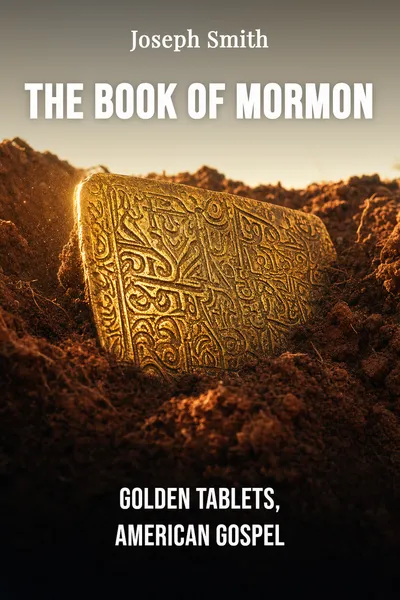
On the night of September 21, 1823, in a farmhouse near Palmyra in upstate New York, a seventeen-year-old named Joseph Smith later said a figure appeared at his bedside — a messenger he called Moroni, a man who had died more than a millennium earlier and now stood glorified, resurrected, luminous. The messenger spoke of a record written on golden plates, buried in a hillside not far from the family farm, telling the history of ancient peoples who had lived in the Americas and of the God who had watched over them. Smith would say he was instructed to translate it. Four years later, according to his account, the plates were his to render.
The book that emerged in 1830 does not read like a family memoir or a frontier tall tale. It reads like scripture — chapters and verses, prophets and kings, wars and covenants, a cadence borrowed from the King James Bible that Americans of the 1820s knew by heart. Its claim is enormous and specific: that the God of the Old and New Testaments also spoke on this side of the ocean, that His dealings did not stop at the edge of the ancient Mediterranean world, and that a full account of it had been waiting in the ground of New York State to be dug up and read.
That claim is what makes The Book of Mormon such a strange and revealing document. Most sacred texts arrive from somewhere far away and long ago, carried across centuries by tradition. This one announced itself as freshly recovered, in English, in a country barely fifty years old, in a landscape its first readers could walk to. It asked a young republic to believe that revelation had a local address.
The question we’re asking : How does a book claim to be scripture recovered from the American ground itself, and what does it ask its readers to believe?What we’ll see : How the record came to Joseph Smith, the sweeping story its pages tell, the gospel it delivers, and why a text like this could only have surfaced where and when it did.
Table of contents
01 Chapter 1 — A farm boy and a buried record
Joseph Smith Jr. was born in Vermont in 1805 and grew up in a farming family that moved west to New York in search of better land. The region around Palmyra in those years was thick with religious fervor — traveling preachers, revival meetings, competing denominations all pressing for souls. It was the kind of place where a teenager might genuinely agonize over which church, if any, had it right. By his own account, Smith did exactly that, and the answer he received was not a recommendation for one denomination over another but something far larger.
The account he gave runs like this. After earlier visions, the messenger Moroni came to him repeatedly and directed him to a hill where a set of thin golden plates lay buried, bound together and covered in an ancient script. Moroni, Smith said, had been the last prophet of the people whose history the plates contained — the son of a man named Mormon, who had compiled the record generations before. The plates were not simply an artifact. They were a charge. Smith was told he had been chosen to bring their contents into English.

02 Chapter 2 — The story the plates tell
The narrative inside The Book of Mormon covers roughly a thousand years, and it opens not in America but in Jerusalem, around 600 BC, on the eve of the Babylonian conquest. A prophet named Lehi, warned by God, leads his family out of the doomed city and eventually across the ocean to a promised land — a new continent. From that migration descend the peoples whose fortunes fill the rest of the book: chiefly two lineages, the Nephites and the Lamanites, named for two of Lehi's sons, who spend centuries in cycles of faith and forgetting, prosperity and war.
The rhythm of the book is the rhythm of the Hebrew Bible transplanted. Prophets rise to warn their people; the people listen, thrive, grow proud, fall into corruption, and are punished; a remnant repents and the cycle begins again. There are righteous kings and scheming usurpers, long stretches of peace and terrible battles, sermons that stop the action to lay out doctrine at length. Woven through it all is a promise that the land itself is consecrated, and that those who keep faith with God will be preserved on it while those who abandon Him will not.
03 Chapter 3 — A gospel written for one continent
That central event arrives after the resurrection. The New Testament ends with Jesus appearing to His disciples in and around Jerusalem; The Book of Mormon extends the story across the ocean. Its climactic passages describe the risen Christ descending to the peoples of the Americas, showing them the wounds in His hands and feet, teaching them directly, and establishing His church among them. It is the same gospel of repentance and redemption preached in Galilee, delivered a second time to a second hemisphere.
This is the book's boldest theological move, and the one that gives Smith's account its shape. The claim is not that America received a different revelation, but that it received the same one — that Christ, having risen, did not confine His ministry to the old world. He speaks to these peoples about salvation, about the atonement that reconciles a fallen humanity to God, and about how they and their descendants are to worship. The propitiation offered on the cross, in this telling, was always meant for more than one shore.
04 Chapter 4 — Scripture that keeps arriving
Step back from the details of plates and prophets, and The Book of Mormon poses a question that is really about time and place. Almost every sacred text a Western reader knows arrived from far away and long ago, its authority resting partly on distance — the sense that revelation happened in an age of miracles now closed. Smith's book refuses that closure. It insists that revelation did not end with the ancient world, that it could touch a hillside in New York State, that scripture might still be arriving.
That refusal is what made it possible only where and when it appeared. A book announcing freshly recovered scripture, in English, addressed to Americans, needed a culture soaked in the Bible but no longer content to receive it only from Europe. The revivalist ferment of the early republic supplied exactly that: readers who knew every rhythm of the King James text, who took visions and prophecy seriously, and who were beginning to imagine that the new continent might have a sacred destiny of its own rather than a borrowed one.
05 Conclusion
The plates, by Smith's account, were returned to the messenger who had led him to them, leaving behind only the book. That is the paradox at the heart of the whole enterprise: the physical record that would have settled every argument is gone, and what remains is the text itself, asking to be judged on what it says rather than on what could be examined. From that farmhouse near Palmyra came not an artifact but a scripture, and a scripture is a thing meant to be lived by, not weighed in the hand.
Related books