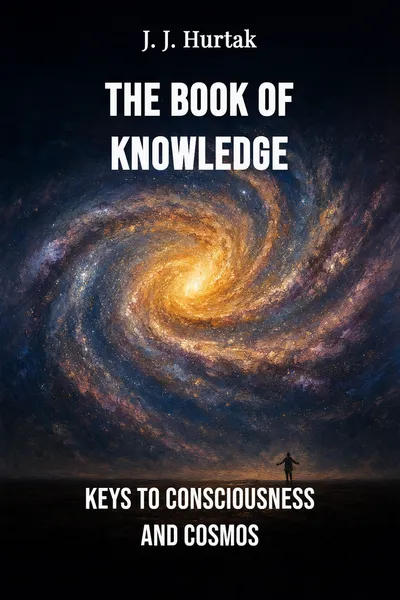
The Book of Knowledge
Keys to consciousness and cosmos
Description
In the early 1970s, an American researcher named James J. Hurtak published a dense, sprawling volume that most bookstores would not have known where to shelve. Its full title ran long — most readers simply called it The Book of Knowledge, or by the phrase folded into its subtitle, The Keys of Enoch. It arrived without the usual scaffolding of a genre. It was not quite a religious text, not quite a physics primer, not quite a work of philosophy, though it borrowed the vocabulary of all three. Hurtak framed it as something received rather than composed: a body of teaching organized into sixty-four numbered keys, each one meant to unlock a piece of a single, very large picture.
That picture is ambitious to the point of vertigo. The keys move between the structure of DNA and the structure of galaxies, between ancient scripture and cutting-edge cosmology, between human biology and what Hurtak calls higher consciousness. The material universe, in this telling, is not a closed mechanism running down toward heat death. It is a layered system, alive with intelligence, in which physical matter and spiritual reality are two readings of one text. The human being sits at the hinge — a creature made of atoms and, in Hurtak's account, capable of participating in something far larger than atoms.
For the tradition of readers who found it, the book became foundational: less a volume to finish than a territory to inhabit. It has never been mainstream, and it was never meant to be. But it has held a remarkably steady following for half a century, and it repays a careful look at what it actually claims — what a work like this sets out to do, and what its keys are supposed to open.
The question we’re asking : What does Hurtak's book actually propose about consciousness, cosmos, and the link between the two?What we’ll see : How a single visionary text tries to hold physics, scripture, and human destiny inside one frame — and what its readers go there to find.
Table of contents
01 Chapter 1 — The vision behind the keys
Hurtak did not present The Book of Knowledge as an argument he had built. He presented it as an account of an experience — a visionary encounter he dated to the early 1970s, in which the teaching was, in his framing, transmitted to him. Whatever one makes of that origin story, it sets the terms for everything that follows. The book does not reason its way from premises to conclusions the way a treatise would. It unfolds as revelation, key by key, each one a compact block of teaching that assumes the reader is willing to travel with it rather than interrogate it line by line.
The structuring device is the key. There are sixty-four of them, and the number is not casual — it echoes the sixty-four codons of the genetic code, one of the recurring bridges Hurtak builds between biology and cosmology. Each key is meant to open access to a level of understanding: a piece of how consciousness relates to matter, how the human relates to the divine, how the local relates to the cosmic. Read together, they are supposed to compose a single ascending map rather than a set of separate lessons.

02 Chapter 2 — A cosmos read as language
The central move of the book is to treat the universe as something legible — a text written in more than one script at once. Where a physics textbook reads the cosmos as matter and force, Hurtak reads it as a layered language in which physical structures carry meaning beyond their physical function. Light, in particular, runs through the keys as more than radiation: it is presented as a carrier of information and consciousness, the medium through which the higher order communicates with the material one.
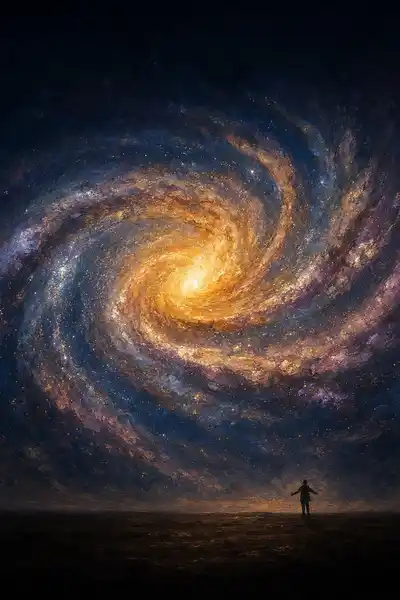
From this follows one of the book's signature patterns: the mirroring of scales. The spiral of DNA and the spiral of a galaxy are not, for Hurtak, a coincidence of shape. They are the same organizing intelligence expressed at different magnitudes. The very small and the very large rhyme because they are drawn from one grammar. The reader is invited to see the double helix inside the body and the rotating arms of a galaxy as two sentences in the same cosmic language, each encoding a version of the same instruction to unfold and become.
03 Chapter 3 — Where science meets the sacred
The most distinctive quality of the book is its refusal to keep science and scripture in separate rooms. Hurtak moves freely between the vocabulary of genetics, physics, and astronomy and the vocabulary of Hebrew scripture, angelic hierarchies, and divine names. He does not treat these as competing accounts of reality that one must choose between. He treats them as complementary descriptions of the same structure, and much of the book's energy goes into stitching them into one continuous fabric.
So the sacred names and the physical constants sit side by side, presented as different faces of a single order. Where a scientist sees a mechanism and a mystic sees a meaning, Hurtak insists both are looking at the same thing from different angles. The DNA that geneticists sequence and the breath of life described in older traditions are, in his framing, two readings of one reality. The book's ambition is to be the document where those readings finally meet on the same page.
04 Chapter 4 — A map for those who go looking
Step back from the individual keys and the book reveals what it really is: an attempt at total synthesis. Hurtak is trying to do the thing that almost no modern text dares to attempt — to hold physics, biology, scripture, and human destiny inside a single frame without letting any of them break the others. That ambition is what places The Book of Knowledge in a long and recognizable lineage, even for readers who will never open it.
The appetite it feeds is durable. Across centuries, certain works have promised the same thing: one text that reconciles what the culture has pulled apart. The specialist age we live in makes that promise more, not less, attractive. We have sorted knowledge into disciplines that no longer speak to one another — the cosmologist and the theologian and the geneticist working in separate buildings, each with a language the others cannot read. A book that claims to be the missing translation between all of them answers a hunger that fragmentation itself created.
05 Conclusion
The Book of Knowledge remains what it was on the day it appeared: a large, difficult, uncompromising attempt to say that everything belongs to one order. Its sixty-four keys move between the codon and the galaxy, between the divine name and the physical constant, always with the same conviction — that matter and spirit are two readings of a single text, and that the human being is the instrument built to read it. Hurtak never asked for it to be tested. He asked for it to be traveled.
Related books