

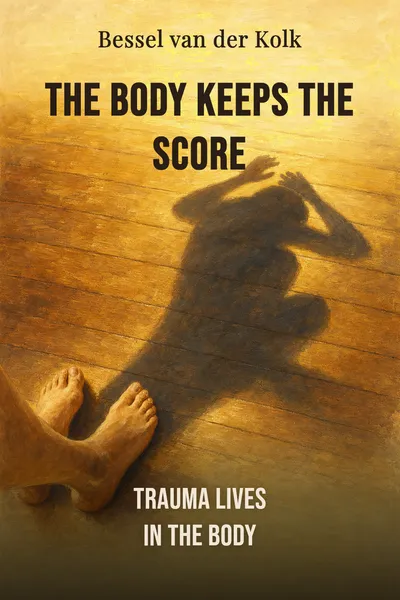
The Body Keeps the Score
Trauma lives in the body
Description
In the late 1970s, a young psychiatrist named Bessel van der Kolk was working at a Veterans Administration clinic outside Boston, listening to men who had come home from Vietnam. One of them handed him a story he had written to a girlfriend he lost before the war, and van der Kolk noticed something that would organize the rest of his career: the men were not remembering the war, they were reliving it. A car backfiring, a sudden smell, a stranger's face — and their bodies snapped back into the jungle, heart pounding, muscles braced, as if the danger were happening now.
That observation sat awkwardly against the psychiatry of the time, which mostly treated the mind as a thing to be talked to and the body as a machine to be medicated. Van der Kolk spent the next four decades — at the VA, at Massachusetts General, and at the Trauma Center he founded in Brookline — arguing that this split misses the whole point. Trauma, he came to insist, is not a story stuck in the past. It is a rearrangement of the body and brain in the present, a nervous system that never got the message that the threat is over.
Published in 2014, The Body Keeps the Score became one of the most widely read books ever written about psychological suffering. Its argument is deceptively simple and, for many readers, deeply personal: the imprint of overwhelming experience lives in the flesh long after the event, and healing has to reach the flesh, not just the memory of it.
The question we’re asking : If trauma settles into the body rather than staying a memory, what does it actually take to heal it?What we’ll see : How overwhelming experience rewires the nervous system, why talking alone often fails to reach it, and what van der Kolk found does.
Table of contents
01Chapter 1 — The letter that would not leave the veterans
The veterans van der Kolk met were not, in the clinical language of the day, mentally ill in any tidy sense. They held down jobs, or tried to. They loved their families, or tried to. But something in them was permanently on guard. They startled at nothing. They flew into rages they could not explain and then felt monstrous for it. Many drank to turn the alarm system off. When they tried to describe what happened to them overseas, some could speak fluently and feel nothing, while others were flooded so completely that words dissolved. Neither state matched the calm, integrated remembering that ordinary memory allows.
This puzzled van der Kolk because psychiatry had a diagnosis for schizophrenia and one for depression, but in 1980 it had only just coined a name for what these men carried: post-traumatic stress disorder. The name was new; the condition, he suspected, was ancient and enormous. And it was not confined to soldiers. As he moved through his career, he found the same signature in abused children, in survivors of rape, in people who had lived through accidents and disasters — the same hypervigilance, the same numbing, the same body braced against a danger that had already passed.

02Chapter 2 — What the frightened brain does to the body
As brain imaging matured through the 1990s and 2000s, van der Kolk and his colleagues could finally watch what happened inside a traumatized person confronted with a reminder of their worst experience. The results gave his hunch a physical map. When people relived their trauma in the scanner, the emotional alarm centers of the brain — the amygdala above all — lit up as if the threat were real and immediate. The body flooded with stress hormones and prepared, once again, to fight or flee.
At the same time, something went quiet. The region near the left front of the brain that helps translate experience into language dimmed. Van der Kolk describes this as speechless terror: at the peak of reliving, the part of the brain that could put the feeling into words is effectively offline. This is why trauma so often resists the ordinary account. The person is not being evasive or difficult. The machinery that turns sensation into narrative has been overridden by the machinery that keeps them alive under attack.
03Chapter 3 — When words cannot reach the wound
If the language centers go dark at the moment of terror, then a therapy built entirely on words faces a hard limit. This is one of the book's most consequential claims. Van der Kolk does not dismiss insight or conversation — he spent his life in clinical dialogue — but he argues that understanding why you feel unsafe rarely, by itself, makes your body feel safe. Many patients can narrate their history with perfect clarity and still dissolve into panic at a footstep. The alarm does not read the memo the intellect has written.
So he went looking for approaches that spoke the body's language directly. One was EMDR, or eye movement desensitization and reprocessing, a method in which a patient recalls a disturbing memory while following a moving stimulus with their eyes. Van der Kolk was initially skeptical — the mechanism was, and remains, poorly understood — but the results he saw were hard to ignore: memories that had stayed raw for decades seemed to lose their charge, filing themselves at last as past rather than present.
04Chapter 4 — Putting the self back together
Step back from the individual case histories and The Body Keeps the Score is making an argument about medicine itself. For most of the twentieth century, van der Kolk contends, the treatment of suffering was carved into territories that did not talk to each other — a psychiatry of chemistry, a psychology of talk, a physical medicine of tissue — and trauma fell through every seam because it belongs to all of them at once. His life's project is a plea to treat the whole person, brain and body and relationships together, rather than the fragment that happens to fall inside one specialist's remit.
The stakes, he insists, are not niche. Drawing on large-scale research such as the study linking adverse childhood experiences to adult illness, he presents trauma as a public health emergency hiding in plain sight — behind addiction, behind chronic disease, behind much of what fills clinics and prisons. When childhood abuse and neglect are common, and when their imprint lasts a lifetime in the body, the cost to a society is vast and largely invisible because we have trained ourselves to look for it in the wrong place.
05Conclusion
The veteran's letter that van der Kolk read in the 1970s never really left him, and it frames everything the book goes on to argue. Those men were not failing to move past the war; their bodies had never registered that the war was over. What began as a clinical curiosity at a VA waiting room became, across four decades, a wholesale case for rethinking what trauma is and where it lives. Not a stubborn memory to be reasoned with, but a nervous system reorganized around a threat, keeping its own faithful and costly record.