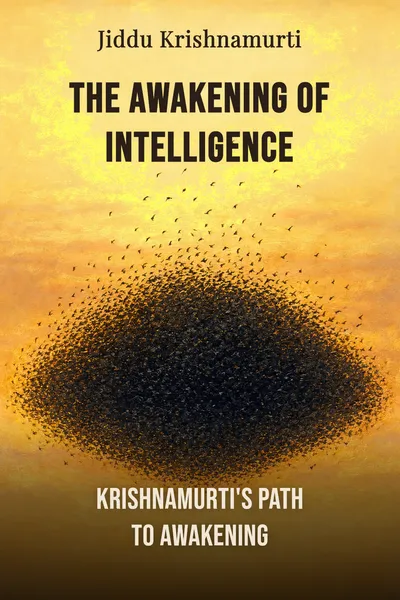
The Awakening of Intelligence
Krishnamurti's path to awakening
Description
In 1929, in front of several thousand followers at a camp in the Netherlands, a young Indian man dissolved the organization built to serve him. The Order of the Star had been created around Jiddu Krishnamurti by the Theosophical Society, which had spent nearly two decades grooming him as the World Teacher, a coming messiah. He stood up and told the assembly that truth is a pathless land, that no organization, no belief, no guru could lead anyone to it, and that he wanted no followers at all. Then he walked away from the money, the property, and the role. He spent the next fifty-seven years talking to whoever would listen, refusing every title anyone tried to pin on him.
The Awakening of Intelligence, published in 1973, collects the residue of those decades: talks, and long recorded conversations with people who came to him with sharp questions. A philosopher of religion, Jacob Needleman. A former assistant turned interlocutor, Alain Naudé. A scholar of the Vedanta, Swami Venkatasananda, who pressed Krishnamurti on whether the very tradition he rejected might still have something to offer. The book is less a treatise than a series of encounters, circling the same stubborn set of problems from different angles, never quite letting any of them settle.
What runs through all of it is a refusal that sounds almost impossible to hold onto. Krishnamurti wants us to see something directly, without the help of anyone who has seen it before us. No steps, no discipline, no accumulated wisdom to lean on. And yet he talked for nearly sixty years, which raises the obvious question of what, exactly, all that talking was meant to do.
The question we’re asking : What does Krishnamurti mean by intelligence, and why does he insist no teacher can hand it to us?What we’ll see : A man who spent a lifetime dismantling the very role others kept trying to give him, and the strange, exacting freedom he offered in its place.
Table of contents
01 Chapter 1 — The guru who refused the job
The strangeness of Krishnamurti starts with his biography. Taken up by the Theosophists as a boy in 1909, he was told he would be the vehicle for a great teacher, the awaited one who would guide humanity. He grew up inside that expectation, surrounded by devotees, funded by an international movement. And then, at thirty-four, he refused it entirely. The dissolution of the Order of the Star was not a crisis of confidence. It was the logical end of what he had started to see: that any structure promising to deliver enlightenment was, by its nature, an obstacle to it.
This refusal is the spine of the conversations in the book. When Alain Naudé and Jacob Needleman press him on the role of the teacher, Krishnamurti does not soften. A guru who says he can lead you to truth is, in his account, selling you dependence. The moment we accept a guide, we have handed over the one thing that matters, which is our own capacity to look. The relationship of disciple and master, however loving, however sincere, keeps us children. It substitutes someone else's sight for our own.

02 Chapter 2 — Thought is the problem, not the solution
If no one can lead us, what is it we are supposed to see for ourselves? Here Krishnamurti turns to the instrument we most trust, which is thought. We assume that thinking harder, analyzing more finely, will eventually solve our confusion. Krishnamurti reverses this. Thought, he argues, is the response of memory, and memory is the past. When we meet a fresh situation with thought, we meet it with the dead residue of everything that came before. We never actually see what is in front of us; we see our accumulated conclusions about it.
This becomes the heart of his account of conflict, fear, and sorrow. Fear, for instance, is not a mysterious visitor. It is thought projecting forward, imagining a loss, rehearsing a pain that has not yet arrived. The mind takes a real event, wraps it in memory and anticipation, and manufactures a continuity of suffering that would collapse if we could simply stay with the fact itself. The trouble is that thought cannot stop thought. Whatever effort we make to end the noise is one more movement of the same machinery.
03 Chapter 3 — Awareness before the mirror moves
What Krishnamurti puts in place of method is a word that sounds almost too simple: awareness. But he means something exact by it. Not concentration, which narrows and excludes. Not analysis, which divides. He means a choiceless attention, a watching of what is actually happening in the mind without naming it, condemning it, or wanting it to be otherwise. The moment we judge what we see, we have brought thought back in, and the seeing stops. Pure awareness, in his sense, is looking without the looker interfering.
He describes this most vividly in talking about the space between a stimulus and our reaction to it. Ordinarily the gap is instantaneous; something happens and we respond out of habit, out of the accumulated self. Awareness widens that gap. In the interval, before thought names the experience and files it under the old categories, there is a chance to see the thing as it is. This is why he speaks of attention as immediate rather than progressive. It does not build over years. It is either present now or it is not.
04 Chapter 4 — Intelligence as a way of living
Step back from the individual conversations and a larger pattern in Krishnamurti's stance comes into view. He is refusing, systematically and for a lifetime, the entire economy of spiritual authority. Human beings, faced with confusion and fear, reliably do the same thing: they look for someone who has the answer, and they organize themselves around that person. Churches, orders, schools, methods, lineages, the endless machinery of guidance. Krishnamurti's whole life was a demonstration that this machinery, however sincere, keeps producing the dependence it claims to relieve.
The uncomfortable implication is that the appetite for a teacher is itself the problem, not a step on the way to solving it. We want someone to tell us what to see because seeing for ourselves is frightening and lonely; it removes the comfort of a hand to hold. Krishnamurti offers no hand. He is doing something closer to the opposite of what a guru does, using his considerable presence to push us off the very support he could so easily have provided, and which thousands were desperate to receive from him.
05 Conclusion
The man who dissolved his own order in 1929 kept talking until his death in 1986, and the shape of that long life is the argument itself. He never founded a religion, never named a successor, never allowed himself to become the authority he had been raised to be. The Awakening of Intelligence catches him mid-conversation, refusing every ledge his interlocutors offer him to rest on, insisting that the seeing has to be ours or it is worthless.
Related books