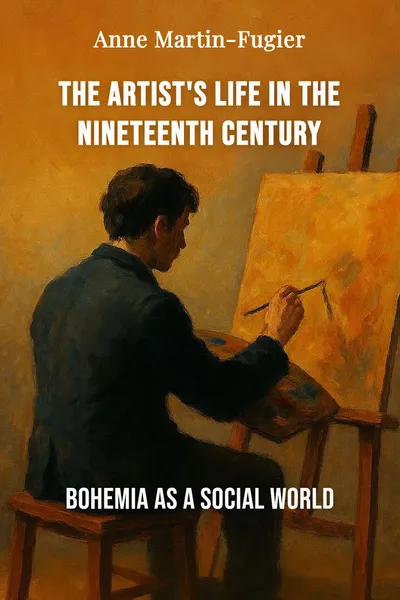
The Artist's Life in the Nineteenth Century
Bohemia as a social world
Description
In the 1840s, a young man could arrive in Paris from the provinces with a small allowance, rent a cheap room on the Left Bank, enroll in a studio, and start calling himself a painter. Nobody could stop him. There was no diploma to earn, no license to hold, no register to sign. He was an artist the moment he decided he was one — which meant the title cost nothing and guaranteed nothing. The city filled with these self-declared painters, sculptors and would-be geniuses, and the word that gathered them up was bohemia.
Anne Martin-Fugier's book tracks what that word actually covered across the century in France: not a myth of doomed poets, but a real social world with its own addresses, its own hours, its own economy. She reconstructs how a young person became an artist — where they lived, who they ate with, how they got their work seen, who paid, and who didn't. The picturesque version, all garrets and consumption and unpaid rent, turns out to be one thin layer over a dense apparatus of studios, juries, cafés, dealers and marriages that determined who survived and who went home.
What emerges is less romantic and more interesting than the legend. Being an artist in nineteenth-century France was a career like others, with an entry, a training, a set of gatekeepers, and a hard question of money underneath everything. The bohemian pose was partly a way of making poverty bearable — and partly a professional strategy while the old system that fed artists quietly gave way to a new one.
The question we’re asking : What did it actually take to live as an artist in nineteenth-century France — and who decided whether you could?What we’ll see : How a milieu with its own places, rituals and hierarchies formed around the fragile business of making a living from art.
Table of contents
01 Chapter 1 — The word before it was a slur
Bohemia arrives as an insult before it becomes a badge. In the early nineteenth century, la bohème named the vagabond, the person with no fixed place and no visible means — the word carried the old association with itinerant Roma, wrongly imagined as coming from Bohemia. Applied to young artists, it registered the same suspicion: here were educated men living like tramps, refusing regular work, owing everyone money. The respectable world used the term to keep them at arm's length.
Henry Murger changed the temperature. His Scènes de la vie de bohème, serialized from 1845 and staged as a play in 1849, took the squalor and made it charming — the shared meals when there was food, the pawned coat, the girl who dies young, the friendships that hold when nothing else does. Murger knew the life from inside; he had lived it, poorly. But his version sanded down the misery into something a bourgeois audience could enjoy without having to smell it. Puccini's opera, decades later, finished the sentimental work.

02 Chapter 2 — Learning the trade, waiting for the jury
Before the pose came the apprenticeship, and it was more structured than the legend admits. A young painter attached himself to a studio — an atelier run by an established master, sometimes the official teaching of the École des Beaux-Arts, sometimes a private studio where dozens of students drew from the model and paid for their place. The atelier had its own brutal customs: the newcomer, the nouveau, was hazed, made to run errands, taxed for the collective stove and wine. It was a school and a fraternity at once, and the friendships and enmities formed there followed men through their whole careers.
The training was long and the technique demanding. Drawing came first, endlessly, from plaster casts and then from the live model; painting and composition followed. A student measured himself against the great prizes, above all the Prix de Rome, which sent its winner to the Villa Medici at state expense and set him on a path toward official commissions. Winning reorganized a life. Losing, repeatedly, was the more common experience.
03 Chapter 3 — The apartment, the café, the studio
The social world of the artist had a geography, and Martin-Fugier maps it precisely. Where you lived told everyone where you stood. The struggling painter took a cheap room and a cheaper studio, often the same drafty space, in the unfashionable quarters. The arrived painter moved to a proper apartment with a purpose-built studio flooded with north light, a place designed to receive collectors and be photographed. The move from one to the other was the visible sign that a career had turned.
The café did the work that no institution could. In an age before the telephone, the café was where information circulated — which dealer was buying, which critic could be reached, who had sold and who had gone under. Groups formed around particular tables, and a young artist's admission to the right circle mattered as much as his talent. Reputation was made in conversation, over hours, in smoke. The café was also where the poor artist could sit all evening for the price of a single drink, warm and among his own.
04 Chapter 4 — When the dealer replaced the state
Step back from the cafés and the garrets and a slower change is visible underneath, and it is the one Martin-Fugier lets the whole book build toward: across the century, the ground on which an artist stood shifted from public patronage to a private market. At the start, the system pointed everything toward the state — the École, the Prix de Rome, the Salon jury, the official commission. Success meant being chosen by the establishment, and the establishment's taste was singular and slow to move.
The dealer changed that. Figures like Paul Durand-Ruel began to buy an artist's output, hold it, promote it, and wait for its value to rise — treating pictures as an investment and the painter as an asset to be developed rather than a supplicant to be judged. This was a different relationship entirely. It offered the artist a steady buyer instead of an annual verdict, and it offered a route to recognition that did not pass through the jury at all. The Impressionists, refused or ignored by the official system, could exist because a market was forming that the official system did not control.
05 Conclusion
We began with a young man who could call himself an artist simply by saying so, and that gesture turns out to contain the whole story. The title was free because it settled nothing — the studio still had to train him, the jury still had to accept him, the café still had to admit him, and someone, eventually, still had to buy. Bohemia was the name for the long interval between the declaration and the verdict, dressed up as a choice.
Related books