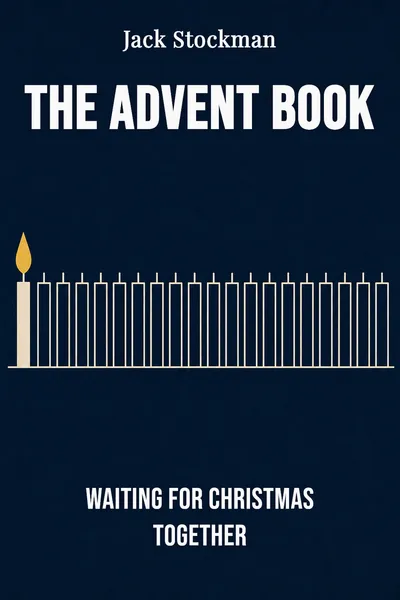
The Advent Book
Waiting for Christmas together
Description
There is a stretch of December when children stop asking how many days are left and start asking every hour. The counting becomes its own kind of hunger. Jack Stockman built a book for exactly that hunger — an illustrated Advent keepsake meant to be opened one page, one day at a time, from the start of the month toward Christmas morning. Not a book to finish in an evening. A book to ration on purpose, so that the waiting itself becomes something a family does together rather than something the youngest members simply endure.
The idea sounds almost too simple to need a book. And yet the object Stockman made turns a private countdown into a shared ritual. Each day carries its own reading and its own piece of artwork, and the artwork is not decoration — it is the door you open, the small surprise that marks another day gone. The reader is meant to touch it, return to it, and eventually to bring it back out the following year, a little more worn, a little more familiar. It is designed to be used, not preserved behind glass.
What Stockman is really working with is the oldest tension of the Advent season: the gap between wanting the thing and being asked to wait for it. Most of modern December is built to close that gap as fast as possible. The Advent Book does the opposite. It stretches the waiting out, hands it a shape, and gives a family a reason to gather around the same page at the same hour, night after night, until the last door opens.
The question we’re asking : How does a book turn the long wait before Christmas into something a family shares rather than simply survives?What we’ll see : How Stockman's illustrated devotional gives the Advent countdown a form, a daily rhythm, and a life that returns year after year.
Table of contents
01 Chapter 1 — Twenty-four little doors
The structure of The Advent Book borrows from a tradition most of us met as children without ever learning its name. The Advent calendar — twenty-four windows, one opened each day of December until Christmas — began in German Lutheran homes in the nineteenth century and was printed commercially in the early 1900s. Stockman keeps the spine of that idea and gives it more weight. Instead of a cardboard window hiding a chocolate, each day opens onto a reading and an image made to be sat with, not swallowed in a second.
The discipline of the form is the point. The book is built so you cannot rush it honestly. There is a page for today and there will be a page for tomorrow, and the whole design quietly insists that tomorrow's page waits until tomorrow. For a child, that restraint is close to unbearable in the best way — the same delicious frustration that makes the countdown feel real. For the adults in the room, it does something subtler: it hands the evening a fixed appointment, a small non-negotiable that the season otherwise tends to swallow.

02 Chapter 2 — The pictures that ask to be opened
Stockman is an illustrator, and the artwork in The Advent Book is not there to brighten the margins. It carries as much of the meaning as the words do. Each day's image is the thing the family gathers to see, the visual event that marks the day as opened. In a season already crowded with screens, the choice to make a hand-drawn picture the centerpiece is deliberate. The image is slow where a screen is fast, and it rewards the kind of looking that a countdown asks for.
The pictures also do the work of reaching the youngest reader who cannot yet follow a paragraph. A three-year-old cannot parse a devotional passage, but a three-year-old can absolutely wait all day to see what today's picture shows. The artwork gives the pre-reading child a genuine stake in the ritual, which matters more than it sounds — because a family ritual only holds if everyone at the table has a reason to lean in. Stockman builds that reason directly into the page.
03 Chapter 3 — A season built for slowing down
Advent, in the Christian calendar, is not Christmas. It is the four weeks of expectation that come before it — a season with its own colour, its own hymns, its own posture of waiting. The word itself comes from the Latin for "coming." It was never meant to be the celebration; it was meant to be the getting-ready, the deliberate holding-off that makes the arrival mean something. Stockman's book is built squarely inside that older understanding, and it leans against the current of how most of us actually spend December.
Because in practice, Advent has mostly collapsed. The tree goes up early, the music starts in November, the parcels arrive whenever they arrive, and Christmas begins the moment the shops decide it should. The waiting that gave the season its shape has been optimized away. What The Advent Book offers is a small, portable way to put it back — not by scolding anyone about consumerism, but simply by handing a family a reason to pace themselves. One page a day is a form of restraint you choose because it feels good, not because you ought to.
04 Chapter 4 — What a keepsake keeps
The most telling thing about The Advent Book is that Stockman designed it to come back. It is a keepsake, not a consumable — meant to be packed away in January and pulled out again the following December, and the December after that. That single design choice changes what the object is. A book read once is content. A book returned to every year for a decade becomes a fixture, and fixtures are how families actually build the thing they call tradition.
This is worth sitting with, because it says something about a whole category of objects we underrate. The ornament from a grandparent, the recipe in a familiar hand, the decoration that goes up in the same corner every year — their value has almost nothing to do with what they cost or how well they are made, and almost everything to do with repetition. They accumulate meaning by being used the same way at the same time, again and again, until the object and the memory are impossible to separate. Stockman is building for exactly that slow accretion.
05 Conclusion
The Advent Book takes the plainest fact of the season — that Christmas is coming and has not arrived yet — and refuses to treat that gap as dead time. It fills the waiting with a daily act: open the door, read the page, look at the picture, together. Twenty-four small gatherings, paced on purpose, building toward a morning everyone can already feel. Stockman's craft as an illustrator does the heavy lifting for the children who cannot yet read, and the readings give the adults something to say, so that no one at the table is left out of the ritual.
Related books