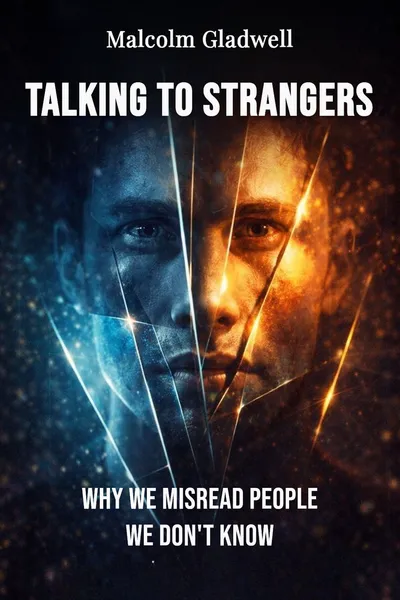
Talking to Strangers
Why we misread people we don't know
Description
On a July evening in 2015, a twenty-eight-year-old Black woman named Sandra Bland was pulled over in Prairie View, Texas, for failing to signal a lane change. The stop escalated within minutes. Three days later she was found dead in a jail cell. Malcolm Gladwell opens and closes his 2019 book Talking to Strangers with that traffic stop, and he uses it to ask a question that sounds almost too simple to carry a whole book: how did a routine encounter between two people who had never met turn so catastrophically wrong so fast?
His answer is not the one we reach for by reflex. We tend to explain disasters like this through malice or bias, and both are real. But Gladwell is after something underneath them: the everyday machinery we all use to size up people we don't know. That machinery, he argues, is quietly broken. We think we can tell when someone is lying, tell an honest face from a shifty one, read a stranger the way we read a friend. We can't. And the confidence gap between what we think we can do and what we actually can do is where the damage happens.
To make the case, Gladwell drags in a strange gallery of characters: intelligence officers duped for years, a judge outperformed by an algorithm, Neville Chamberlain misjudging Hitler face to face, Bernie Madoff's investors, a Stanford campus in the dark. Different worlds, one recurring mistake. The book is less a set of tips than an argument about why the tips don't work.
The question we’re asking : Why do we so reliably misjudge people we've never met, even when we're paying close attention?What we’ll see : How two quiet default settings in the human mind turn strangers into people we're sure we've read, and usually haven't.
Table of contents
01 Chapter 1 — A spy who fooled the people who caught spies
Gladwell starts inside the CIA, which is roughly the last place you'd expect people to be fooled about who's lying. For years in the 1980s and 1990s, Cuban intelligence ran a network of double agents inside American operations, and the Americans didn't notice. When they finally reviewed the tapes, the interrogators who'd handled these agents realized they'd been played the whole time. These were professionals whose entire job was reading strangers for deception, and they had defaulted to belief.
The pattern repeats across the book. Ana Montes, a senior Defense Intelligence Agency analyst, spied for Cuba for nearly two decades before she was caught in 2001, working in plain sight among colleagues trained in counterintelligence. And then there's Bernie Madoff, who ran the largest Ponzi scheme in history while sitting across the table from sophisticated financiers, regulators, and fund managers. A handful of skeptics smelled something wrong. Almost everyone else took him at his word.

02 Chapter 2 — The cost of assuming everyone is lying
If defaulting to truth costs us the occasional con artist, what would the opposite cost us? Gladwell answers with an experiment from the world of criminal justice. A team of economists, led by Sendhil Mullainathan, fed a machine-learning system data on more than half a million bail decisions from New York City. The algorithm looked only at the defendant's record and the charge, then predicted who was likely to reoffend if released. The judges, by contrast, saw the person: face, posture, demeanor, the whole human being.
The judges lost. The algorithm's list of the riskiest defendants committed crimes at a far lower rate when released than the people judges actually chose to detain. Seeing the stranger, in other words, made the judges worse. The face added noise, not signal. All that human information the judges were sure was helping them was quietly leading them astray.
03 Chapter 3 — Faces don't come with subtitles
The transparency error gets worse when a stranger is also from an unfamiliar world. Gladwell replays Neville Chamberlain's meetings with Hitler in 1938. Chamberlain flew to Germany three times, sat across from the man, studied his handshake and his expressions, and came away convinced Hitler was someone he could deal with. The people who read Hitler correctly, Churchill among them, mostly never met him. Chamberlain had the most face-to-face information and drew the worst conclusion. Proximity didn't help. It hurt.
Then Gladwell adds a second complication that supercharges the whole failure: alcohol. He revisits the sexual-assault case involving Brock Turner at Stanford in 2015, where both people were heavily intoxicated. Drawing on research into how alcohol works on the brain, he describes what psychologists call myopia. Drinking doesn't so much unleash a hidden true self as it narrows attention to the immediate and the present, stripping away the longer view and the ability to read subtle social cues.
04 Chapter 4 — The stranger stays a stranger
Step back and the whole book points at a single, uncomfortable conclusion: the problem isn't that we're bad at reading strangers. It's that we refuse to accept that we're bad at it. Gladwell isn't arguing for universal suspicion, which he's already shown to be both miserable and inaccurate. He's arguing for humility, for a lowered estimate of our own perceptiveness. The strangers we meet are genuinely opaque, and pretending otherwise is where the damage begins.
This reframes what we usually call misjudgment. When a jury believes a confident liar, when a manager hires the smooth talker, when a border officer waves through the calm smuggler and detains the nervous tourist, we're tempted to say someone was careless or biased. Gladwell says something more unsettling: they were using the same face-reading instinct everyone uses, an instinct that works well enough among people we know and fails silently among people we don't. The failure is baked into the tool.
05 Conclusion
Talking to Strangers doesn't hand us a technique for spotting liars, because Gladwell's whole point is that no such reliable technique exists. What he offers instead is a correction to our self-image. We are not the shrewd judges of character we imagine ourselves to be. Default to truth keeps society running and occasionally lets a con artist through; the belief that faces are transparent windows fails us most badly with the people furthest from our own world. Both settings are human, both are useful, and both mislead us in ways we rarely notice.
Related books