
Synchronicity
When coincidence means something
Description
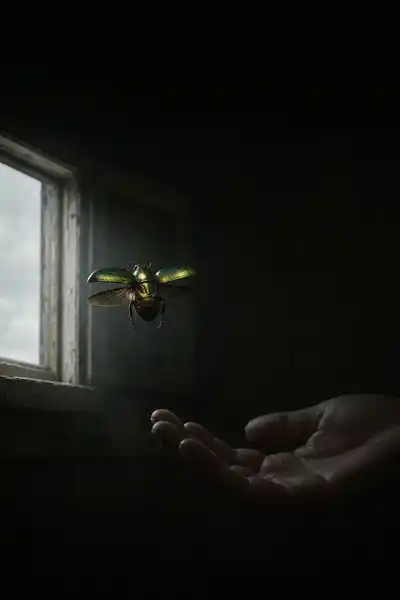
A woman sat in Carl Jung's consulting room in Zurich, describing a dream from the night before. In the dream, someone had given her a piece of golden jewelry shaped like a scarab beetle. She was a difficult patient, Jung wrote — brilliant, over-rational, sealed inside a Cartesian view of the world that no interpretation could crack. As she spoke, Jung heard a soft tapping at the window behind him. He turned, opened it, and caught the insect flying in: a rose-chafer, the closest thing the Swiss climate offers to a golden scarab. He handed it to her and said, roughly, here is your beetle. The moment, he claimed, broke her resistance in a way years of argument had not.
Jung had been collecting moments like this his whole life. Not tricks, not séances — the ordinary, unnerving coincidences where an inner state and an outer event line up so precisely that chance feels like a thin explanation. A dream, then the beetle. A thought of someone, then their letter. He discussed the puzzle with Einstein over dinner before the First World War, borrowed the vocabulary of physics from his friend the Nobel laureate Wolfgang Pauli, and turned it over for decades before he dared publish. When he finally did, in 1952, he gave it a name that has since drifted loose into everyday speech, usually meaning far less than he intended.
That word was synchronicity, and Jung meant something precise and strange by it — not luck, not fate, not the universe sending signals. He was trying to name a category that science had quietly agreed not to have: events connected by meaning rather than by cause. It is the least fashionable idea a psychiatrist could stake his reputation on, and Jung knew it. He built the case carefully, with data, an astrological experiment, and a physicist at his side.
The question we’re asking : What did Jung mean when he insisted that some coincidences genuinely mean something — and can such a claim be argued rather than merely felt?What we’ll see : How a lifelong fascination with the improbable hardened into a theory, an experiment, and a quiet challenge to the way we assume the world hangs together.
Table of contents
01Chapter 1 — The scarab at the window
The scarab story is the one everyone remembers, and Jung told it because it did the work his abstractions could not. His patient was cured of nothing by the beetle. What cracked was her certainty — the assumption that the world runs on billiard-ball causation and nothing else gets in. For a rationalist, the arrival of an impossible insect at the exact instant of the dream was not proof of anything supernatural. It was simply an event that her frame could not file, and the failure of the frame let something else move.
Jung was careful about what he was and was not claiming. He never said the beetle was summoned, or sent, or that the dream caused it to fly in. There was no mechanism running from her mind to the window. That is precisely the point: a cause would have made the whole thing ordinary. What made it a synchronicity was the pairing of a subjective state — the dream, freighted with the ancient Egyptian symbolism of the scarab as rebirth — with an objective event that carried the same meaning, at the same moment, with no causal thread between them.

02Chapter 2 — A word for what science left out
Modern science, Jung argued, had won its extraordinary power by making a single bet: that everything worth knowing is connected by cause and effect. Find the mechanism, run the experiment enough times, and the world yields its laws. It is a magnificent method and it left a whole class of events with nowhere to stand — the ones that happen once, that cannot be repeated, and that seem linked not by force but by significance. Causality, Jung noted, is itself a statistical truth. It describes what happens on average, across many trials. The unique event, the outlier, slips through the net by design.
Into that gap he placed synchronicity, which he defined as an acausal connecting principle. The phrase is deliberately clumsy. He wanted a way to say that two events could hang together meaningfully without one making the other happen — a horizontal link of sense running alongside the vertical chain of cause. He had first floated the word in a 1930 lecture, prompted not by the laboratory but by the I Ching, the ancient Chinese oracle he consulted for years. Its method assumes the pattern of a chance throw of coins mirrors the pattern of the moment you throw them. Meaning, not mechanism.
03Chapter 3 — Testing the horoscopes
Here Jung did something few of his admirers expected and few of his critics forgave: he tried to put the idea to a numerical test. If synchronicity were real, he reasoned, it should leave traces in old, meaning-laden traditions — and astrology offered a ready-made experiment. The claim that married couples show characteristic alignments between their horoscopes was, on the causal view, nonsense. But it was a testable nonsense. So Jung gathered birth data from hundreds of married pairs and looked at whether the classical astrological markers of marriage turned up more often than chance would predict.
The results were maddening and, to Jung, instructive. In the first batch of couples, one of the predicted conjunctions appeared at a rate that looked strikingly significant. He added a second batch, and a different marker lit up. A third, and yet another. Each subset seemed to confirm astrology — but each confirmed a different piece of it, and when the whole dataset was pooled, the effect drained away toward the statistical average. On any ordinary reading, the experiment had failed to prove astrology, and Jung freely conceded it.
04Chapter 4 — The world as one meaning
Strip away the beetle and the horoscopes, and what Jung is finally proposing is a claim about the nature of reality itself. Meaning, on his account, is not something the human mind alone paints onto a blank, indifferent universe. It is out there, woven into the weave, occasionally surfacing in coincidences too exact to dismiss. That is a far larger idea than a curious footnote about lucky timing. It says the split we take for granted — a mental world of significance in here, a physical world of dumb matter out there — may be a convenience of thought rather than a truth of things.
This is where synchronicity becomes genuinely disruptive rather than merely charming. Jung is not asking us to believe in fortune-tellers. He is asking whether meaning could be as fundamental to the cosmos as energy or mass — a third thing that causal science, having deliberately excluded it, is structurally unable to see. He borrowed a medieval phrase, the unus mundus, the one world, to name the underlying unity from which both psyche and matter might spring. Meaningful coincidence, in that picture, is simply the moment the seam shows and the two apparent worlds are caught being one.
05Conclusion
Jung published the essay in 1952, near the end of a long life spent at the edge of what psychology was allowed to say. He knew he was handing his critics a weapon, and he did it anyway, alongside Pauli, because a lifetime of scarabs and stopped clocks had convinced him the phenomenon was real even if his explanation of it was not yet ripe. The word he coined escaped the essay almost immediately and got flattened into a synonym for anything vaguely meaningful — which is exactly the loose thinking he built the whole careful apparatus to resist.