

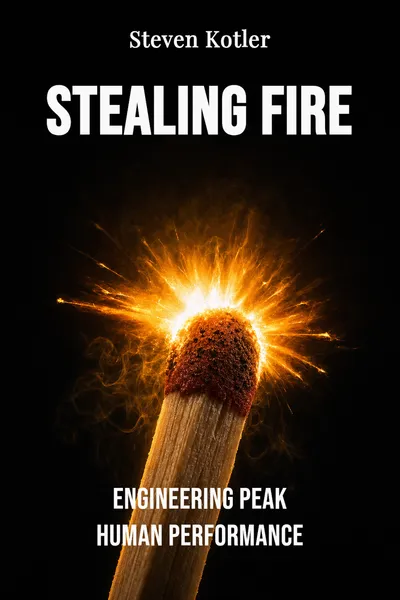
Stealing Fire
Engineering peak human performance
Description
In the mid-2000s, a group of Navy SEALs at a training facility outside San Diego were doing something that looked, from the outside, a lot like meditation with combat gear on. Steven Kotler and Jamie Wheal, the two writers behind Stealing Fire, kept running into these people — SEALs, but also Google executives, extreme skiers, festival organizers, neuroscientists at Stanford. Different worlds, no obvious overlap. And yet they kept describing the same thing: a state where the sense of self quiets down, time stretches or vanishes, effort feels effortless, and performance jumps to a level the person can't reach on an ordinary Tuesday.
That state has had a lot of names. Athletes call it the zone. Psychologists, following Mihaly Csikszentmihalyi, call it flow. Mystics have called it grace, satori, communion with something larger. For most of history it arrived unbidden — a gift, an accident, the reward of decades of practice or the side effect of near-death. What Kotler and Wheal noticed was that a scattered set of communities had stopped waiting for the gift. They were reverse-engineering it. Building it on purpose, on schedule, and increasingly at scale.
Stealing Fire is the report from that borderland. Its authors argue that we are living through a quiet revolution in how humans access non-ordinary consciousness — one that pulls the experience out of temples and away from chance, and puts it in the hands of anyone with the right knowledge. Which is exactly where the trouble, and the promise, both begin.
The question we’re asking : How did altered states move from mystical accident to something people now engineer on demand — and what does it cost us to control them?What we’ll see : We follow the writers into the odd communities chasing the same feeling, unpack what the brain is actually doing there, and reckon with what happens when transcendence becomes a technology anyone can buy.
Table of contents
01Chapter 1 — The Navy SEALs who chased the same feeling
The book opens with a puzzle the authors couldn't shake. In a converted facility near San Diego, elite soldiers were using electrodes, sensory-deprivation pools and carefully staged training to reliably drop into a heightened state — one where fear thinned out and a team could act almost as a single organism. Around the same time, Kotler and Wheal were meeting Silicon Valley founders who paid serious money for the same thing, action-sports athletes who risked their lives partly to feel it, and burners in the Nevada desert who built a whole temporary city around it. None of these groups talked to each other. All of them wanted the identical experience.
Csikszentmihalyi had spent decades documenting this state under the name flow: total absorption in a task, the merging of action and awareness, a sense of control paired with the disappearance of self-consciousness. His subjects were surgeons, rock climbers, chess players, factory workers who loved their jobs. The common thread wasn't the activity. It was a particular texture of consciousness that people described in almost interchangeable words, whether they'd found it painting or free-soloing a cliff.

02Chapter 2 — Four doors into one room
If ecstasis is a single room, Kotler and Wheal argue there are four doors into it — and describing the doors is more useful than arguing about which is holy. They call these the four forces: psychology, neurobiology, pharmacology and technology. Each is a different lever on the same machinery, and the recent leap is that we finally understand the machinery well enough to pull the levers deliberately rather than hoping they trip on their own.
The neurobiology is where the book does its most careful work. In these states, the authors describe a pattern they compress into the acronym STER: selflessness, timelessness, effortlessness, richness. Selflessness comes from transient hypofrontality — parts of the prefrontal cortex, the region that runs the inner narrator and the sense of a bounded self, quiet down. When the self-monitoring circuitry goes offline, the nagging voice of doubt and the felt boundary between you and the task both soften. Timelessness follows, because our sense of time is partly built by that same busy prefrontal machinery. Take it offline and the clock loosens.
03Chapter 3 — The billion-dollar business of leaving yourself
Understanding the mechanism was step one. The far stranger development the book tracks is what happened next: an entire economy grew up around selling access to it. Kotler and Wheal put a number on the appetite — they estimate that Americans spend roughly four trillion dollars a year on ways to change consciousness, once you tally everything from lattes and alcohol to meditation retreats, gaming, extreme sports and pharmaceuticals. Whatever the exact figure, the scale of the demand is not in question. We are, collectively, willing to pay enormous sums to briefly stop being ourselves.
The supply side has professionalized fast. Google ran an internal mindfulness program, Search Inside Yourself, that became a small institution. The military built and refined its flow-training protocols. Silicon Valley's fascination with microdosing psychedelics moved from whispered rumor to conference-panel topic. Festivals like Burning Man engineered mass communal states as their central product rather than a happy side effect. What links these is intent: none of them are waiting for lightning. They are building lightning rods and charging admission.
04Chapter 4 — Borrowing fire without getting burned
The title is the tell. Prometheus stole fire from the gods and gave it to humanity — and the myth never lets you forget the cost, either to him or to the mortals who now had to handle something dangerous. Kotler and Wheal chose that frame deliberately. What their book describes is a genuine theft: the tools of transcendence pried loose from the institutions that guarded them and handed to anyone. Fire cooks food and burns down houses. The ecstatic state is exactly that ambivalent.
The perils they lay out are specific, not vague hand-wringing. The states are intensely rewarding, and intense reward is the raw material of addiction — chasing ecstasis can become its own trap, the seeking mistaken for the finding. The selflessness that makes a state feel liberating also lowers the guard against manipulation; a crowd dissolved into oneness is exhilarating and it is also how demagogues and cults have always worked. And the same technologies that quiet the inner critic to unlock creativity could just as easily be used to quiet judgment, resistance or dissent. A door that opens both ways opens both ways.
05Conclusion
We started with soldiers doing something that looked like combat meditation and turned out to be a laboratory. That image holds the whole argument. What the SEALs, the founders and the festivalgoers were all reaching for was once considered a gift from beyond the self, arriving on its own terms if it arrived at all. Kotler and Wheal's report is that it no longer works that way. The gift has been reverse-engineered into a set of levers — psychological, neurological, chemical, technological — that anyone can learn to pull.