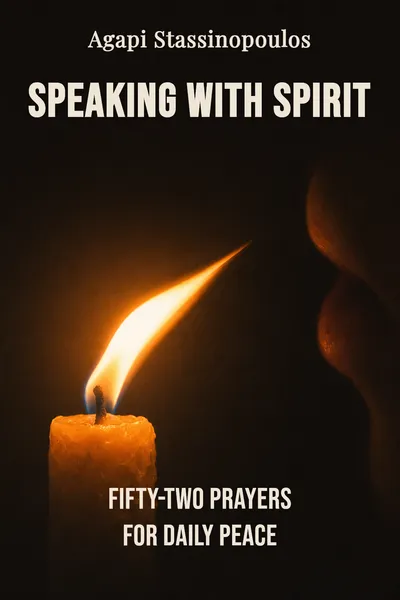
Speaking with Spirit
Fifty-two prayers for daily peace
Description
Agapi Stassinopoulos has spent a good part of her adult life in front of rooms — leading meditations, running workshops, coaxing overworked people into sitting still for ten minutes. She is the sister of Arianna Huffington, and for years her work has orbited the same territory: how to steady a mind that has too many tabs open. "Speaking with Spirit," published in 2021, distills that work into something smaller and stranger than a self-help manual. It is a book of prayers. Fifty-two of them, one for each week of the year, written to be read aloud, sat with, or returned to whenever the ground feels unsteady.
The word "prayer" tends to arrive with baggage. It suggests a religion, a building, a doctrine you either signed up for or didn't. Stassinopoulos, who grew up in Greece in the Orthodox tradition, deliberately loosens the term. Her prayers name gratitude, courage, grief, forgiveness, the fear of change — the ordinary weather of a life — and address them to whatever the reader is comfortable calling the divine. Spirit, source, the universe, God, the quiet part of yourself that already knows. The book does not ask us to believe anything in particular. It asks us to speak.
That's the quiet provocation of the thing. In a culture that has largely outsourced its inner life to apps and productivity hacks, here is a book suggesting that saying words on purpose — slowly, sincerely, week after week — might do something a checklist can't. Whether that lands as comfort or as wishful thinking depends a lot on how we read it.
The question we’re asking : What does a book of fifty-two prayers offer someone who isn't sure they believe in prayer?What we’ll see : A collection built for daily return, and what the simple act of speaking intention aloud is really meant to do.
Table of contents
01 Chapter 1 — A prayer for every week of the year
The structure of the book is its first argument. Fifty-two prayers, one per week, is not an accident of length — it maps onto a calendar, and it assumes we'll keep coming back. Stassinopoulos isn't handing over a text to read once and shelve. She's proposing a rhythm. A prayer a week is slow enough to sit with and frequent enough to become a habit, the way a Sunday walk or a Monday reset becomes something the body starts to expect.
The prayers move across the terrain of a life rather than through a doctrine. There are prayers for gratitude and prayers for grief, for beginning something and for letting something go, for the days when courage is required and the days when the only honest request is for rest. Some address fear directly — the fear of not being enough, of change, of loss. Others simply give thanks, which Stassinopoulos treats as its own kind of medicine. The range is deliberate: whatever week we open the book, something in it is meant to meet us where we are.

02 Chapter 2 — The forms a prayer can take
The prayers themselves are short. Most run a page or less, written in plain, direct language that avoids both archaic solemnity and modern jargon. There is no "thee" and "thou," and equally no talk of manifesting or vibrations. Stassinopoulos writes the way she speaks in her workshops — clearly, with a rhythm meant to be heard, so that reading one aloud feels less like reciting scripture than like saying something you mean to a friend who happens to be listening.
Structurally, many of them follow a gentle arc: they name a feeling, sit with it honestly, and then turn toward something steadier. A prayer about anxiety doesn't pretend the anxiety away; it acknowledges the racing mind, then asks for the capacity to breathe through it. A prayer about grief doesn't rush past the loss; it makes room for it before asking for the strength to carry on. This movement — from acknowledgment to release — is the quiet engine of the book. It mirrors what actually happens in a good meditation, which is no coincidence given Stassinopoulos's background.
03 Chapter 3 — What the words are actually for
The obvious skeptical question is whether any of this does anything. If you don't believe a prayer is heard, what's the point of saying it? Stassinopoulos's answer, implicit throughout the book, is that the words work on the speaker regardless of who or what is listening. The prayer is not primarily a transaction with the divine. It's a way of arranging our own attention — of pausing, naming what we feel, and choosing where to point ourselves next.
This is where her meditation lineage shows. A prayer, in her hands, functions a lot like a guided practice: it interrupts the automatic churn of thought, slows the breath, and replaces a spiral of worry with a single, deliberate line of language. Saying "may I meet this day with courage" is not magic. But it is a small act of framing, and framing shapes experience. The person who begins the morning by naming courage is, at minimum, a person who has spent thirty seconds thinking about courage rather than dread.
04 Chapter 4 — Speaking as a practice, not a belief
Step back from the fifty-two prayers and a broader idea comes into view: the human impulse to say things on purpose, out loud, at the edges of what we can control. Long before Stassinopoulos, people spoke to the harvest, the sea, the dead, the unknown — not always because they expected an answer, but because articulation is how we metabolize the ungovernable. A book of daily prayers is a modern instance of a very old behavior. It gives ritual language to the parts of life that refuse to be managed.
What's notable about Stassinopoulos's version is how thoroughly she detaches the practice from the doctrine. She keeps the ritual and loosens the belief. In doing so she lands on something the secular wellness world has been circling for years — that structure and repetition steady the mind, that a daily anchor matters more than what the anchor is named. Her prayers are, functionally, a spiritual routine offered to people who may have no religion but still feel the absence of one.
05 Conclusion
Fifty-two prayers, one for each week, written to be read aloud by anyone willing to slow down long enough to mean them. That's the whole of what Stassinopoulos is offering, and the modesty is the point. She isn't asking us to convert, or to believe her prayers travel anywhere in particular. She's asking us to speak — to name what we feel, thank what we have, and face what we fear, in language deliberate enough to leave a mark on the day.
Related books