
Space Is Open For Business
Private enterprise reaches orbit
Description
For most of the twentieth century, going to space meant one thing: a government did it. The rockets belonged to NASA or the Soviet program, the budgets came from national treasuries, and the whole endeavor carried the weight of the Cold War and the flag. A private company reaching orbit sounded roughly as plausible as a private company minting its own currency. Space was a place states went, at enormous cost, to prove something to other states. It was not a place you started a business.
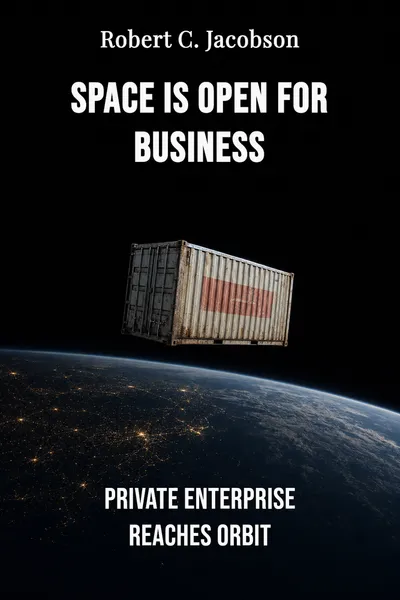
That assumption has quietly come apart. In his book Space Is Open For Business, Robert C. Jacobson maps an arena that governments no longer control alone — one where private launch providers ferry cargo to orbit, where satellite startups raise venture rounds, where investors who once wrote checks to software companies are now underwriting rockets and lunar landers. Jacobson didn't write this as a policy paper or an engineering manual. He built it out of conversations with the founders, financiers, and operators actually doing the work, trying to make the business of space legible to people who've never thought of it as a business at all.
What he found is a sector caught between two identities: the old world of national prestige and multi-decade programs, and a newer world that talks in term sheets, addressable markets, and unit economics. Somewhere in that overlap, an industry is being born — messy, underpriced, and far larger in its ambitions than its current revenues would suggest.
The question we’re asking : How does private enterprise turn an arena built by governments into a place where ordinary businesses can be started, funded, and scaled?What we’ll see : How the state monopoly loosened, where private money is flowing, what remains unpriced, and what it means for a market still learning to describe itself.
Table of contents
01Chapter 1 — The government monopoly cracks
Jacobson's starting point is that the shift wasn't sudden. It was decades of accumulated cost pressure finally finding a release valve. The state model of spaceflight was extraordinary at proving national capability and terrible at controlling expense. Every mission was bespoke, every rocket largely thrown away, and every dollar answerable to political cycles rather than to customers. When budgets tightened after the Cold War, the old logic — spend whatever it takes, the prestige is worth it — lost its footing.
The opening came when governments, chiefly the United States, decided they no longer needed to own the whole stack. Instead of building and operating every vehicle, agencies began buying services from private firms — paying a company to deliver cargo to orbit rather than commissioning a rocket the government would own outright. Jacobson treats this procurement shift as the quiet hinge of the entire story. It turned the state from the sole builder into an anchor customer, and an anchor customer is something a business can actually plan around.

02Chapter 2 — Where the money actually goes
Ask most people to picture the space business and they picture a rocket. Jacobson spends a good deal of the book explaining why that instinct is misleading. Launch is the visible, dramatic part, but it's only the doorway. The larger and more varied opportunity sits in what the launches are for — the satellites, the data, the services, and the infrastructure that live in orbit once the rocket has done its job and gone home.
Satellites turn out to be the commercial heart of the near-term sector. Earth-observation companies sell imagery and analytics to agriculture, insurance, shipping, and finance. Communications constellations aim to sell connectivity to places terrestrial networks never reached. These are recognizable businesses with recognizable customers, and Jacobson keeps returning to them because they anchor the more speculative dreams in something that already generates revenue. Space, in this framing, is less a destination than a platform other industries quietly rely on.
03Chapter 3 — The frontier nobody has priced yet
The hardest part of the space business, Jacobson argues, is that so much of its value lives in the future tense. A satellite company can point to contracts and cash flow. A firm proposing to mine water from asteroids or manufacture fiber optics in microgravity is selling a possibility, and possibilities are notoriously difficult to put a number on. Much of the sector's ambition sits precisely in this unpriced zone, where the potential is enormous and the evidence is thin.
This creates a peculiar investment problem. The timelines are long — often longer than a typical venture fund's patience — and the capital requirements are heavy before any revenue appears. A software startup can iterate cheaply and fail fast. A launch company or an orbital habitat cannot; the hardware is expensive, the failures are public and sometimes literally explosive, and the feedback loops are slow. Jacobson doesn't downplay this. He treats the risk as the defining feature of the arena rather than an inconvenient footnote.
04Chapter 4 — A market learning to see itself
Step back from any single rocket or satellite, and Jacobson's larger argument comes into focus: commercial space is not yet a mature industry so much as an emerging market still assembling its own vocabulary. It borrows terms from venture capital, from aerospace, from the old government programs, and none of them fit perfectly. Nobody has fully settled how to value a launch company, how to underwrite a lunar venture, or how to compare firms whose products won't exist for years. The sector, in his framing, is in the middle of learning to describe itself.
That self-description matters more than it sounds. Markets don't just need customers and capital; they need shared language, agreed metrics, and a story coherent enough that a banker, a regulator, and a founder can all use it. Jacobson's book is partly an attempt to supply exactly that — an accessible map that lets outsiders see space as an ordinary place to build a business rather than an exotic domain reserved for engineers and astronauts. Making the arena legible is itself a form of infrastructure.
05Conclusion
The sentence that gives the book its title is, in the end, an argument rather than an observation. Space is open for business not because the technical problems are solved or the profits are proven, but because the structure has changed: the state gave up its monopoly on access, costs began falling, and a generation of founders and investors decided that orbit was somewhere you could build a company rather than merely plant a flag. Jacobson's map is a snapshot of that transition in motion, still incomplete and still contested.