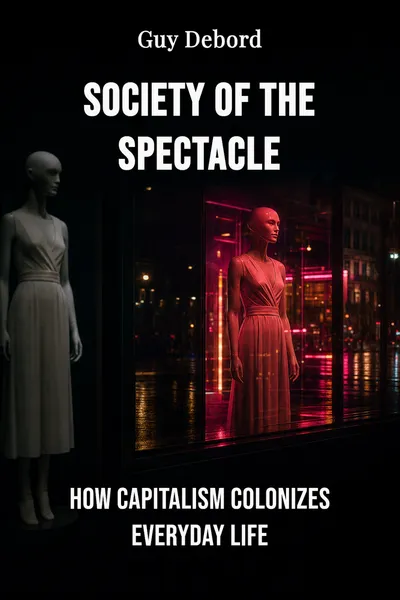
Society of the Spectacle
How capitalism colonizes everyday life
Description
In November 1967, a small Paris publisher named Buchet-Chastel put out a slim book of 221 numbered paragraphs, written in a prose so dense it read like scripture. The author, Guy Debord, was thirty-five, a filmmaker and agitator who had spent the decade running the Situationist International, a tiny federation of artists and theorists who wanted to abolish art and reinvent daily life in the same gesture. The book was called La Société du spectacle. It sold modestly at first. Then, six months later, students and workers shut down France in the events of May 1968, and Debord's paragraphs turned up scrawled on walls across the Latin Quarter.
The book was built to be quoted and to resist paraphrase at the same time. Debord borrowed the cadence of Marx and the reversals of Hegel, then bent them toward a single claim: that the accumulation of capital had reached a stage where it no longer just produced goods, it produced a whole way of seeing. "All that was once directly lived," the opening thesis runs, "has become mere representation." Life had drifted into images of life. And those images, Debord insisted, were not a distraction from the economy — they were the economy, wearing a face.
Nearly six decades on, the diagnosis has proven strangely durable. Debord was writing before the internet, before streaming, before the phone that lives in a pocket. Yet the vocabulary he coined keeps getting borrowed to describe a world he never saw. What he actually meant by the word — and why he chose it over easier ones — is where the argument starts to bite.
The question we’re asking : What did Debord mean when he said modern life had become a spectacle, and why did he treat it as the logic of capitalism itself rather than a comment on television?What we’ll see : How a book written on the eve of May 1968 recast images, commodities and everyday experience as a single system — and why its charge has outlasted the world that produced it.
Table of contents
01 Chapter 1 — Paris, 1967, and a book that read like a verdict
Debord did not arrive at the spectacle from the library. He came to it from the street. Through the 1950s he had run with the Lettrists, then founded the Situationist International in 1957, a group whose members drifted through cities on foot mapping their emotional geography, hijacked advertising slogans, and dreamed of turning ordinary existence into something worth living. The theory grew out of that practice. By the time he sat down to write, Debord had spent a decade convinced that modern capitalism had not failed to deliver on its promises — it had delivered them in a form that hollowed them out.
The book's method is deliberately Marxist, and Debord wanted the resemblance noticed. Marx had opened Capital by saying that in societies dominated by capitalist production, wealth presents itself as an "immense accumulation of commodities." Debord opens by rewriting that line: in modern conditions, life presents itself as an "immense accumulation of spectacles." The move is not decoration. He is claiming that his own century has passed through a threshold Marx only glimpsed — the point where the commodity has finished colonizing social life so completely that it now colonizes perception.

02 Chapter 2 — The image that swallowed the thing
The most common misreading of Debord is to hear the word spectacle and picture television — the passive viewer slumped in front of a screen. He anticipated the mistake and blocked it early. "The spectacle," he writes in the fourth thesis, "is not a collection of images; rather, it is a social relationship between people that is mediated by images." The screen is a symptom. The disease is a whole way of relating — to work, to others, to oneself — that now passes through representation before it reaches anything real.
To grasp the claim, follow the commodity. In Marx's account, the worker makes a thing and the thing is sold, but the social labor that went into it disappears behind a price tag; the object seems to have a value of its own, detached from the human relations that produced it. Debord argues that this abstraction has now spread from the object to experience itself. It is no longer only goods that arrive pre-packaged and detached from us. Leisure, holidays, love, rebellion, even authenticity are offered back to us as products, as images of a life we might purchase rather than a life we might live.
03 Chapter 3 — Living inside the shop window
Debord's sharpest move is to insist that the spectacle is not opposed to daily life but has become its content. This is where the phrase in the headline earns its keep. Capitalism, in his reading, no longer merely occupies the factory and the office; it has colonized the evening, the weekend, the intimate hours that were once supposed to be a refuge from it. The time freed by higher productivity did not become free time. It became consumption time — a second shift spent absorbing the images the economy produces about how one ought to relax, dress, travel and desire.
He draws a distinction that runs through the whole book, between the "concentrated" spectacle of dictatorships, organized around a single leader and a state, and the "diffuse" spectacle of consumer capitalism, organized around an endless parade of competing commodities each promising a better self. The diffuse version is subtler and, Debord thought, more total, because it never announces itself as coercion. It arrives as choice. It hands us a thousand things to want and calls the wanting freedom, so that the person most thoroughly governed by it feels most convinced of their own autonomy.
04 Chapter 4 — When the map becomes the territory
Step back from the individual theses and the book's larger wager comes into view. Debord is not making a point about media, or advertising, or the vulgarity of consumer culture — complaints that were already old in 1967 and easy to fold into ordinary moralism. He is making a claim about the structure of an entire society. The spectacle, for him, is not one region of modern life but its unifying principle, the form that ties together the economy, the state, culture and private experience into a single order that reproduces itself. To describe it as television, or as any particular technology, is to miss that it is a stage capitalism reaches, not a gadget it invents.
That is what gives the book its unsettling reach. Debord thought the spectacle would deepen, and in 1988 he returned with Comments on the Society of the Spectacle to argue that the concentrated and diffuse forms had merged into what he called the "integrated" spectacle, spreading into every corner of politics and everyday perception. He died in 1994, before the web, before the feed, before the platforms that turned every user into a broadcaster of their own curated life. Readers keep reaching for his vocabulary because his analysis was structural rather than technological; he described a logic, and the logic kept finding new machinery to run on.
05 Conclusion
The paragraphs that ended up on Paris walls in 1968 were never meant to be slogans. Debord built his book to resist the very fluency that makes a phrase quotable, and he spent the decades after publication guarding it against the fate he had diagnosed — the critique absorbed, softened, sold back as style. He was not wholly successful. "Society of the spectacle" is now itself a kind of brand, invoked by people who have never read past the fourth thesis. That is not a failure of the argument. It is the argument, playing out.
Related books