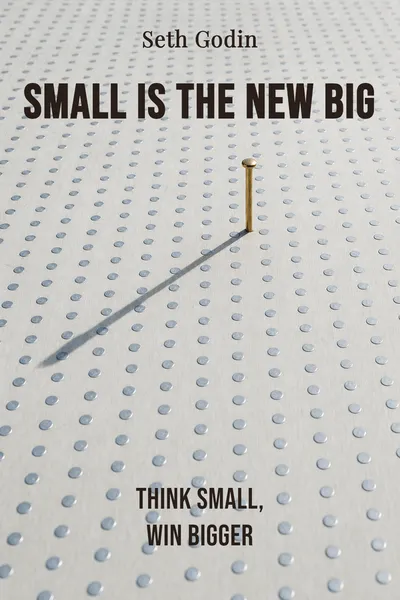
Small Is the New Big
Think small, win bigger
Description
Seth Godin published "Small Is the New Big" in 2006, and it barely looks like a book. It's a stack of a few hundred short pieces — some a single page, some a single paragraph — pulled largely from the blog he'd been keeping since the early 2000s, arranged alphabetically rather than in chapters. There's no arc, no five-step framework, no case study that runs for thirty pages. You can open it anywhere, read three riffs, put it down, and pick it up a week later at a different letter. For a business author who had already sold millions with "Permission Marketing" and "Purple Cow," it was a strange thing to release: a book that refuses to behave like one.
That refusal is the argument. Godin spent the first half of his career watching a machine — the industrial, mass-market, get-big-or-go-home machine that ran the twentieth century — and by the mid-2000s he'd decided the machine was breaking. Factories, TV networks, national retail chains, the whole apparatus built to make identical things for identical people and shout at them until they bought. Cheap tools and open networks were quietly handing the advantage to anyone willing to be specific, weird, and fast. The company with the biggest factory was suddenly the company with the most to lose.
So the book's form matches its claim. A collection of small, sharp things aimed at people who no longer need permission or scale to make a dent. Godin isn't writing for the boardroom; he's writing for the person wondering whether their odd little idea is too small to matter. His answer, repeated in a hundred variations, is that small has stopped being a consolation prize.
The question we’re asking : Why did the thing everyone spent a century trying to become — big — start working against them?What we’ll see : How a blog-turned-book reframes size, risk, and the kind of work that actually gets noticed now.
Table of contents
01 Chapter 1 — The century that told everyone to get bigger
Godin's starting point is a story most of us absorbed without noticing we'd learned it. For roughly a hundred years, the smart move in business was to scale. Build the bigger factory, negotiate the cheaper supplier, buy the national ad campaign, open the thousandth store. Size lowered your costs, and lower costs won. The whole logic of the industrial age rewarded the company that could make the most identical units and push them through the widest distribution. Small was where you started; big was where you were supposed to end up.
That system had a specific shape, and Godin is precise about it. It ran on interchangeable parts and interchangeable people, on average products for average customers, on the assumption that a handful of gatekeepers — the TV network, the department-store buyer, the newspaper — controlled who got heard. If you wanted to reach a lot of people, you paid the gatekeeper and you smoothed your product down until it offended no one. Blandness was rational. Being remarkable was a risk you couldn't afford at scale.

02 Chapter 2 — Riffs instead of a system
Most business books sell you a system. They name a concept, defend it across chapters, back it with research, and hand you a framework you can apply on Monday. "Small Is the New Big" does almost none of this, and the choice is deliberate. Godin gives you riffs — hundreds of short provocations, each turning one idea over once and moving on. One page might argue that the person who answers the phone is your entire brand. The next might insist that free samples are the most underrated tool a small operator has. There's no connective tissue forcing them into a grand theory.
The effect is closer to a friend firing off observations than to a professor building a case. And that's not a stylistic accident; it's the whole thesis performed on the page. A system is an industrial object — standardized, scalable, designed to be applied identically everywhere. A riff is the opposite. It assumes you're smart enough to take the useful ones and ignore the rest, to adapt them to your particular, non-average situation. The book trusts the reader the way Godin wants businesses to trust their customers.
03 Chapter 3 — The purple cow beats the market plan
The single idea threaded through the whole collection is one Godin had already named in an earlier book: the purple cow. Drive past a field of brown cows and you see nothing; you've seen a thousand. A purple cow, you'd stop the car. Remarkable, in his sense, means literally worth making a remark about — worth someone telling a friend. And in a world where the gatekeepers are gone and everyone can talk to everyone, being worth talking about isn't a nice-to-have. It's the only distribution strategy left that a small operation can actually afford.
The alternative — being safe, being average, being fine — used to be the responsible choice. Godin's argument is that safe is now the risky option. If your product is unremarkable, no one carries the word for you, and you're left buying attention you can't afford against giants who can. The examples he reaches for are small on purpose: the bakery that does one thing gloriously, the consultant known for a single strange strength, the tiny brand that becomes a cult. None of them win by being cheaper or bigger. They win by being impossible to confuse with anyone else.
04 Chapter 4 — When small stops being a size
Step back from the anecdotes and the book is arguing something more slippery than "small companies are good." Godin isn't really talking about headcount or revenue. He's talking about a posture toward risk and attention — and that posture can live inside a huge organization or die inside a two-person shop. "Small" in his usage means the freedom to be specific, to move before you're certain, to care about one thing more than about covering all your bases. A giant that keeps that reflex is small in the sense he cares about. A tiny operation that plays it safe is just a big company that never grew.
This matters because the industrial logic Godin diagnosed hasn't gone away — it's gone quiet, and hidden inside the tools we use to measure work. We still reward the average and the safe, just with new vocabulary. Reach, scale, growth, followers, the assumption that more is self-evidently better. A creator asks how to get bigger before asking whether the work is worth remarking on. The old machine that made identical products for identical people didn't disappear; it migrated into the default way we still judge whether something is succeeding.
05 Conclusion
A book with no chapters, assembled from a blog, arranged by alphabet, aimed at people who don't need permission to matter — the object and the argument turn out to be the same thing. Godin took the case for being small, specific, and remarkable and built a book that behaves that way, right down to refusing the standard business-book machinery of frameworks and case studies. You can disagree with any single riff and still finish it having caught the reflex he was trying to hand over.
Related books