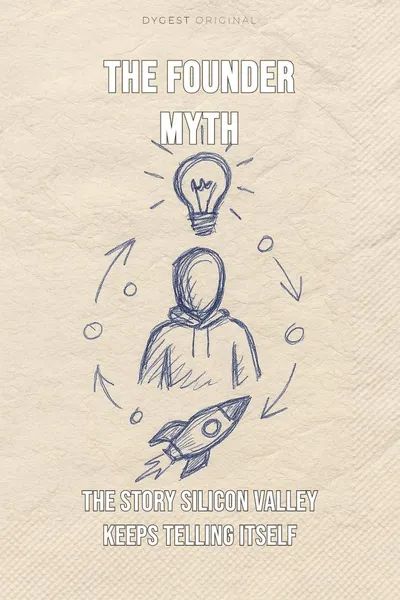
The founder myth
The story Silicon Valley keeps telling itself
Description
A young person, usually male, drops out of an elite university to chase a vision the established industry has missed. He works in a garage, a dorm, or an Airbnb. He is told the idea is stupid, the market too small, the timing wrong. He persists through near-death in which the company runs out of money and everyone says to stop. Then one pivot, one late investor, one product tweak changes everything. Five years later he is on magazine covers, the company is worth billions, and he is asked how he knew. The answer always involves grit, vision, and a willingness to ignore conventional wisdom. The founder myth, in its compressed form, is the story above.
The myth has a factual basis in the cases it is built on. Zuckerberg really did start Facebook from a Harvard dorm. Gates really did drop out to write MS-DOS. Jobs really did build the first Apple in a garage with Wozniak. Bezos really did leave a Wall Street job to sell books from Seattle. The broad contours are correct, and those founders did exhibit unusual capacity for sustained focus and nonconformist thinking. The problem is not what the myth says about the specific founders it celebrates. The problem is what the myth does when it becomes the default explanation of how startups succeed, which is almost all of the time.
The founder myth, promoted through books, podcasts, conferences, and the internal self-understanding of venture capital, has become the dominant narrative of twenty-first-century entrepreneurship. It shapes how aspiring founders think about themselves, how investors evaluate opportunities, how the culture valorizes certain career paths, and how catastrophic failures get reframed as stepping stones. The narrative is not wrong in the cases it describes. It is misleading in the much larger set of cases it is applied to. Understanding what the myth gets right, what it leaves out, and what it costs is a prerequisite for thinking clearly about startup success and failure.
● The question we're asking: what does the founder myth actually claim, and what does reality look like underneath the narrative?
● What we'll see: the origin stories behind the myth, its operational effects on the industry, the survivor bias it rests on, and what an honest account of founding looks like.
Table of contents
01The origin stories
The founder myth coalesced during the 1990s and 2000s around Silicon Valley origin stories, packaged and repackaged by business media and biographies. The 2011 Walter Isaacson biography of Jobs was a hinge text. The 2010 Social Network film about Zuckerberg added a cinematic template. Subsequent founder memoirs — Horowitz on management, Hoffman on scaling, Thiel on contrarian thinking — solidified a canon every aspiring founder was expected to read. The canon was American, male, technical, and drawn from a twenty-year window coinciding with the internet's emergence as a mass platform.
The canon stories share features that drift from reality. The founder is presented as having had an unusually clear vision from an early stage. Co-founders get less credit than the single named founder. Teams who did most of the work become supporting players. Prior failures, if mentioned, are framed as learning experiences rather than evidence the founder was previously wrong. Luck is minimized relative to skill. The pattern distills a messy multi-year collaborative process into a narrative foregrounding individual agency. The distilling is not dishonest exactly, but it is systematic.

02The operational effects
The myth has operational consequences. VC has institutionalized it into investment decisions. VCs describe themselves as looking for exceptional founders rather than exceptional ideas or markets. The framing privileges specific pattern-matches — former tech workers, Stanford or MIT graduates, people who look and sound like the canon. This produces under-investment in founders who do not fit the pattern. Female-founded startups receive roughly two percent of VC funding. Black-founded startups receive roughly one percent. These disparities are substantially explained by the pattern-matching the myth enables.
The myth shapes how founders understand their own trajectories. The emphasis on vision creates pressure to present oneself as a lone genius, because that is what investors respond to. The emphasis on persistence-through-adversity creates pressure to hide adversity while it is happening. The emphasis on the single pivot creates pressure to retroactively narrate messy iteration as deliberate strategy. The net effect is distortions in how the industry talks about itself, which feeds back into how founders decide and how investors evaluate them.
03The survivor bias underneath
The most important critique is that the evidence base is biased by survivor selection. Founder stories draw almost exclusively from founders who succeeded. The practices described are presented as causes. But since we have no data on founders who followed the same practices and failed, we cannot tell whether the practices were causal or merely correlated with other factors. The problem is identical to the Built to Last and Good to Great problem — confident claims about success the evidence cannot support.
The specific problem is that founder-myth narratives attribute success to the founder's individual characteristics — grit, vision, judgment — when the same characteristics are exhibited by enormous numbers of unsuccessful founders. Elizabeth Holmes of Theranos had vision, grit, and charisma in abundance. The same framing that made Jobs look like a prophet made Holmes look like the next Jobs, right up until the fraud became undeniable. The myth gave her credibility that her business plan could not have earned. Her failure was not an aberration from the framework — it was a predictable consequence of valorizing the characteristics the framework celebrates.
04What an honest account looks like
An honest account treats the founder as one necessary but not sufficient input. The founder has to do certain things right — assemble a functional team, raise capital, build a product some customers want, iterate on feedback. These are non-trivial. Most founders who fail fail on these operational tasks, not grand strategic questions. But operational competence is not sufficient to produce the outlier successes. Those require competence plus external conditions — market timing, technology availability, competitive positioning — that the founder has limited ability to control.
An honest account takes seriously the role of networks and privilege. Founders from elite universities have dramatically higher success rates, not because of the education but because of the networks it provides. Founders from wealthy backgrounds have higher success rates because they can survive lean years. Founders from networks that include previous successful founders inherit operational knowledge and warm investor introductions. These are not failings of the individual founders — they are features of how the industry works. The honest account names them.
05Conclusion
The founder myth matters because it continues to shape how the tech industry thinks about itself, how investors allocate capital, how aspiring founders spend their twenties, and how the culture valorizes certain work. The gap between myth and reality has real consequences for who gets funded, who feels they can become a founder, and what businesses get attempted. An industry that understood its evidence base more honestly would make different decisions. The myth, by foregrounding individual agency at the expense of structural conditions, has biased the industry's decisions in ways visible in its outputs.
Related books