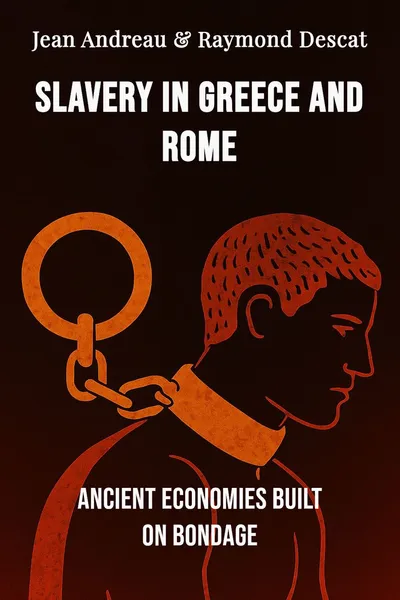
Slavery in Greece and Rome
Ancient economies built on bondage
Description
In the Athens of the fifth century BC, a well-off household might count two or three enslaved people, and a silver mine at Laurion might work hundreds of them underground in conditions nobody expected them to survive. On the same streets, a banker who had himself been born into slavery could lend money to free citizens and die one of the richest men in the city. The institution that produced both of these lives went by a single Greek word, doulos, and a single Latin one, servus — and the flatness of those words hides almost everything worth knowing. Ancient slavery was not one thing. It was a whole spectrum of unfreedom, running from the mine shaft to the counting house, and the people caught in it did almost every job the economy required.
Jean Andreau and Raymond Descat, two historians of the ancient economy, set out to describe that spectrum without the two reflexes that usually distort it: the old habit of treating slavery as a quaint feature of noble civilizations, and the newer habit of flattening every form of bondage into a single horror borrowed from the Atlantic plantations. Greece and Rome were genuinely slave societies — not societies that happened to own slaves, but societies whose wealth, leisure and self-image rested on owning them. Yet the Greek version and the Roman version differed, and both changed across the centuries.
What they offer is less a moral verdict than an accounting. How many enslaved people were there, really, and where did they come from? What did they cost, what did they produce, and what did a master expect to get back? Beneath the philosophy and the marble, the question is stubbornly economic: what exactly did bondage make possible?
The question we’re asking : What did slavery actually do inside the economies of Greece and Rome — and what did those economies become because of it?What we’ll see : We follow enslaved people from the capture that made them property to the markets, mines and workshops that priced their labor, and finally to what their bondage quietly built.
Table of contents
01Chapter 1 — The word that covered a hundred conditions
Start with the vocabulary, because the vocabulary lies by being too simple. A single Latin word, servus, applied to a child born in the house, a prisoner taken in war, a skilled accountant running a master's affairs, and a chained laborer dying in a Spanish silver mine. Andreau and Descat insist that we read these as different conditions sharing a legal status, not as a single experience. The law said a slave was property. Daily life said something far more varied, and the gap between the two is where most of the history happens.
Greece and Rome also differed from each other. The Greek world had, alongside outright chattel slavery, intermediate forms — the helots of Sparta, bound to the land and to the Spartan state rather than owned by individuals, or the dependent populations of other cities who were neither free citizens nor quite property in the Athenian sense. Rome, by contrast, pushed toward a sharper binary: you were free or you were a thing, with fewer of these in-between statuses. But Rome complicated its own binary with the freedman, the former slave who carried the mark of his past into a halfway citizenship.

02Chapter 2 — How a person became a thing
Where did the enslaved come from? The ancient answer, uncomfortable in its matter-of-factness, is mostly war. A victorious army did not merely defeat its enemy; it enslaved the survivors, and a successful campaign flooded the markets with captives. The Roman conquests of the second and first centuries BC — Greece, Carthage, Gaul — moved human beings on a scale that reshaped prices across the Mediterranean. Andreau and Descat treat this as a structural fact: Roman expansion was, among other things, a machine for producing slaves, and the supply of labor rose and fell with the fortunes of the legions.
War was not the only source. Piracy fed the markets steadily, kidnapping free people and selling them far from home. Children born to enslaved mothers were slaves by birth, a quieter but reliable supply that mattered more once the great conquests slowed. Debt could reduce a free person to bondage, though Athens famously abolished debt-slavery of its own citizens under Solon in the early sixth century BC — a reform that tells us the practice had existed and had become intolerable between citizens, even as enslaving foreigners remained perfectly acceptable.
03Chapter 3 — The slave as an investment
Here Andreau and Descat are at their most original, because their expertise is the ancient economy, and they ask the economist's question: what did a master expect in return? A slave was an asset with a purchase price, a maintenance cost, a productive life and a resale value. Masters reasoned, however roughly, in these terms. In the Roman agricultural writers — Cato, Varro, Columella — one finds something close to cost accounting: how many enslaved hands a given farm required, what to feed them, when to sell off the old and the sick before they became pure expense.
The uses were astonishingly broad. At the bottom sat the mines and the large estates, where labor was worked hard and treated as expendable, because captives were cheap when the wars ran well. But enslaved people also staffed workshops, kept shops, taught children, copied manuscripts, practiced medicine and managed money. Rome built an entire administrative layer on skilled slaves and freedmen, who ran businesses on their masters' behalf precisely because their unfree status made them controllable in ways a hired free man was not.
04Chapter 4 — A civilization that could not picture itself otherwise
Step back from the ledgers and a larger pattern appears. Greek and Roman freedom was defined against slavery; the two concepts were born together and could not be separated. To be free meant, concretely, to be the kind of person who was not a slave — who did not labor at another's command, who owned his time, who could sit in the assembly or the forum because someone else did the work that sustained him. Andreau and Descat make the uncomfortable point plainly: the leisure that produced ancient philosophy, politics and art was leisure made possible by bondage. The citizen's liberty rested on the slave's unfreedom.
This is why the thinkers of antiquity so rarely questioned the institution. Aristotle's notorious argument that some people are slaves by nature was not an eccentric cruelty but an attempt to justify something everyone took for granted. A world without slaves was almost literally unthinkable; it lay outside the available imagination, the way a world without wage labor lies outside most modern imaginations. The authors are careful not to excuse this, but they insist we understand its depth: slavery was not a policy that could be debated and repealed, it was the ground the whole society stood on.
05Conclusion
Return to the two Athenian lives: the man dying in the Laurion shaft and the former slave who became a banker. They were produced by the same institution, and the distance between them is the real subject of Andreau and Descat's account. Ancient slavery was not a uniform horror and not a benign domestic arrangement; it was a flexible economic technology that could place a human being anywhere from a mine to a counting house, always above the same legal floor of total dispossession. The numbers are uncertain, the forms varied by city and century, but the structure held: wealth, leisure and citizenship rested on labor that belonged to someone else.
Related books