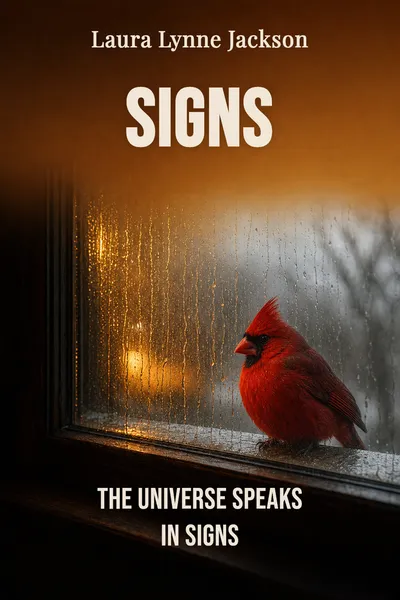
Signs
The universe speaks in signs
Description
Laura Lynne Jackson spent years standing in front of a classroom on Long Island teaching high school English before most people knew what else she did after the bell rang. In private, and eventually in front of researchers at institutions like the University of Arizona and the Windbridge Institute, she worked as a psychic medium — someone who claims to receive messages from people who have died. In her 2019 book Signs, she takes that unusual double life and turns it toward a single, oddly practical proposition: that the people we lose, and what she calls the larger intelligence of the universe, are trying to reach us all the time, through small events we tend to dismiss.
The premise sounds like a lot to swallow, and Jackson knows it. A cardinal at the window on a hard morning. A song on the radio at the exact wrong-and-right moment. A stranger who says the one thing you needed to hear. Most of us file these under coincidence and move on. Jackson's argument is that the filing is the mistake — that meaning is being offered constantly, and that the only real question is whether we're paying attention. The book is less a proof than an invitation to change what we notice.
It's a book that lives entirely in the space between comfort and credulity, and it doesn't pretend otherwise. Written partly for people carrying fresh grief, it reads like a friend who's convinced she's onto something and wants to hand you the method. Whether that friend is right is a question the book can't settle. What it can do is describe, in detail, a way of moving through loss that treats the ordinary world as full of address rather than empty of it.
The question we’re asking : What does it actually mean to say the universe communicates through signs, and how would a person go about receiving them?What we’ll see : How a medium's own experience became a method for reading grief, coincidence, and connection as a kind of ongoing conversation.
Table of contents
01 Chapter 1 — The medium who kept a day job
Jackson's credibility, in her own telling, rests on how reluctant she was. She grew up sensing things she couldn't explain, felt out of place because of it, and spent a long stretch of her early adult life keeping that side of herself firmly offstage. She married, had children, taught English literature — a life about as far from a boardwalk psychic tent as you can get. The ordinariness is the point. She wants the reader to understand that she didn't come to this looking to build a brand; she came to it trying to make sense of experiences that wouldn't leave her alone.
The turn came partly through testing. Rather than simply asserting her abilities, Jackson agreed to participate in controlled studies designed to rule out cold reading, guessing, and cues from the sitter. She describes scoring well in these blind conditions and being certified through a research program that vets mediums under laboratory-style protocols. She leans on this not to win an argument outright, but to say: I did not decide this was real because it flattered me. I kept looking for the exit and couldn't find one.

02 Chapter 2 — A vocabulary of feathers, coins and songs
The heart of Signs is a kind of informal dictionary. Jackson catalogs the forms these messages tend to take, drawn from her own life and from the many people who've written to her. Birds, especially cardinals, show up constantly — appearing at anniversaries, at gravesides, at moments of decision. Coins found in unlikely places. Feathers. A specific song surfacing on the radio or in a store when a particular person is on your mind. Numbers that repeat until you can't ignore them. Electrical flickers, lights, dreams that feel more like visits than dreams.
She's aware of the obvious objection, and she meets it head-on. Cardinals are common; songs play everywhere; of course you notice the penny after your father died because you're primed to. Jackson's response isn't to deny the ordinariness of these things but to reframe what makes them signs. It isn't rarity, she argues — it's timing and personal resonance. The feather means nothing to a stranger. It means everything if it lands the day you were begging for a reason to keep going, and if the person you lost once collected them. The sign is defined by fit, not by strangeness.
03 Chapter 3 — How to ask, and how to listen
Where the book becomes most like a manual is in its practical instructions. Jackson believes you can invite signs, not just wait for them. Her method starts with asking — literally, plainly, in your own head or out loud — for a particular sign from a particular person or from the universe at large. She suggests choosing something specific enough to be recognizable but common enough to actually appear: a certain bird, a flower, a phrase. Then, crucially, letting go of the demand and going about your day, because straining for the answer, she argues, is the surest way to miss it.
The second half of the technique is receptivity, and this is where she spends real care. Signs, in her account, rarely arrive on command or on schedule; they come sideways, when your guard is down — in the shower, on a walk, in the drowsy minutes before sleep. She encourages practices that quiet the mental noise: meditation, time in nature, paying attention to the body's small intuitive nudges. The reasoning is consistent with her whole worldview — the channel is always open, so the work is on our end, clearing enough static to hear what's coming through.
04 Chapter 4 — When the ones who left keep talking
Step back from the feathers and the coins, and Signs is really a book about grief — specifically, about refusing the finality that grief usually forces on us. Its deepest move isn't metaphysical so much as relational: it proposes that the bond with someone who dies doesn't end but changes form, and that signs are how that changed relationship stays alive. This puts Jackson, perhaps unexpectedly, close to what grief researchers now describe as continuing bonds — the idea that healthy mourning often involves maintaining a connection with the deceased rather than severing it. Where clinicians speak of internal representation, Jackson speaks of cardinals at the window; the underlying instinct is the same.
That's why the book lands so hard for readers in fresh loss, and why it unsettles skeptics for the same reason. To treat the world as full of address is enormously consoling — you are not abandoned, the conversation continues, love outlasts the body. But it also asks something in return: a willingness to hold a belief the evidence can't confirm, and to risk finding messages in noise. Jackson never resolves this tension, and to her credit she mostly doesn't try. She offers the comfort openly and lets the reader decide what it's worth.
05 Conclusion
Signs closes where it began, with the double life of a woman who taught grammar by day and sat with the grieving by night, convinced that the two worlds were never really separate. Jackson's wager runs through every chapter: that the people we lose aren't as gone as they feel, that the universe is more talkative than we assume, and that the difference between a lonely world and a companioned one comes down to what we're willing to notice. She hands over her method — ask, release, receive — not as a proof but as a practice.
Related books