Shamanism
Healers, mystics, and magicians
Description
In the frozen forests of central Siberia, a Russian traveler in the seventeenth century watched a man beat a drum until he collapsed, spoke in the voices of animals, and claimed afterward to have flown to the sky and returned with a sick person's stolen soul. The Tungus people around him had a word for this man: šaman. When Mircea Eliade published his great study of the practice in 1951, that borrowed word had already spread far beyond the tribe that coined it, becoming the label Western scholars pinned on every ecstatic healer from the Amazon to the Arctic. Eliade, a Romanian émigré who founded the modern history of religions, wanted to know what, if anything, held all these figures together.
His answer was patient and enormous. Over some 500 pages he moved across two and a half millennia and half the globe — Siberia and Central Asia first, where the phenomenon was named, then North and South America, Indonesia, Tibet, China, ancient Greece. Everywhere he found the same figure standing at the center of religious life: a man or woman who was, at once, magician and medicine man, healer and miracle-worker, priest, mystic, and poet. Someone who did not merely believe in the spirit world but claimed to travel there and come back.
What makes his book endure is that he refused the easy verdicts of his era. The shaman was not, for Eliade, a fraud performing tricks for a credulous village, nor a mental patient whose fits happened to earn social approval. He was something stranger and more precise: a specialist in ecstasy, a master of a technique for leaving the body. To read Eliade is to watch a scholar take a phenomenon everyone assumed was primitive superstition and treat it, instead, as a coherent and ancient science of the soul.
The question we’re asking : What did Eliade see in the figure of the shaman that centuries of travelers and missionaries had missed?What we’ll see : How a Siberian word became a way of understanding the ecstatic healer across the whole span of human religious life.
Table of contents
01 Chapter 1 — The word that traveled out of Siberia
The term comes from the Tungus of Siberia, and Eliade insisted we keep that origin in view. Siberia and Central Asia were where European observers first met the phenomenon, described it, and gave it its name — which is why he treated that region as the classic ground, the place where shamanism appeared in its most complete and least diluted form. From there he worked outward, testing whether the same structure showed up elsewhere. It did, again and again, which was the whole surprise of his project.
But Eliade was careful about what the word should cover. Not every magician is a shaman, he argued, and not every person who deals with spirits qualifies either. Plenty of societies have sorcerers, medicine men, and priests who never leave their bodies. The shaman is defined by something narrower and more spectacular: a mastery of ecstasy, the capacity to enter a controlled trance in which the soul is believed to quit the body and travel — up to the sky, or down to the underworld. That specialized ecstatic technique is the heart of the definition.

02 Chapter 2 — How one becomes a shaman
Nobody simply decides to be a shaman. Across the traditions Eliade surveyed, the calling arrives as a crisis — often an illness, sometimes a series of dreams, occasionally a stroke of lightning or a hereditary summons that cannot be refused. The future shaman falls sick, withdraws, behaves strangely, seems to hover near death. In many Siberian accounts the candidate is said to lie inert for days while, in another realm entirely, something decisive is being done to him.
That something is one of the most striking motifs in the book: the initiatory dismemberment. The candidate experiences, in vision, being taken apart. Spirits strip the flesh from his bones, count and clean them, sometimes replace them, forge him a new body, and put him back together. Eliade read this recurring ordeal as a death and rebirth — the old ordinary person must be destroyed so that the shaman can be assembled from the pieces. Only someone who has died in this way can move freely among the dead.
03 Chapter 3 — The map of the three worlds
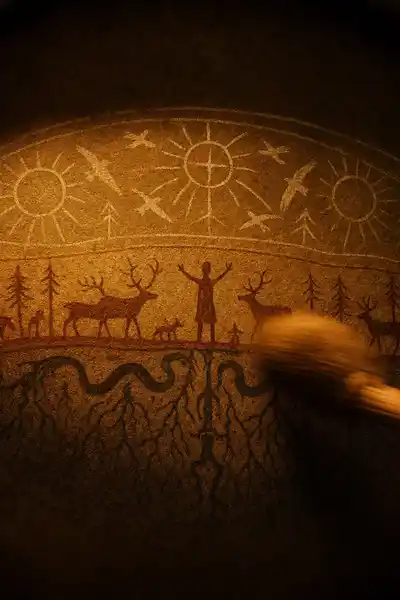
Underneath the enormous variety of practices, Eliade found a shared cosmology, and it was beautifully simple. The universe has three levels — sky above, earth in the middle, underworld below — and they are joined at the center by an axis. That axis might be pictured as a world tree, a central mountain, a pillar, or a rope, but its function is always the same: it is the road the shaman travels. His whole vocation depends on the belief that this axis can be climbed or descended by a soul that knows the way.
The shaman's equipment maps onto this cosmology with startling consistency. The drum, Eliade argued, is not merely an instrument for inducing trance; it is often built from the wood of the world tree, and beating it is a way of mounting to the sky. The notches cut into a birch pole, the ladder, the ritual climb — these enact the ascent. The costume, hung with iron and images of bones and birds, turns the shaman into a creature capable of flight. Everywhere the symbolism converges on a single act: rising and returning.
04 Chapter 4 — What the trance was always about
Step back from the drums and the dismemberment, and Eliade's larger claim comes into view. Shamanism, for him, was one of the oldest and clearest expressions of a longing that runs through all religion: the desire to abolish the distance between the human and the divine, to recover a lost connection between earth and sky. The shaman is the person who still knows how to make the crossing that, according to countless myths, everyone could once make before some primordial fall cut the rope and closed the road.
Read this way, the ecstatic journey is not exotic at all. It is a technique for doing what mystics, prophets, and initiates everywhere have wanted to do — to leave the ordinary condition, if only briefly, and touch a reality behind it. Eliade saw in the shaman's flight a structure that reappears in the ascension myths, the celestial ladders, and the visionary voyages of the great religious traditions. The shaman was not a leftover from a primitive past but an early, and unusually pure, form of the mystical impulse itself.
05 Conclusion
The word that a Russian traveler carried out of the Siberian forest turned out, in Eliade's hands, to name something far larger than a single tribe's healer. Following it across continents and centuries, he assembled a portrait of a figure who reappears wherever human beings believe the soul can leave the body and come back changed: the specialist in ecstasy, elected by crisis, dismembered and remade, master of the road that joins the three worlds. What had looked to missionaries like superstition became, under his patient comparison, a coherent spiritual technology of great antiquity.
Related books