Sacred Cow
Meat, done right
Description
Somewhere in the last decade, a piece of steak stopped being just dinner and became a position. Order it at a table of eight and you can watch the room recalibrate: someone mentions methane, someone else water, a third person brings up the rainforest, and suddenly the plate carries the weight of a planet. Diana Rodgers, a dietitian who runs a working farm outside Boston, spent years watching this happen — clients arriving convinced that the healthiest, most ethical thing they could do was quietly give up meat. She wrote Sacred Cow, with the nutrition researcher Robb Wolf, because she thought the conversation had gone badly wrong somewhere upstream.
The book, published in 2020, is a deliberate act of pushing back. Not against vegetarians, and not with the swagger of a carnivore influencer, but against a specific claim that had hardened into common sense: that eating animals is bad for our bodies and bad for the Earth, full stop. Rodgers and Wolf argue that this framing collapses a dozen separate questions into one, and answers all of them with the same reflex. Health, ethics, emissions, land, human dignity — each deserves its own reckoning, and each, they contend, looks different when you actually run the numbers on how meat is raised rather than whether it is raised at all.
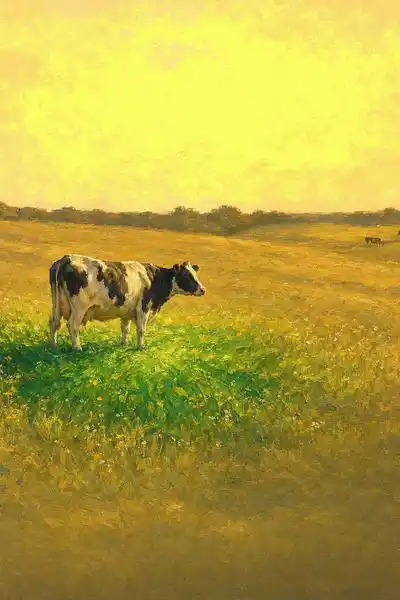
What makes the argument worth sitting with is that Rodgers is not defending the feedlot. She is defending a cow on grass, and asking whether the thing we've decided to feel guilty about is even the thing we should be looking at.
The question we’re asking : Is meat a problem to be minimized, or does the answer depend entirely on how the animal was raised?What we’ll see : How a dietitian and a researcher take apart the case against meat one strand at a time — nutrition, land, emissions, ethics — and rebuild it around a single distinction.
Table of contents
01 Chapter 1 — The nutrient math nobody runs
Rodgers begins where a dietitian would: not with the planet but with the body. The standard advice to eat less meat, she argues, treats calories and protein as interchangeable, as if a serving of lentils and a serving of beef were doing the same job with different branding. They aren't. The book walks through what nutritionists call bioavailability — how much of a nutrient the body can actually absorb and use, as opposed to how much is technically present on the label. Iron, zinc, and vitamin B12 from animal sources arrive in forms the human gut takes up efficiently. The plant equivalents often come bound up with compounds that block absorption, so the number on the package overstates what you'll ever see.
This matters most, she points out, for the people least able to afford a mistake: pregnant women, young children, the elderly, anyone eating on a tight budget. B12 is essentially absent from plants; iron deficiency is already the most common nutritional shortfall in the world. A diet built on the assumption that we can simply swap animals out and top up the gaps with supplements works fine for a well-informed adult with money and a pharmacy nearby. It works less well for a two-year-old, or a family in a place where fortified cereals and a shelf of pills are not a given.

02 Chapter 2 — When the cow becomes the villain
The environmental case against beef usually arrives as a single, sticky figure — cattle produce some large share of greenhouse gases, therefore the responsible move is to eat fewer of them. Rodgers and Wolf spend a good part of the book taking that figure apart, and their objection is less about the arithmetic than about the framing. Livestock do emit. Cows belch methane, and methane is a potent warming gas. But the widely repeated numbers, they argue, often blur the line between global figures dominated by intensive systems and the specific question of a grass-fed animal on well-managed land in a place like the United States.
The methane point turns out to be more interesting than the headline. Methane from cattle is part of a biogenic cycle: the carbon in it comes from grass, which pulled it out of the air through photosynthesis, and after roughly a decade the methane breaks back down to carbon dioxide that plants take up again. It's a loop, not a one-way deposit, in a way that the carbon dioxide from burning fossil fuel — carbon that was locked underground for millions of years — simply is not. Treating the two as equivalent, the book argues, is one of the ways the accounting misleads.
03 Chapter 3 — Grazing as repair, not damage
The heart of the book is an idea that sounds counterintuitive until Rodgers explains the biology: that grazing animals, managed well, can heal land rather than degrade it. This is the case for what's often called regenerative or managed grazing, and it rests on how grasslands evolved. For thousands of years, vast herds of ruminants moved across prairies in tight bunches, grazing an area hard, fertilizing it, trampling old growth into the soil, and then moving on — chased by predators — leaving the land months to recover before they returned.
Managed grazing tries to mimic that rhythm with fencing and planning rather than wolves. Cattle are concentrated on a small paddock, allowed to graze and stomp and manure it briefly, then moved so the plants can regrow with their roots stimulated rather than exhausted. The claim Rodgers and Wolf make, drawing on soil scientists and practitioners, is that this cycle can build organic matter in the soil, improve its ability to hold water, and pull carbon down out of the atmosphere into the ground — the same carbon the anti-beef argument counts only as it goes up.
04 Chapter 4 — The wrong question about a whole food
Step back from the cow, and Sacred Cow is really an argument about how we've learned to think about food at all. Somewhere along the way we started sorting foods into moral categories — this one virtuous, that one guilty — as if the label on the ingredient told you everything about its cost. Rodgers's whole method is a refusal of that move. She keeps replacing the question "is meat good or bad?" with a more awkward one: good or bad compared to what, produced how, eaten by whom, in place of what? The category doesn't answer that. Only the system does.
This is why the book spends as much time on almond monocultures and soy fields and tilled cropland as it does on cattle. A field of vegetables is not a moral free pass; it can mean drained aquifers, eroded soil, dead pollinators, and displaced wildlife, depending entirely on how it's farmed. The point isn't to shift the blame onto plants. It's to notice that once you look at food as part of an ecological web rather than as an item with a fixed verdict attached, the tidy hierarchy of good and bad foods dissolves into something messier and more honest.
05 Conclusion
Rodgers ends more or less where she started — with the person at the table, quietly deciding that giving up meat is the responsible thing to do. Her aim was never to talk that person into a steak, but to show that the decision they thought was simple is tangled up with questions they were never asked to consider: what the animal ate, what land it stood on, what would grow there instead, what a diet without it would quietly cost a body and a landscape. The cow, she argues, was made to carry blame that belongs to a system, and dropping it does not lift the burden — it just moves it somewhere less visible.
Related books