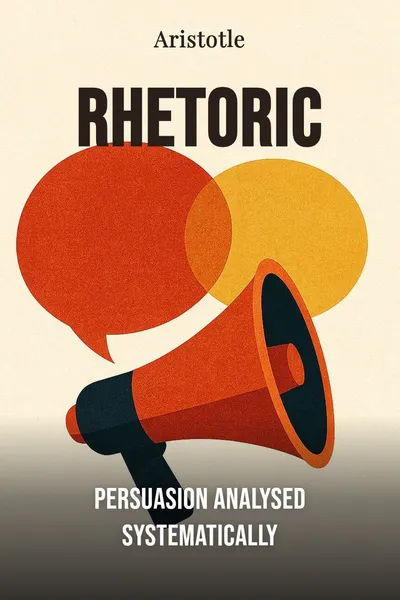
Rhetoric
Persuasion analysed systematically
Description
In fourth-century Athens, arguing well in public was not a hobby. A citizen might have to defend himself in court with no lawyer, sway an assembly of hundreds on a question of war, or speak over a friend's grave. Speech was how power moved, and the men who taught it — the Sophists — sold technique the way a modern coach sells a killer opening line. Aristotle, who ran his own school in Athens after years studying under Plato, watched this trade with something between suspicion and fascination. His teacher Plato had mostly despised rhetoric as flattery dressed up as knowledge. Aristotle did something stranger. He took it seriously enough to dissect it.
The result, the treatise we call the Rhetoric, is probably drawn from lecture notes rather than polished for publication, which is why it reads less like a manifesto than a workshop. In it, Aristotle refuses both easy answers. Rhetoric is not the shady art of making the weaker case look stronger, the charge Plato had thrown at the Sophists. But it is not philosophy either, not a search for certain truth. It is a faculty — a trained capacity — for seeing, in any situation, what could plausibly persuade this audience about this matter. He then set about mapping how that capacity actually works.
What comes out is the first attempt to treat persuasion as something you can study rather than merely perform. Aristotle sorts the ways a speech convinces into a small number of moving parts, and those parts have proven durable enough that we still reach for his terms twenty-three centuries later, often without knowing whose they are. The framework is calm, almost clinical — and that calm is exactly the point.
The question we’re asking : How did Aristotle turn the slippery business of persuasion into a system anyone could learn?What we’ll see : How the Rhetoric breaks a persuasive speech into its working parts, and why Aristotle called the whole thing a civic skill rather than a trick.
Table of contents
01Chapter 1 — A messy craft finally gets a system
Before Aristotle, teaching rhetoric mostly meant handing students a bag of devices: how to open, how to stir pity, how to bury a weak point in the middle where nobody looks. The handbooks of the day, he complains early in the treatise, obsessed over these emotional tricks and said almost nothing about the actual substance of argument — the reasoning that ought to do the real work. They taught the trimmings and skipped the meal. Aristotle's first move is to widen the frame: rhetoric, he says, is the counterpart of dialectic, the disciplined back-and-forth of philosophical debate. Both deal not in proofs but in what seems reasonable to reasonable people.
That parallel matters more than it looks. Dialectic reasons about general questions among experts; rhetoric reasons about particular decisions in front of ordinary crowds who won't follow a long chain of logic. So the rhetorician has to work with what an audience already believes, argue from probabilities rather than certainties, and compress the reasoning so it lands. This isn't a lowering of standards. It's a recognition that persuasion happens in real rooms, under time pressure, among people who are tired, partisan, and mortal.

02Chapter 2 — Ethos — the speaker is the first argument
The first source of persuasion is the one people notice last: the speaker himself. Aristotle calls it ethos, and his claim is bracing — a speaker's character, as it comes across in the speech, may be the most effective means of persuasion he has. We believe good people more readily, he says, and more completely, especially on matters where certainty is impossible and we have to fall back on trusting a judgment rather than checking a proof. When the facts are genuinely unsettled, the question quietly becomes: whose read on this do I trust?
What's sharp about Aristotle's version is where he locates that trust. It is not the speaker's prior reputation, the résumé he walks in with. It is the character the speech itself constructs, moment by moment, in the hearing of it. A stranger can earn our confidence in ten minutes; a famous man can squander his in one careless sentence. Ethos is a performance in the honest sense — it is built in the room.
03Chapter 3 — Pathos and logos — the audience and the case
The second source lives not in the speaker but in the listener. Aristotle calls it pathos, the persuasion that works by putting the audience into a particular frame of mind, because we do not judge the same way when we are pleased and friendly as when we are pained and hostile. An angry crowd and a calm one, hearing identical facts, reach different verdicts. So the treatise does something no handbook had done: it turns into a serious study of the emotions themselves.
And it is genuinely serious. Aristotle works through anger, calm, fear, confidence, shame, pity, indignation and more, and for each he asks three cool questions — what state of mind are people in when they feel it, who do they feel it toward, and on what grounds. Anger, for instance, he defines as a response to a perceived slight, from someone who had no right to slight us, aimed at something we care about. Understand the mechanism and a speaker can arouse the emotion honestly, by pointing to the features of the situation that actually warrant it — or recognize when someone is manufacturing it out of nothing.
04Chapter 4 — The available means, not the winning trick
The definition Aristotle gives rhetoric is easy to skim past and worth slowing down on: it is the faculty of observing, in any given case, the available means of persuasion. Not the means of winning. The available means. He deliberately measures the art by the speaker's ability to see what could persuade, not by whether persuasion actually lands — because the same case can be argued well and still lose to a duller crowd or a better-connected opponent. Rhetoric is an eye for possibility, a way of reading a situation, closer to a doctor's skill than a magician's spell.
That framing carries a quiet ethics. A doctor studies disease not to spread it but to treat it; understanding how illness works is precisely what lets him heal. Aristotle answers the obvious objection — that teaching persuasion arms the dishonest — the same way. Yes, the tools can be misused, as nearly every valuable thing can. But refusing to understand persuasion doesn't disarm the manipulators; it only leaves everyone else defenseless in front of them. The citizen who can recognize a hollow ethos, a manufactured anger, a missing premise is harder to fool.
05Conclusion
Aristotle sat down to study something his own teacher had dismissed as flattery, and he came away with the opposite conclusion. Persuasion was not a stain on public life but the very medium of it, and like anything that shapes decisions among free people, it could be examined, named, and taught. Ethos, pathos and logos are not three buttons to push. They are three honest questions any speech invites — do I trust this person, what is this doing to my feelings, and does the argument actually hold — and the citizen who keeps all three in view is both a clearer speaker and a harder target.
Related books