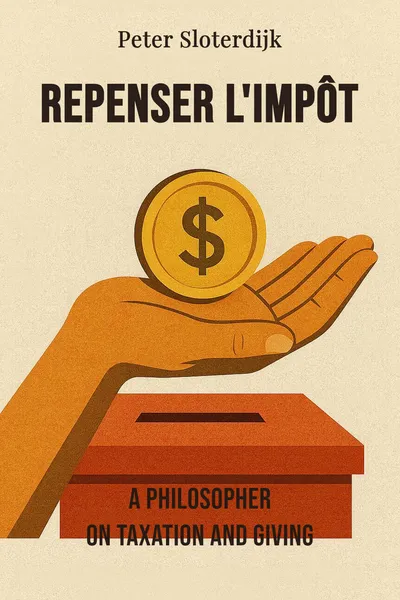
Repenser l'impôt
A philosopher on taxation and giving
Description
In 2009, in the pages of a German weekly, the philosopher Peter Sloterdijk published an essay that annoyed nearly everyone. His targets were the modern welfare state and the way it funds itself. His claim, boiled down, was that a rich democracy had come to treat the citizens who pay most of its bills as suspects to be relieved of their money, rather than as benefactors keeping the whole thing afloat. The reaction was sharp — a very public quarrel with the sociologist Axel Honneth followed, conducted at the volume Germans reserve for arguments about the state. Out of that fight came a short, combative book, later published in French as Repenser l'impôt.
The book is not a tax-policy proposal. Sloterdijk is a philosopher, not an accountant, and he is uninterested in marginal rates or loophole reform. What he wants to change is the verb. We say the state levies, deducts, withholds, takes. He asks what happens to a society when its central act of solidarity is described, by everyone, in the grammar of confiscation — as if every April the citizen were being lightly robbed by an institution he supposedly consented to.
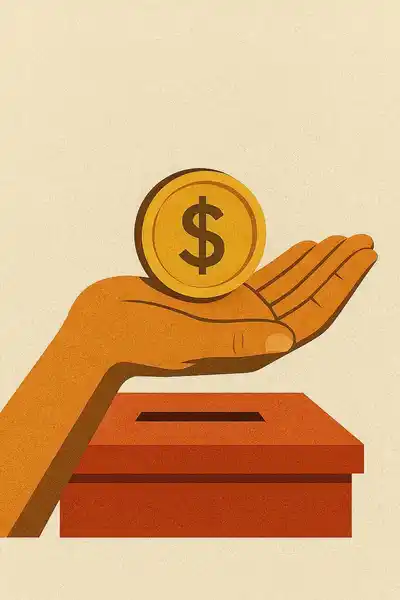
His alternative is deliberately scandalous. Suppose taxation were understood not as a levy extracted under threat, but as a gift — a voluntary contribution to the common pot, made by people who could, in principle, refuse. The suggestion sounds naive, and Sloterdijk knows it. That is rather the point. He is testing what the naive version reveals about the cynical one we already live inside.
The question we’re asking : What changes when we stop describing taxation as something taken from us and start describing it as something we give?What we’ll see : A philosopher's attempt to rewrite the oldest sentence in fiscal politics — and what his provocation exposes about a state that quietly needs its taxpayers to feel robbed.
Table of contents
01Chapter 1 — The word that decides everything
Sloterdijk begins where philosophers like to begin: with a word doing more work than we notice. Every developed state runs on a single grammatical assumption, so old we have stopped hearing it. The assumption is that money moves from the citizen to the treasury by force. The state levies. It deducts at source, before the wage even reaches the hand. It withholds. The language is the language of a hold-up conducted politely, on a schedule, with receipts.
His argument is that this grammar is not neutral. It shapes the feeling of the whole transaction. If the founding verb is take, then paying tax can never feel like anything but loss, and the payer can never feel like anything but a victim of a slightly more legitimate mugging. Resentment is baked into the vocabulary. We resent before we calculate. And a citizenry trained to experience its largest civic act as robbery will, unsurprisingly, look for every honorable way to rob back.

02Chapter 2 — The century the state learned to take
To see why the grammar of taking feels so permanent, Sloterdijk sends us back to how recently it was installed. For most of history, states were poor. Rulers financed themselves through customs, tolls, the sale of offices, the odd war-loan, and periodic squeezing of whoever could not resist. The modern income tax — the state reaching directly and continuously into the earnings of the ordinary citizen — is barely more than a century old as a normal peacetime fact. It arrived with mass war and mass welfare, and it never left.
The scale of what followed is easy to underplay. A twentieth-century developed state grew to claim something like a third to a half of everything its economy produces, year after year, and to redistribute it. Sloterdijk's point is not that this is monstrous — he is emphatic that the welfare state is one of the achievements of European civilization, a genuine miracle of solidarity. His point is that we built the most generous machine in human history and then insisted on describing its operation with the vocabulary of expropriation.
03Chapter 3 — Nietzsche's giving virtue, applied to the treasury
The philosophical engine of the book is borrowed, openly, from Nietzsche. In Thus Spoke Zarathustra, Nietzsche names what he calls the gift-giving virtue — the disposition of the person so full, so capable, that giving becomes an overflow rather than a sacrifice. To give from abundance, on this view, is not to lose something. It is the highest expression of strength, the sign of a self large enough that generosity costs it nothing it minds losing.
Sloterdijk takes this out of its lonely mountain setting and points it at the tax return. What if the productive citizen — the entrepreneur, the surgeon, the high earner — were culturally understood as a giver in exactly Nietzsche's sense? Not a milch cow to be drained by an institution that assumes bad faith, but a person of surplus whose contribution to the common pot is the dignified overflow of capacity. The change is not fiscal. It is a change in how such a person is allowed to feel about the largest cheque he writes each year.
04Chapter 4 — A republic that thanks its donors
Step back from the provocation and what Sloterdijk has really diagnosed is a psychology — the emotional constitution of the fiscal state itself. His deepest suggestion is that the modern welfare state has become quietly dependent on grievance at both ends. It needs the taxpayer to feel a little robbed, because grievance justifies compliance machinery, and it needs the beneficiary to feel a little owed, because entitlement justifies the machine's expansion. Resentment, on this reading, is not a malfunction of the system. It is the fuel the system runs on.
That is an uncomfortable idea precisely because it does not sort neatly onto the usual left–right map. Sloterdijk is not making a libertarian case for lower taxes; he says plainly he wants the generosity to continue. He is making a case about the mood of collective life — about whether a rich democracy can practice solidarity without describing that solidarity in the tone of a permanent hostage negotiation. His wager is that the tone is not free. A polity that can only speak of contribution in the language of extraction slowly loses the capacity to feel like a shared project at all.
05Conclusion
Sloterdijk began with a single verb and ended with the emotional life of the modern state. The book's argument runs entirely along that thread: we say the treasury takes, and because we say it, the citizen who pays feels robbed, the citizen who receives feels shortchanged, and the most generous machine ever built for solidarity somehow manufactures resentment as its main by-product. Swap take for give and not one figure on the form moves — but the mood of the whole transaction does.
Related books