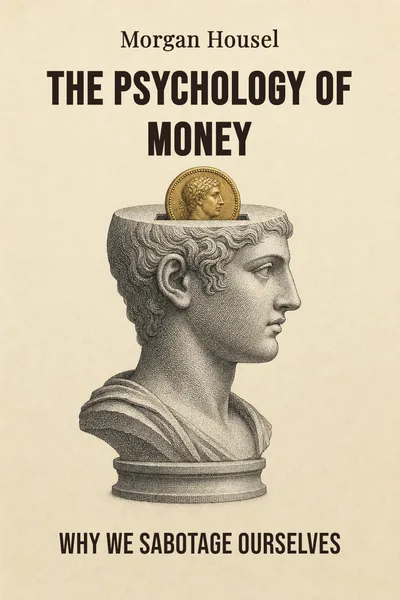
The Psychology of Money
Why we sabotage ourselves
Description
Ronald Read spent most of his working life as a gas-station attendant and a janitor at a JCPenney store in Vermont. He drove a secondhand car, mended his coat with safety pins, and was, by every outward sign, a man of modest means. When he died in 2014 at the age of ninety-two, he left behind an estate of roughly $8 million, most of it given to a local hospital and library. He had no inheritance and no lottery ticket. He had simply bought solid stocks and held them for decades. The same year, a Merrill Lynch executive named Richard Fuscone — Harvard MBA, the kind of résumé that opens any door — had his homes foreclosed on after the financial crisis wiped him out.
That pairing opens Morgan Housel's 2020 book The Psychology of Money, and it sets up the puzzle that runs through the whole thing. In almost no other field can someone with no training, no connections and no obvious talent dramatically outperform someone with the best education money can buy. A janitor cannot perform open-heart surgery better than a cardiologist. But a janitor can, and did, end up wealthier than a Wall Street veteran. Housel, who spent years writing about investing, concluded that money is not really a subject like physics, governed by clean rules. It is a subject like psychology, governed by how people behave when fear, greed and ego are in the room.
His claim is almost rude in its simplicity: doing well with money has little to do with how smart we are and a great deal to do with how we behave. And behavior, unlike a spreadsheet, is hard to teach. We can know every formula and still sabotage ourselves at the worst possible moment — selling in a panic, chasing a hot tip, spending to impress people we don't even like. Why does that happen, even to people who clearly know better?
The question we’re asking : Why do intelligent people make terrible money decisions while ordinary people quietly build fortunes?What we’ll see : How a financial writer reframes wealth as a question of temperament rather than intelligence, and what that does to the advice we usually hear.
Table of contents
01 Chapter 1 — The janitor and the executive
The Read and Fuscone story isn't there for shock value. Housel uses it to dismantle an assumption built into almost every conversation about money — that financial outcomes track financial knowledge. We talk about investing as if it were engineering, a domain where the person with more technical skill builds the better bridge. But Read had no edge in analysis. What he had was patience, frugality and forty years of leaving things alone. Fuscone had every analytical edge imaginable, and used some of it to borrow heavily and live large, which is exactly what destroyed him when the market turned.
The lesson Housel draws is that finance is taught as a hard science when it behaves like a soft one. A genius who loses control of their emotions, he writes, can be a financial disaster. The reverse holds too: ordinary people with no financial education can be wealthy if they have a handful of behavioral skills that have nothing to do with formal measures of intelligence. This is genuinely strange. There's no other industry where this is true, and it means the gap between what we should do and what we actually do is where most of the action is.

02 Chapter 2 — No one is crazy
One of Housel's most disarming arguments is captured in three words: no one is crazy. The lottery-ticket buyer scraping by on low wages and the cautious saver who keeps everything in cash are both, he insists, doing something that makes sense given the life they've lived. People who didn't grow up with money may buy lottery tickets because, for a few dollars, they get to taste a dream that no realistic financial plan offers them. From the outside it looks irrational. From the inside it's a coherent response to a specific set of circumstances.
This isn't an excuse for bad decisions so much as a reframe of where they come from. When we see someone making a money choice that strikes us as foolish, our instinct is to assume they're missing information we have. Housel's point is that they're usually not stupid — they're running on a different emotional ledger, shaped by what scarcity or windfall taught them long before they could analyze any of it. Behaviors that look insane to one generation make total sense to another that lived through different events.
03 Chapter 3 — Tails do all the work
If there's a single idea Housel returns to most, it's the outsized power of long stretches of time and a small number of huge events. He's fond of pointing out that the bulk of Warren Buffett's fortune was built after his sixties. Buffett is a brilliant investor, but the thing that made him one of the richest people alive is that he's been investing since childhood — for the better part of a century. Had he started in his thirties and retired at sixty-five with the same returns, his net worth would be a tiny fraction of what it is. The skill is real, but compounding over an absurdly long horizon is the engine.
Compounding is counterintuitive because the human brain handles linear growth far better than exponential. We see a modest annual return and mentally add it up, when the real story is multiplication stacked on multiplication, with the largest gains arriving late and almost invisibly. This is why patience isn't a soft virtue in Housel's telling but a hard financial input. Doing nothing — staying invested, resisting the urge to tinker — is frequently the highest-value action available, even though it feels like negligence.
04 Chapter 4 — Enough, and the cost of never having it
Step back from the tactics and Housel's real subject comes into view: money is a mirror. The way we handle it reflects how we deal with fear, envy, ego and the simple discomfort of not knowing what comes next. This is why he keeps insisting that intelligence is a poor predictor of financial security. The traits that actually decide outcomes — restraint, patience, an immunity to other people's opinions — aren't measured by any test, and they often sit in tension with the drives that make people ambitious and successful in the first place.
Nowhere is this clearer than in his treatment of enough. Housel tells the story, attributed to a conversation involving the writers Kurt Vonnegut and Joseph Heller, of a billionaire's party where Heller is told their host makes more in a day than Heller earned from his entire novel — and Heller replies that he has something the host will never have: enough. For Housel, the absence of that word is the most dangerous condition in personal finance. People who already have everything keep risking it for more they don't need, and the downside of losing what's essential always outweighs the upside of gaining what's superfluous.
05 Conclusion
Ronald Read never read a finance textbook, and Richard Fuscone had memorized several. Yet the janitor died wealthy and the executive lost his homes, and the difference between them wasn't intelligence or information. It was temperament — patience against impatience, restraint against excess, the willingness to leave things alone against the itch to act. That contrast is the whole book in miniature, and it's why Housel treats money as a behavioral subject before it's ever a mathematical one.
Related books