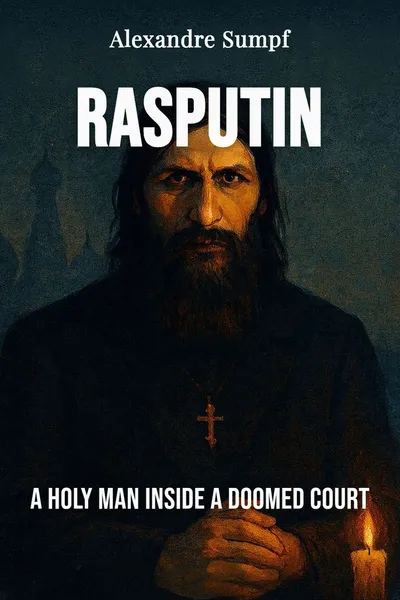
Rasputin
A holy man inside a doomed court
Description
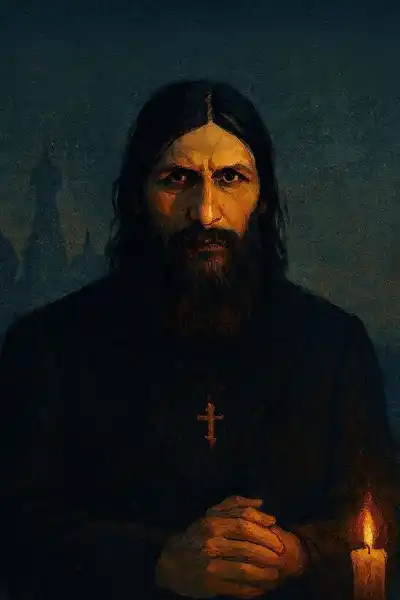
On the night of December 30, 1916, in the cellar of the Yusupov Palace in Petrograd, a group of aristocrats set about killing a Siberian peasant. They fed him cakes and wine, shot him, and threw the body into the frozen Neva. The men who did it — Prince Felix Yusupov, a grand duke, a right-wing politician — believed they were saving Russia. The peasant was Grigori Rasputin, and within weeks the story of his death had swollen into something monstrous: poison that failed, bullets that failed, a body that would not die. Almost none of the gothic detail holds up. What holds up is that a handful of the empire's most powerful men decided the fate of the nation ran through one illiterate wanderer from the village of Pokrovskoye.
That conviction is the strange fact at the center of Rasputin's story. He held no office, commanded no troops, controlled no ministry. He was a self-taught holy man who drifted into the court of Nicholas II and Alexandra and stayed there, off and on, for roughly a decade. By the time he was murdered, much of literate Russia was convinced he ran the government, seduced the empress, and pushed the country toward ruin. The historian Alexandre Sumpf sets out to do something harder than repeat the scandal — to pull the actual man back out from under the myth that buried him.
What emerges is a figure far smaller, and far more revealing, than the legend. The interesting part was never whether Rasputin had hypnotic powers. It was why an empire near collapse needed to believe he did.
The question we’re asking : Who was Rasputin behind the legend, and why did a doomed court come to hinge its fears and hopes on him?What we’ll see : How a peasant reached the palace, why the empress clung to him, how the myth swallowed the man, and what the whole affair lays bare about the Romanovs.
Table of contents
01Chapter 1 — A Siberian peasant on the road to the capital
Grigori Rasputin was born around 1869 in Pokrovskoye, a village in western Siberia, into a peasant family that was neither destitute nor remarkable. The name that would become notorious was a real surname, not a slur invented later, though its resemblance to the Russian word for debauchery gave his enemies a gift they used relentlessly. He married young, fathered children, and worked the land like everyone around him. Nothing in the first thirty years of his life pointed toward a palace.
What changed him was a religious turn common enough in rural Russia. Sometime in his late twenties, Rasputin left home and began the life of a strannik — a wandering pilgrim, moving from monastery to monastery, praying, fasting, living on charity. It was a recognized vocation, not an eccentricity. Russia in those years was full of holy wanderers, elders, and self-appointed men of God who existed outside the official Orthodox Church while drawing on its deep well of popular faith. Rasputin fit that mold. He picked up scripture, learned to speak in the intense, improvised register of the folk mystic, and acquired a reputation as a man through whom something divine seemed to pass.

02Chapter 2 — The healer the empress could not do without
The bond that made Rasputin's career was not with the emperor but with the empress, and its cause was a single medical fact. The heir to the throne, Tsarevich Alexei, born in 1904, suffered from hemophilia — a disorder in which the blood does not clot, so that a minor injury or internal bleed could become life-threatening. The condition was kept a state secret. It ran through the descendants of Queen Victoria, Alexandra's grandmother, and it turned every childhood bruise into a potential death sentence. The most modern medicine of the age could do essentially nothing.
Into that desperation walked Rasputin. On more than one occasion, when Alexei was in crisis and the doctors had given up, Rasputin was summoned — sometimes present, sometimes sending word by telegram — and the bleeding subsided. Whether he calmed the boy, whether his insistence on keeping doctors and their aspirin away happened to help, or whether the episodes simply ran their course, the effect on Alexandra was total. She became convinced that this peasant was the one man on earth who could keep her son alive, and that his presence was a sign of God's protection over the dynasty. For a devout, isolated mother watching her only son suffer, no argument could touch that conviction.
03Chapter 3 — The legend outgrew the man
By the years of the First World War, the Rasputin of rumor had almost nothing to do with the man from Pokrovskoye. He was said to be the empress's lover, the true ruler of Russia, the hand that appointed and dismissed ministers, a German agent, a satanic force draining the life of the nation. Cartoons showed him looming over tiny puppet-figures of the tsar and tsarina. The stories about his private life — the drinking, the women, the debauched nights — mixed real indiscretion with wild invention, and no one bothered to sort one from the other.
There was a kernel of fact. Rasputin did drink, did surround himself with admiring women, did enjoy the access and money his position brought, and did offer opinions on appointments that the empress sometimes relayed. But Sumpf shows the distance between that and the omnipotent schemer of the myth. Rasputin had no coherent political program, no faction, no real grasp of statecraft. His interventions were erratic and often ignored. He was a court favorite in an age that no longer knew what to do with court favorites — not a shadow government.
04Chapter 4 — What a peasant reveals about a dynasty
Step back from the séances and the poisoned cakes, and Rasputin stops being a cause of the Romanovs' fall and becomes a symptom of it. The truly telling fact is not that a Siberian peasant reached the heart of the empire, but that the empire had grown so closed, so cut off from the country it ruled, that a single man could come to seem like its master. Sumpf uses Rasputin as a lens, and what the lens brings into focus is the isolation of Nicholas and Alexandra in their final years.
The court that clung to Rasputin was a court that had stopped listening to almost everyone else. Nicholas distrusted his ministers, his relatives, the Duma, and much of educated society; Alexandra distrusted them more. Their world had shrunk to the palace, the sick child, and the handful of people they believed God had sent. In that vacuum a holy man's word could outweigh a minister's, not because he was powerful but because the alternative voices had all been shut out. Rasputin did not break the machinery of the monarchy. He filled a silence that the monarchy had created around itself.
05Conclusion
Rasputin was pulled from the Neva a few days after his murder, and the autopsy told a plainer story than the legend that was already circulating: he had been shot, and he had drowned. No unkillable monster, no poison that bounced off him — just a badly beaten body under the ice. The man who died there was a peasant mystic who had wandered into a court desperate for a miracle and stayed because, for one sick boy, he seemed to be one. The rest was written by people who needed him to be larger.
Related books