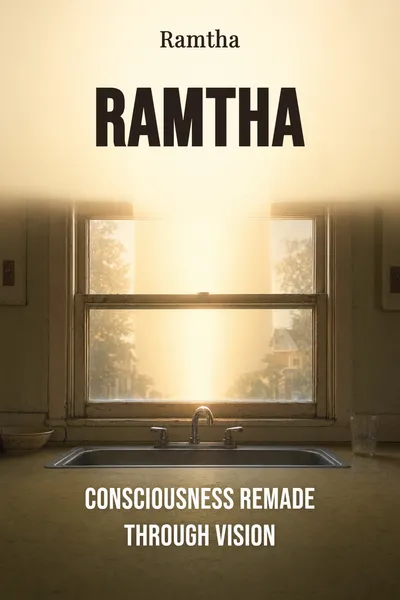
Ramtha
Consciousness remade through vision
Description
In the late 1970s, a woman named JZ Knight, living in Tacoma, Washington, began telling people that a being had appeared in her kitchen. Not a metaphor, not a feeling — a presence she described as a giant, luminous figure who called himself Ramtha and announced he had come to help her over what he called "the ditch." Knight would go on to say that this entity spoke through her, that she stepped aside and let his voice use her body, and that what he dictated across sessions was not her own thinking at all. The book that carries his name is presented exactly that way: not authored by Knight, but delivered through her.
Whatever one makes of the origin story — and it is, to put it mildly, a contested one — the text itself is a coherent thing. It reads like a long address from someone who assumes he has all the time in the universe. The claim is enormous and stated flatly: Ramtha says he was once a human being, that he lived and suffered and eventually ascended, and that he is now speaking to remind us of something we have forgotten. What we have forgotten, according to the book, is that we are God. Not children of God, not creatures loved by God. God.
That is the through-line of the whole work, and everything else hangs off it. If the self is divine, then fear is a mistake, suffering is optional, and the world we see is something we are actively making. The book moves through these ideas the way a speaker moves through a room — circling, repeating, insisting. It rewards being read less as an argument and more as a sustained act of persuasion, aimed at a reader assumed to be tired and half-asleep.
The question we’re asking : What does a book claiming to be dictated by a non-human intelligence actually teach, and where does its power to persuade come from?What we’ll see : How the text builds its picture of the self, fear, and reality — and what a teaching grounded entirely in inner vision asks of anyone who reads it.
Table of contents
01 Chapter 1 — A voice that claims to be older than the body
The book opens by establishing who is supposedly speaking, and it does so without apology. Ramtha introduces himself as an ascended being, once a warrior and conqueror in a distant past he places tens of thousands of years ago, on a continent he calls Lemuria. He describes a life of rage and violence, a near-fatal wounding, and a long convalescence during which he began to contemplate the sun, the wind, and eventually the force he calls the Unknown God. Over what he presents as many years, he says he mastered the body, mastered thought, and finally lifted himself out of physical form altogether. He did not die. He ascended, and now he returns as pure awareness borrowing a human voice.
This framing does real work. By placing the narrator outside ordinary human limits, the book grants itself a vantage point no living teacher could claim. Ramtha speaks as someone who has already crossed the distance he is describing, so his statements arrive not as theory but as testimony. He calls the reader "entity" and "beloved master," addresses forms of address that flatten the usual hierarchy between teacher and student. In his telling, we are not below him. We are simply behind him, walking the same road.

02 Chapter 2 — The god you already are
The central claim, repeated until it can no longer be missed, is that each person is God. The book is emphatic that this is not blasphemy or exaggeration but the plainest fact, obscured only by forgetting. There is, in Ramtha's telling, one source — he calls it the Unknown God, or the isness, or Thought — and everything that exists is that source in motion, contemplating itself into form. A human being is not a spark thrown off by the divine; a human being is the divine, temporarily convinced it is something less.
From this everything follows. If we are God, then the creative power usually attributed to a distant deity is our own. We are, according to the book, always creating — our thoughts precipitate into experience, our attention shapes what comes to us. The reason life feels like something that happens to us, rather than something we make, is that we have handed our authority away: to religions, to governments, to the opinions of others, to the verdicts of the body. Ramtha's project is to hand it back.
03 Chapter 3 — Fear as the only thing standing in the way
If we are already divine, why don't we feel it? The book's answer is single-minded: fear. Almost every limitation Ramtha describes — illness, poverty, loneliness, the sense of being trapped by circumstance — he traces back to fear operating quietly beneath ordinary awareness. Fear of death, fear of lack, fear of the opinions of others, fear of the unknown itself. These are not minor irritants in his account. They are the walls of the prison, and they are self-built.
He treats fear less as an emotion to be managed than as a false god to be dethroned. To live in fear, in his framing, is to accept the very smallness the book is trying to dissolve. It is to believe that the world can harm you, which is to believe that you are separate from the world, which is to have forgotten who you are. The move he asks for is not to fight fear but to see through it — to recognize it as a thought like any other, and therefore something the thinker can simply decline to entertain.
04 Chapter 4 — Reality as the mirror of thought
Stepping back, the striking thing about this book is that it grounds its entire metaphysics in a single, unfalsifiable move: it locates truth inside the first-person witness. Reality, for Ramtha, is not something out there that thought must conform to. It is the mirror of thought — obedient, responsive, made moment to moment by the awareness observing it. What you hold to be true becomes true for you. What you fear approaches you; what you love, you draw near. The outer world is treated less as a fixed stage than as a screen onto which the self projects, and then walks into.
This is a genuinely closed system, and its closure is both its strength and its limit. Because everything is explained by the power of thought, no counter-evidence can reach it. If the recognition of one's divinity brings joy and abundance, the teaching is confirmed. If it doesn't, the fault lies with lingering fear or insufficient belief — with the student, never the claim. A teaching built on inner vision cannot, by design, be tested from the outside. It can only be entered. That is why the book reads the way it does: not as a case to be weighed but as an initiation to be accepted or declined.
05 Conclusion
The book ends where it began — with a voice insisting that the reader is more than they believe, and that the only distance to be crossed is the distance from fear to recognition. It closes the loop it opened in that kitchen: the being who says he once conquered a continent and then ascended is, in the end, describing a journey he claims anyone can take, because it is a journey inward rather than outward. Nothing has to be acquired. Something only has to be remembered.
Related books