
Psychology and Religion
Religion buried in the mind
Description
In 1937, Carl Jung stood at Yale to give the Terry Lectures, an endowed series on religion and science, and did something a psychologist of his standing was not supposed to do. He talked about God — or rather, he refused to talk about whether God exists, and insisted instead on talking about what happens inside a mind when a person prays, converts, dreads damnation, or dreams of a shining circle. Those three lectures became the short, dense book we now read as Psychology and Religion. Jung was in his early sixties, already famous, already estranged from Freud for two decades, and he arrived with case notes rather than scripture: a patient's dream of a house, a ritual with a hidden geometry, a recurring image that no one had taught the dreamer to draw.
His argument cut against the mood of the century. The confident line — from the Enlightenment through Freud — held that religion was a leftover, an illusion the species would outgrow once it grew up. Jung had watched that prediction and found it didn't match his clinic. The religious material hadn't left his patients; it had gone underground, surfacing in dreams and symptoms among people who had no church and wanted none. Something in them kept producing the old forms without being told to.
So he proposed a fact he claimed to have observed rather than a creed he wanted defended: that the psyche has a religious function of its own, as native to it as hunger or fear. Whether anything answers that function from the outside was, he said, a question he had no instrument to measure. What he could measure was the function itself — where it appears, what shapes it takes, and why the same figures keep returning across cultures that never met.
The question we’re asking : What did Jung mean when he called religion a fact in the mind rather than a matter of belief?What we’ll see : How a working psychologist read the old symbols as living processes still at work in people who thought they had left all that behind.
Table of contents
01Chapter 1 — The dream that behaves like a rite
Jung liked to open with evidence, and his favorite kind was a dream from someone with no religious stake in the matter. In Psychology and Religion he leans on the case of a highly educated man, a scientist by temperament, skeptical and modern, who came to Jung with a long series of dreams neither of them had scripted. What struck Jung was not that the dreams were strange — dreams are strange — but that they were organized. They circled the same motifs, returned to them, corrected earlier versions, as if some process in the man were working toward a goal he could not see.
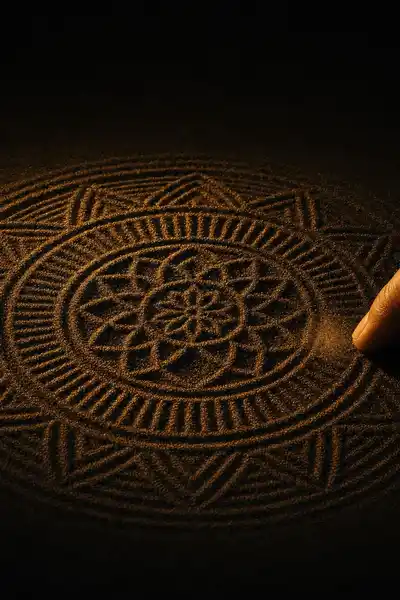
And the motifs were, of all things, religious. A voice announcing a sacred space. A house with an upper storey of the everyday and a cellar that opened onto something older. A recurring figure of an enclosed circle, a fourfold pattern, a center. The dreamer had not read the mystics; he would have been faintly embarrassed to. Yet his sleeping mind was producing, unprompted, the vocabulary of rite and initiation that Jung recognized from centuries of texts.

02Chapter 2 — A fact in the psyche, not a matter of belief
Jung's central move was to redefine the word religion for the length of his inquiry. He borrowed from the Latin sense of religio — a careful, scrupulous attention to something that grips a person from within — and set aside the modern sense of subscribing to a set of beliefs. Religion, in his working definition, was not what one professes but what one is seized by. A conversion, a compulsion, a dread that reorganizes a life — these were the phenomena, and they were observable whether or not any theology stood behind them.
This let him claim neutrality he thought his science required. He was not, he repeated, saying God exists; that was outside a psychologist's competence and always would be. He was saying that the experience of the numinous — a term he took from the theologian Rudolf Otto for that mixture of awe and dread in the face of something overwhelming — is an empirical fact of mental life. People have it. It changes them. It can be documented, in patients and in the historical record, with the same seriousness one brings to any recurring symptom.
03Chapter 3 — The Trinity, the mandala, and the arithmetic of wholeness
To show how these forms operate, Jung turned to material most psychologists wouldn't touch: dogma, and the crankish archive of alchemy. He read the Christian doctrine of the Trinity not as a proposition to defend but as a psychic diagram — an image of the self worked out over centuries, expressing a drive toward a unified, differentiated wholeness. Three, though, kept troubling him. A trinity felt to him like a totality with something left out, and he became preoccupied with the question of the missing fourth.
This is where the alchemists earned their place in the book. Jung had spent years in old, half-mad manuscripts of men trying to turn lead into gold, and had concluded they were only incidentally chemists. Their real operation, projected onto matter, was a drama of the soul: purification, dissolution, the union of opposites, the birth of a precious center. Where official theology counted to three, the alchemical and gnostic traditions kept insisting on the fourth term — the material, the dark, the feminine, the shadow that clean doctrine excluded. Wholeness, for Jung, required admitting what the sacred number had left out.
04Chapter 4 — When the gods come back through the basement
Step back from the case notes and Jung's larger claim comes into view: the religious function is permanent, so its symbols never actually leave. They only change address. When a civilization stops tending them consciously — stops housing them in shared rite and image — the energy does not dissipate. It sinks into what Jung called the collective unconscious and reappears where no one is guarding the door: in dreams, yes, but also in the fevers of a crowd, in the sudden sacredness attached to a leader, a nation, a doctrine of progress.
Writing in the late 1930s, Jung was not speaking abstractly. He watched the mass political movements of his own decade and read them as religious phenomena in disguise — the numinous, evicted from the churches, taking possession of politics with all its old force and none of its old restraints. A rite had at least framed the overwhelming and set limits around it. A political mania had the same grip and no frame, which was precisely what made it dangerous. The gods had not died; they had been demoted to ideologies, where they behaved worse.
05Conclusion
The book that began as three lectures at Yale ends where Jung's clinic began: with a dreamer who never asked for any of this, producing the old sacred shapes in the dark. Jung never claimed to have found God in the unconscious, and he was almost stubborn about saying so. What he claimed to have found was a function that behaves, in every observable way, as religions have always described — a pull toward a center, a dread of the overwhelming, a hunger for wholeness that outlasts every argument raised against it.