Psychology and Alchemy
Gold, God, and the inner self
Description
For most of the twentieth century, alchemy was the joke of the history of science: bearded men in smoky cellars, heating lead in the hope it would turn to gold, chasing a stone that never came. Isaac Newton spent years on it and everyone agreed to pretend he hadn't. Then, in the 1930s, a Swiss psychiatrist named Carl Jung started buying up the old alchemical treatises — the ones with pictures of kings drowning, hermaphrodites, dragons eating their own tails — and reading them not as failed chemistry, but as something closer to a dream diary of Europe. The book that came out of that reading, Psychology and Alchemy, appeared in 1944. It is one of the strangest things a famous doctor ever published.
Jung's claim was blunt and a little scandalous. The alchemists, he said, were not really making gold. They thought they were. But what they were actually doing, in the language of furnaces and solvents, was describing a transformation happening inside themselves — and they didn't know it. The gold at the end was never a metal. And here is the part that got him accused of both mysticism and heresy: the same drama, Jung argued, sits at the center of Christianity, in the figure of a God who descends into matter, dies, and is reborn.
So we have three things that supposedly have nothing to do with each other — a discredited proto-chemistry, a religion, and the modern consulting room — and one man insisting they are telling the same story in different costumes. It is easy to file this under Jung being Jung. It is harder, and more interesting, to follow the actual argument and see where the rhyme comes from.
The question we’re asking : Why would a serious psychiatrist spend years decoding the recipes of failed gold-makers, and what did he think they had accidentally written down?What we’ll see : How Jung came to read the furnace as a mirror, the Christian and the alchemical drama as one, and the whole enterprise as a map of the self.
Table of contents
01 Chapter 1 — The chemist who was praying without knowing it
Jung's starting point was a puzzle he had lived with for decades in his practice. His patients kept dreaming in symbols nobody had taught them — circles divided into four, kings and queens, water and fire, a hidden treasure guarded by an animal. These images didn't come from the dreamer's biography. They seemed older than the person having them. Jung had a word for this reservoir: the collective unconscious, a layer of the mind shared across humanity, stocked with recurring figures he called archetypes. The trouble was that he needed evidence from outside the clinic. He needed to find the same images somewhere they couldn't have been copied from him.
He found them in the alchemical corpus, and the fit unsettled him. Here were texts written across fifteen centuries, from Alexandrian Greeks to seventeenth-century Germans, full of the exact motifs his patients produced in their sleep. The alchemists wrote in an impossible private code — the same operation might be called a marriage, a death, a washing, a beheading. For a chemist this is nonsense; you cannot run a lab on metaphors that shift meaning every paragraph. Jung read it differently. If the language couldn't describe a real chemical process reliably, maybe it was never describing chemistry at all.

02 Chapter 2 — A dream of a strange house, and a doctor who followed it
Before Jung reaches the alchemists in the book, he spends a long stretch on something much closer to home: a series of dreams from a single patient, over four hundred of them, recorded in detail. The patient was a highly educated scientist — often identified as the physicist Wolfgang Pauli, though Jung keeps him anonymous — a man with no interest in mysticism and no knowledge of alchemy whatsoever. That was precisely the point. If these images surfaced in a rational skeptic, they weren't cultural clichés he had absorbed. They came from somewhere deeper.
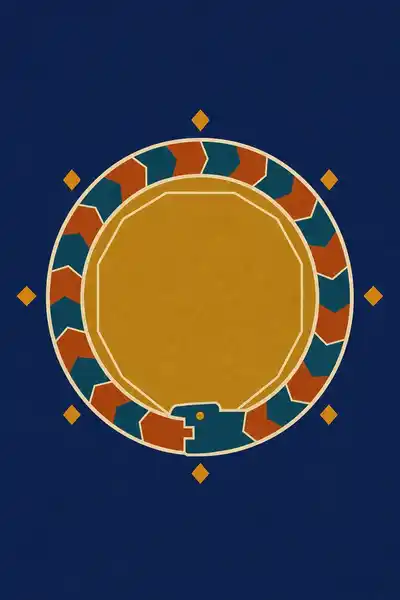
The dreams circle obsessively around a few shapes. A house with an unknown upper floor or hidden room. A journey around a square. Above all, the mandala — a circular figure with a fourfold structure, a center, a symmetry. Jung watched these dreams move, over months, from chaos and anxiety toward these ordered, centered forms, as if the dreamer's psyche were slowly organizing itself around a middle point it hadn't known it had. The center, in Jung's reading, was the self — not the everyday ego, but the total personality, conscious and unconscious together.
03 Chapter 3 — When the stone and the Christ start to rhyme
The boldest move in the book is where Jung sets the alchemical goal beside the central figure of Christianity and shows how far the parallel runs. The alchemists called their final product the lapis, the philosopher's stone — and they described it, astonishingly, in language borrowed straight from Christ. The stone was born lowly and despised, hidden in worthless matter, rejected by the ignorant. It suffered, was broken down, died, and rose again purified. It redeemed the base metals around it. Some texts flatly called the stone a second Christ, a savior of the natural world.
Jung didn't read this as blasphemy or as sloppy borrowing. He read it as the same archetype surfacing twice. Both stories describe a divine or precious thing that must descend into the lowest matter, be dissolved and killed, and be reborn transformed — and in doing so redeem what surrounds it. In Christianity, God takes on flesh and the drama is played out once, in history, by a single perfect figure. In alchemy, Jung argued, the operator has to complete the redemption himself, in his own dark matter, again and again in the flask. The alchemist becomes, quietly, a kind of co-redeemer of nature.
04 Chapter 4 — The lab was always the inside of a head
Step back from the flasks and the woodcuts, and what Jung is really describing is a process he named individuation: the slow, lifelong work of a person becoming whole, integrating the parts of themselves they've disowned, and arriving at a center that isn't the anxious little ego but the fuller self. The alchemical opus, in his hands, is a four-hundred-year-hallucinated instruction manual for that process — written by people who thought they were doing chemistry. The blackening, the dissolving, the deaths and rebirths in the vessel are the stages of a psyche taking itself apart and putting itself back together.
This is why Jung treats the alchemists as allies rather than as a quaint dead end. They stumbled onto something modern psychology would only formalize much later: that the mind does not experience its own transformation directly. It needs images, symbols, a story projected onto the outer world before it can be recognized inside. The alchemists projected onto metal. The Christian projects onto the figure of God. The modern patient projects onto the strange house and the mandala in a dream. The screen changes; the film is the same.
05 Conclusion
Jung never claimed the alchemists were secretly enlightened, nor that their recipes worked. Lead stayed lead. What he claimed is that they had written down, in the only vocabulary they possessed, the same transformation his patients kept dreaming and the same drama Christianity had raised into dogma — a descent into darkness, a dissolution, a rebirth, a precious center recovered. The furnace, the cross, and the consulting room turned out to be three stages for one recurring play about becoming whole.
Related books