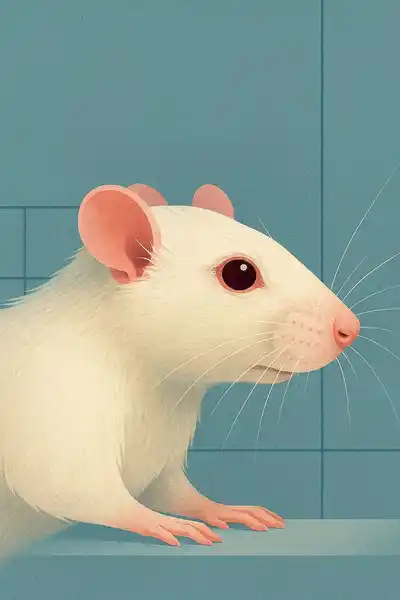
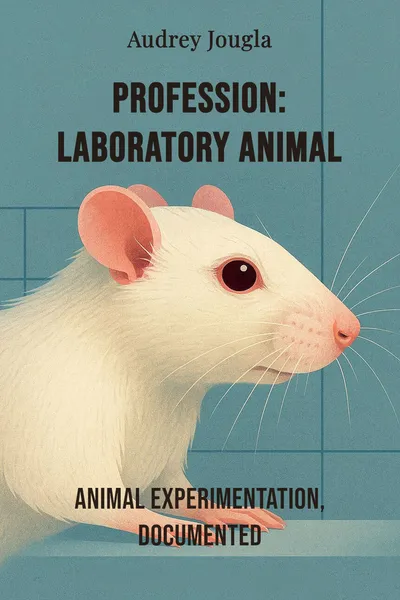
Profession: Laboratory Animal
Animal experimentation, documented
Description
Audrey Jougla wanted to see for herself. A philosophy graduate turned journalist, she spent months trying to get inside the places where animals are used for science — the laboratories, the breeding facilities, the corridors of universities and pharmaceutical companies where, every year, millions of mice, rats, rabbits, dogs and primates live and die under protocol. What she found first was not cruelty. It was a door that would not open. Requests went unanswered, tours were declined, forms circled back to other forms. The secrecy itself became her subject before she had even seen a cage.
When she finally got in — sometimes officially, sometimes through people willing to talk off the record — the picture that emerged was harder to hold than either camp wants it to be. Not the sadistic scientist of activist leaflets, not the noble march of progress of institutional brochures. Instead: ordinary people doing careful, regulated work, inside a system arranged so that almost no one, including the technicians, ever has to look at the whole of it. That arrangement is what her book documents.
The book is less an indictment than a report from a place the rest of us are kept away from. It counts, it describes, it asks what the official language is doing. And it lands on the framework the whole field points to whenever it is questioned — a set of principles nearly everyone endorses, and almost no one can guarantee.
The question we’re asking : What actually happens inside animal experimentation once the door is opened, and what does the reassuring language around it conceal?What we’ll see : An investigation into a world kept deliberately out of sight — its scale, its vocabulary, and the ethical framework it leans on to keep going.
Table of contents
01 Chapter 1 — Behind a door nobody opens
The first thing Jougla ran into was not a fact but a refusal. She wanted access to laboratories, and access is precisely what the system is built to control. Journalists are rarely let in. Photographs are almost never allowed. The buildings themselves are designed to be unremarkable — no signs, no windows onto the animal rooms, entrances that give nothing away. A place where hundreds of thousands of animals are housed can sit on a campus for decades without most students knowing it is there.
This opacity, she argues, is not incidental. It is load-bearing. A field that operated in full view would have to defend, in public and in detail, things that are easier to keep abstract: the smell of the rooms, the sound the animals make, what a procedure actually looks like from the animal's side of it. Kept behind the door, all of that stays a rumor. The institution can speak in the language of ethics committees and welfare protocols while the sensory reality stays sealed off.

02 Chapter 2 — The numbers, and what the numbers leave out
The scale is genuinely hard to picture. Across the European Union, official figures put the number of animals used in research and testing at roughly ten to eleven million a year; worldwide estimates run into the tens of millions, and some counts far higher once breeding surplus is included. The overwhelming majority are rodents — mice above all, then rats — followed by fish, birds, rabbits, and much smaller numbers of dogs, cats and non-human primates. The primates get the headlines. The mice do the dying.
Jougla's point is not simply that the numbers are large. It is that the numbers are constructed. What gets counted, and how, is a matter of definitions, and the definitions are set by the same world being measured. Animals bred for research but never used in a protocol — killed as surplus, or because they carried the wrong genetic profile — have historically been easy to leave out of the totals. The figure that reaches the public is the tidy one. The messier arithmetic stays in the facility.
03 Chapter 3 — The word that makes it bearable
A trained philosopher, Jougla pays close attention to vocabulary, because vocabulary is where a difficult practice gets domesticated. Inside the laboratory, an animal is a model. It is not killed; it is sacrificed, or euthanized, or the study is terminated. A procedure that would be described in plain terms outside the building becomes, inside it, a protocol with a severity classification. Each word is technically accurate. Each one also puts a layer of gauze between the person and the act.
This is not, in her telling, a conspiracy of euphemism. It is how any demanding profession makes itself livable. Surgeons, soldiers, undertakers all develop a language that lets them keep functioning. The scientific vocabulary of animal research does the same work: it converts a living creature into a variable, a countable unit in an experimental design. Once it is a model, the moral weight shifts. You do not grieve a data point.
04 Chapter 4 — A framework built to reassure
Whenever the practice is challenged, the field reaches for the same answer: the three Rs. Formulated in 1959 by the British researchers William Russell and Rex Burch, the principle asks that experiments Replace animals with alternatives wherever possible, Reduce the number used to the minimum, and Refine procedures to lessen suffering. It is now written into European law and invoked in nearly every ethics review. It is, Jougla acknowledges, a genuine ethical advance — and this is precisely what makes it worth examining.
Because the three Rs do two jobs at once. They set a real standard, and they reassure. A framework that everyone endorses becomes a framework that ends the argument: if the three Rs are being applied, the conscience is covered. The trouble is that two of the three are elastic. Reduction and refinement improve conditions without questioning the practice itself — fewer animals, less pain, but the logic of using them stays whole. They make the system more humane and, in doing so, more durable. Discomfort managed is discomfort defused.
05 Conclusion
Jougla began at a door that would not open, and much of what she found only confirmed why it stays shut. Not because something monstrous is hidden behind it, but because the ordinary reality of animal research — the scale, the routine, the careful vocabulary, the ethics forms — is easier to accept when it is not looked at directly. Her report does the looking. It counts what is usually rounded off, translates the words back into what they describe, and follows the reassuring framework to the edge of what it actually promises.
Related books