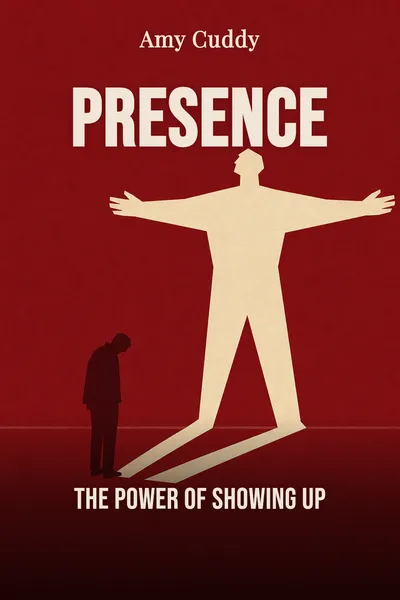
Presence
The power of showing up
Description
In 2012, a social psychologist named Amy Cuddy stood on a TED stage in Edinburgh and told a story she had never told publicly. Years earlier, a car accident had left her with a serious brain injury; she was told she might not finish college. She did — eventually, and then some, landing at Princeton and later on the Harvard Business School faculty. But for years she carried a conviction that she didn't belong in any of the rooms she'd fought her way into. That talk went on to become one of the most viewed in TED's history, tens of millions of views and counting, largely because of a single, oddly physical idea: that standing a certain way for two minutes might change how you feel about yourself.
The talk made Cuddy famous and, later, made her the center of a heated scientific argument about whether the specific effect she'd described held up. Her 2015 book grew out of the same material but reached for something wider than a stage trick. It is less about a pose than about a question most of us recognize but rarely name: why do we so often fail to be ourselves precisely when it matters most — the interview, the pitch, the hard conversation — and walk away thinking, that wasn't me, I know I could have done better.
Cuddy calls the alternative presence. Not charisma, not dominance, not the confidence that fills a room. Something quieter and harder: the state of being genuinely tuned to your own thoughts, values and abilities, so that what you show the world matches what's actually inside you. The book is an attempt to explain where that state comes from, why it deserts us under pressure, and how we might coax it back.
The question we’re asking : Why do we so often fail to be ourselves in the moments that matter most — and can that be changed?What we’ll see : How a psychologist rebuilt the idea of confidence from the body up, and where the science got contested along the way.
Table of contents
01 Chapter 1 — The moment we most want to nail, and most often blow
We all have a version of the scene. A job interview, a first date, a presentation to people who could change the direction of a career. The stakes are high, we've prepared, we care — and something goes sideways. We overexplain or clam up, we hear our own voice go thin, we perform a nervous impression of ourselves. Afterward the regret isn't really about the outcome. It's the sense that the real person, the one who is perfectly capable, never showed up in the room.
Cuddy's starting point is that this is nearly universal and almost never talked about honestly. She spent years studying it partly because she lived it. After her brain injury, and again as a first-generation academic surrounded by people who seemed born to their seats, she felt like an impostor waiting to be found out. The feeling is common enough to have a name — impostor phenomenon, described by the psychologists Pauline Clance and Suzanne Imes back in the late 1970s — and Cuddy's contribution is to treat it not as a personal flaw but as a predictable response to feeling powerless.

02 Chapter 2 — What the body tells the brain
The through-line of the book is that the mind and body run a two-way conversation, and we've badly underweighted one direction of it. We know feelings shape posture — sadness slumps us, confidence squares our shoulders. Cuddy's interest is the reverse: that posture might feed back into feeling. Adopt an expansive, open stance and you may nudge yourself toward a more powerful internal state; fold inward, make yourself small, and you may deepen the sense of being small.
This is where the famous idea lives. In work with Dana Carney and Andy Yap, published around 2010, Cuddy reported that holding an expansive "high-power pose" for two minutes — think of the way people throw their arms up after crossing a finish line — was associated with feeling more powerful, a greater willingness to take risks, and even hormonal shifts, higher testosterone and lower cortisol. The practical translation was seductive: before a big moment, slip into a bathroom or a stairwell, stand tall for a couple of minutes, and prime yourself to bring your real self into the room.
03 Chapter 3 — The trap of trying to fake it
The most quoted line from Cuddy's talk is "fake it till you become it" — a deliberate revision of the older "fake it till you make it." The distinction is the whole point, and it's where the book pushes back against a familiar self-improvement script. Faking it to make it means performing a version of yourself you don't believe in, hoping the world buys it. That, Cuddy argues, tends to backfire, because pretending is effortful and people read the effort as inauthenticity. We can smell a performance, including our own.
Faking it to become it is subtler. It means using small physical and behavioral adjustments not to impersonate a more impressive person, but to quiet the anxiety that's blocking access to the person you already are. The goal isn't to add confidence you lack; it's to remove the self-doubt that's crowding out resources you have. Presence, in this telling, is a matter of subtraction as much as addition.
04 Chapter 4 — Bringing yourself, not a better version of yourself
Step back from the pose and the peer-review fights, and the book is making a claim that cuts against most of the advice industry it sits beside. The self-help shelf largely sells transformation: become more assertive, more magnetic, more like the successful people you admire. Cuddy's argument runs the other way. The problem in the moments that matter isn't that we're insufficiently impressive. It's that we're not present — we've left ourselves at the door and sent an anxious understudy in our place.
That reframing is quietly radical for anyone who has spent a life feeling like an impostor. It says the work isn't to acquire a self worth showing, but to trust the one already there enough to let it be seen. Cuddy leans on the idea, drawn partly from the self-affirmation research of Claude Steele and others, that reconnecting with your core values before a stressful event steadies you more than rehearsing a slicker version of yourself. You perform best not when you're trying hardest to be liked, but when you've stopped auditioning.
05 Conclusion
Cuddy stood on that Edinburgh stage as living proof of her own thesis: someone who had spent years feeling like she didn't belong, telling millions of people that the belonging was never really the question. The talk and the book that followed turned a small physical experiment into a very large conversation, and then that conversation turned on the experiment, testing its parts and finding some of them wanting. The two-minute pose became famous, then contested, then quietly right-sized into what it probably always should have been — a doorway, not a machine.
Related books