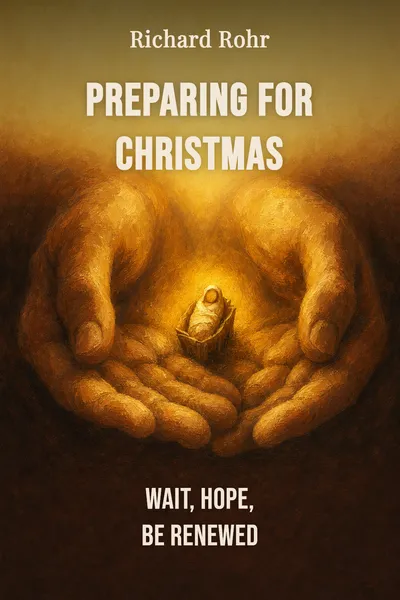
Preparing for Christmas
Wait, hope, be renewed
Description
By early December, the machinery is already running. Lights go up, calendars fill, the shopping starts, and the four weeks before Christmas turn into a sprint toward a deadline. Somewhere underneath the noise sits an older idea most of us have half-forgotten: that this stretch of the calendar was never meant to be a countdown to a party. It was meant to be a season of its own, with its own texture — slower, darker, stranger than the celebration it leads to. The Franciscan writer Richard Rohr calls that season Advent, and in a short book of daily meditations titled Preparing for Christmas, he tries to hand it back to us.
Rohr's premise is quietly disruptive. Advent, he argues, is not the warm-up act for Christmas. It is a spiritual practice in itself, built around a posture we are terrible at — waiting. Not the impatient waiting of a checkout line, but the kind that stays open, alert, unhurried, willing to sit in the dark before dawn. The book is deliberately brief: a handful of pages a day, meant to be read in the quiet, not consumed in one sitting. Its subject is what happens inside a person who agrees to slow down and pay attention.
That is a hard sell in a month engineered for acceleration. Yet Rohr keeps circling three words — wait, hope, be renewed — and insisting they belong together. What he offers is less a set of instructions than an invitation to notice what the rush is costing us, and what a different pace might make room for. It is worth staying with, if only to see what the season looks like when we stop treating it as an obstacle between us and the holiday.
The question we’re asking : What does Rohr mean when he says Advent is a practice we keep skipping — and what would it mean to actually keep it?What we’ll see : How a short book of daily meditations reframes the weeks before Christmas as a school of waiting, smallness, and quiet renewal.
Table of contents
01 Chapter 1 — The season we keep trying to skip
Rohr opens by naming the thing everyone feels but rarely says: we have collapsed Advent into Christmas. The four weeks that once had their own mood — expectant, a little somber, tuned to longing rather than fulfillment — have been overwritten by an early, relentless festivity. By the time the actual feast arrives, we are exhausted by a celebration that started weeks too soon. Something has been lost in the merge, and Rohr thinks it is something we badly need.
What Advent traditionally holds, in his telling, is a deliberate posture of incompleteness. The church built these weeks around the sense of something not yet here, a promise not yet kept. That is an uncomfortable place to sit, which is exactly why we rush past it. We would rather have the arrival than the waiting, the answer than the question, the light on already rather than the honest acknowledgment of the dark. Advent asks us to stay in the dark a little longer, and to stop pretending it is not there.

02 Chapter 2 — Waiting as its own discipline
Waiting, for Rohr, is not passive. That is the reframe at the heart of the book. We tend to treat waiting as dead time, a nuisance to be filled or eliminated. He insists it is a discipline, even a skill — one of the hardest things a person can learn to do well. To wait rightly is to stay present to an incompleteness without rushing to resolve it, to hold a question open long enough for it to change you rather than grabbing the first answer that quiets your anxiety.
He draws on the biblical figures the Advent readings return to each year — the prophets who spoke into long silences, John the Baptist calling from the wilderness, and especially Mary, who carries a promise she cannot control or hurry. These are not people managing a schedule. They are people learning to live inside a delay they did not choose, keeping faith with something they cannot yet see. Rohr reads them less as historical actors than as teachers of a posture, models of what it looks like to remain expectant without becoming impatient.
03 Chapter 3 — The scandal of a God who becomes small
At the center of Advent stands the idea Rohr finds most radical and most easily domesticated: incarnation. The claim that the divine arrives not in power but in a baby, not in a palace but in a feeding trough on the edge of an occupied province. We have heard the nativity so many times it has gone soft, but Rohr wants to recover its edge. The story is scandalous. It says the sacred shows up in weakness, in vulnerability, in the utterly unremarkable — a poor family, a borrowed shelter, a child with no protection at all.
This is the theological weight under all the talk of waiting. What we are waiting for, in Advent, is not a triumph. It is a descent. Rohr reads incarnation as God's willingness to become small, to enter human limitation from the inside rather than fixing it from above. And that reframes everything about how transformation happens. If the divine chooses smallness, then the places we are tempted to overlook — our own poverty, failure, and helplessness — turn out to be exactly where something new can be born.
04 Chapter 4 — What Advent asks of the rest of the year
Step back from the calendar and Rohr's Advent starts to look less like a seasonal exercise and more like a description of how a human life actually changes. That is the wider claim underneath the daily meditations. The pattern the season rehearses — waiting in the dark, staying present to what is unfinished, becoming small enough to receive something unearned — is not special to December. It is, in his view, the shape of every genuine transformation we ever undergo.
We would prefer transformation to work the way the rest of our lives work: through effort, planning, and control. Set a goal, apply willpower, produce a result. Rohr's whole tradition insists it does not work that way, not the deep kind. The changes that actually remake a person tend to come through experiences we did not choose and could not engineer — loss, waiting, limitation, the slow collapse of what we thought we could manage. Advent is a rehearsal for meeting those seasons well, a yearly reminder that the important things arrive rather than get built.
05 Conclusion
The book ends where it began, on a single quiet suggestion: that we let the season be what it was meant to be. Not a countdown, not a deadline, but four weeks of practiced attention — enough time to feel a longing before it is answered, to sit in the dark before the light, to make room before the gift. Rohr never pretends this is easy. His whole method is to keep the readings short and the pace slow, trusting that a few minutes a day, repeated, can do what a grand resolution cannot. The invitation is modest by design.
Related books