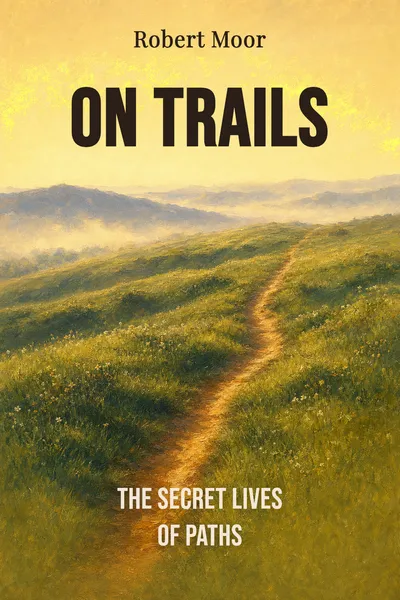
On Trails
The secret lives of paths
Description
In the spring of 2009, Robert Moor set out to walk the Appalachian Trail, roughly 2,200 miles of dirt threading from Georgia to Maine. He spent about five months on it, doing what thru-hikers do: eating badly, sleeping in shelters, losing toenails, watching his own mind narrow to the strip of ground in front of his boots. Somewhere in the mud of that long walk, a small question lodged itself and refused to leave. He was following a line other people had drawn — but who drew it, and why there? Why this ridge and not the next one over? The trail felt permanent, almost natural, the way a river feels natural. It is not. Someone, or something, made every foot of it.
That itch became a book. Moor spent years afterward chasing trails backward through time and across species — following elephant paths, fossilized tracks half a billion years old, sheep runs in the highlands, the desire lines worn into campus lawns. What he found was that a trail is not a thing so much as a process: a conversation between many bodies and a piece of ground, written slowly, one footstep at a time. Paths are not laid down and finished. They are constantly negotiated, improved, abandoned, and rerouted by everyone who uses them.
The subject sounds modest — dirt, feet, direction. It turns out to open onto something much larger about how any group finds its way. Moor came off the mountain with a hunch that the humble footpath might be one of the deepest things we have ever built together, and that we have been building versions of it long after we stopped walking anywhere.
The question we’re asking : How does a path come into being, why do some grow stronger with use while others vanish, and what makes us follow one at all?What we’ll see : A walk that turns into an investigation of how living things, over hundreds of millions of years, learned to leave a usable line behind them.
Table of contents
01 Chapter 1 — Five months of walking, one nagging question
The trail Moor walked did not feel like an invention. That was the strange part. After weeks on the Appalachian Trail, the white blazes painted on the trees began to seem less like directions and more like facts of the landscape, as fixed as the granite. He could switch his thinking off entirely and let his feet carry him. And that surrender was exactly what started to bother him. Something so effortless to follow had to have been enormously difficult to make — and yet no single person had made it, and no single person could have.
The Appalachian Trail as he knew it was itself the product of endless revision. Conceived in the 1920s by the forester Benton MacKaye as a kind of social escape valve, it was stitched together over decades from older Native footpaths, logging roads, farm tracks, and stretches of pure improvisation, then rerouted again and again as land changed hands and hikers wore new grooves. What looked like one clean line was really thousands of decisions layered on top of each other, most of them made by people long gone who never met and never coordinated.

02 Chapter 2 — What a fossil trail teaches about the first paths
To find the origin, Moor went looking for the oldest trail on Earth. It led him to the fossil beds of Newfoundland, at a place called Mistaken Point, where the rock preserves marks left by some of the first mobile animals — soft, simple creatures that lived on the seafloor roughly 565 million years ago, before there were legs or eyes or anything we would recognize as a head. Among the impressions is a faint, meandering groove: evidence that one of these organisms moved across the mud in a deliberate line. It may be the earliest trail we have ever found.
The lesson he drew from it is disarmingly basic. A trail begins the moment a living thing needs something that is somewhere else. Food, warmth, a mate, safety — the body reaches toward it, and in reaching, leaves a mark. That first mark is not yet a path. It becomes one only when a second creature reads it and finds it useful enough to follow. A trail, in other words, requires at least two: one to write, one to read. It is the oldest form of communication that does not need a voice.
03 Chapter 3 — The animal, the herd, and the wisdom of the worn groove
Between the fossil and the hiker sit the animals, and this is where Moor's investigation gets its richest material. He spends time with the trails of sheep, deer, and especially elephants, whose ancient migratory routes across Africa were so intelligently laid — always finding the lowest pass, the reliable water, the firmest footing — that early human road-builders often simply followed them. Some modern highways trace lines first surveyed, in effect, by animals that could not read a map but could feel a slope through their feet.
The key idea he draws from herds is that a good trail does not require a single smart individual. It emerges from many ordinary ones, each making a mediocre local choice, whose choices average out into something wise. A lone ant wandering is nearly random. But an ant that stumbles onto a shorter route home lays down a little more scent, which pulls a few more ants onto it, which lays down more scent — and within hours the colony has collectively solved a routing problem that no ant understood. The trail is smarter than any of its makers.
04 Chapter 4 — From footpath to fiber-optic cable
Step back from the dirt and Moor's argument opens wide. The trail, he suggests, is a template we have used for almost everything we build together. It is our oldest technology for taking the hard-won experience of many bodies and compressing it into a form the next person can use without repeating the effort. Once you see paths that way, you start finding them where there is no ground at all.
Language works like a trail. A word is a groove worn smooth by millions of mouths, a route to a meaning that we follow without ever having to reinvent it. Roads are literal trails hardened into asphalt, most of them tracing lines that footpaths and cart tracks proposed centuries earlier. The internet, Moor points out, is described in the vocabulary of the trail almost by instinct — we speak of navigating, of pages we visit, of the paths a signal takes through cable laid, often enough, along old railway beds that themselves followed rivers and passes. The medium keeps changing. The logic of the worn line does not.
05 Conclusion
Moor came off the Appalachian Trail with a blister collection and a question, and the question turned out to be bigger than the walk. The line he had followed so mindlessly for five months was, he learned, the same kind of thing as the groove in the Newfoundland rock, the elephant route under the highway, the word in his mouth, the cable under the sea. All of them are experience made walkable — the labor of many bodies saved up and handed forward, free, to whoever comes next.
Related books