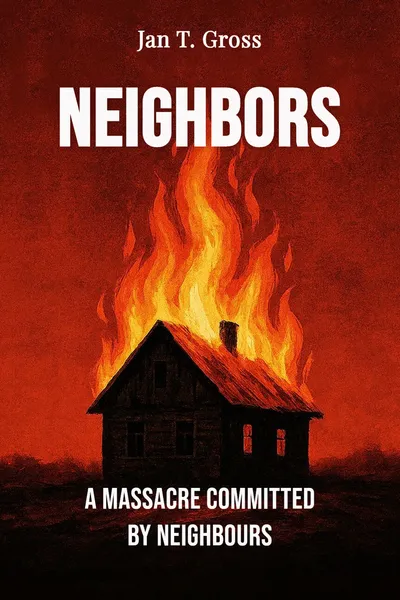
Neighbors
A massacre committed by neighbours
Description
On July 10, 1941, in the small town of Jedwabne in northeastern Poland, roughly half the population murdered the other half. The killers were not Germans shipped in for the task. They were Catholic Poles — farmers, a cobbler, a postman, men who had sold goods to the people they were about to kill. The victims were the town's Jews, several hundred of them, driven that day into a barn at the edge of the village. The barn was doused with kerosene and set alight. By evening a community that had shared the same market square for generations had, in the most literal sense, ceased to exist.
For nearly sixty years, the official account was simpler and more bearable: the Germans did it. A stone monument near the site said as much. The German occupation had begun only weeks earlier, when the Wehrmacht pushed the Soviets out of eastern Poland, and under occupation almost any atrocity could be laid at the occupier's door. The town remembered, more or less, what had happened. It simply did not say it out loud. Then, in 2000, a Polish-born historian named Jan T. Gross published a short book that named the killers as the neighbors they were.
The book was barely more than a hundred pages, built from survivor testimony, a postwar trial transcript, and a long-ignored memorial account. It set off one of the fiercest arguments Poland has had with itself since the war. Gross's reconstruction of a single summer day in one obscure town forced a question that reached far past Jedwabne.
The question we’re asking : What exactly happened in Jedwabne on July 10, 1941 — and why did it take almost sixty years for Poland to say who did it?What we’ll see : How Gross rebuilt a day from fragments, and how a nation that saw itself only as a victim reacted when the mirror turned.
Table of contents
01Chapter 1 — The town where everyone knew everyone
Jedwabne was the kind of place where anonymity was impossible. Before the war it held perhaps 2,500 people, and something close to two-thirds of them were Jewish. The two communities had lived side by side for generations in the ordinary, uneven way of such towns — shopping in the same market, borrowing and lending, speaking a shared language of everyday transaction, while keeping separate schools, separate prayer, separate marriages. This was not a sudden collision of strangers. The men who would do the killing and the people they killed had names for each other. They knew whose shop was whose, whose children played together, who owed whom.
Gross is careful about this intimacy because it is the whole weight of the book. The horror of Jedwabne is not that faceless soldiers destroyed a faceless community. It is that the destruction was carried out by people the victims could recognize. A survivor could later say who had held the club, who had driven the column toward the barn. That specificity is precisely what the German-perpetrator story erased, and what Gross insists we hold onto.

02Chapter 2 — The day of July 10, 1941
The violence did not begin at the barn. By Gross's reconstruction, the town's Jews were first driven into the market square, where they were forced to perform humiliations — among them pulling up grass with their hands, weeding the square, carrying a statue of Lenin left over from the Soviet period while chanting that the war was their fault. Men were beaten. Some were killed in the square itself, individually, with farm tools and clubs, before the larger slaughter was organized. The torment was public and unhurried, watched by a town that knew exactly who was being tormented.
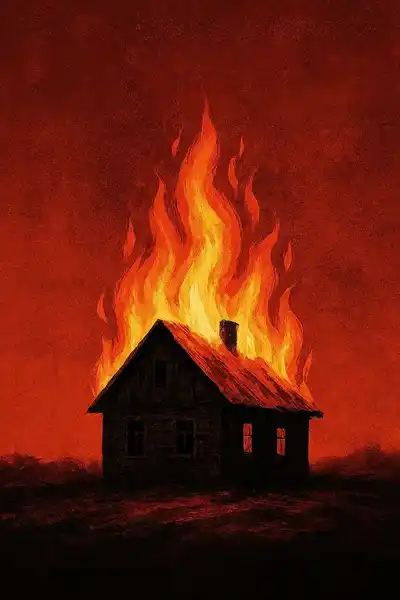
Then came the barn. The surviving Jews — men, women, children, several hundred by most estimates — were herded through the streets toward a wooden barn belonging to a local farmer on the town's edge. They were forced inside. The doors were secured. The barn was soaked with kerosene, almost certainly from German stocks, and set on fire. Those who tried to escape were pushed back. When it was over, the killers dug through the ashes for valuables and divided up what the dead had owned — houses, bedding, pots, the ordinary furniture of lives that had ended that afternoon.
03Chapter 3 — The story Poland had told itself
For most of the postwar era, Poland understood its wartime self through a single, largely accurate story: the country had been invaded, partitioned, occupied with exceptional cruelty, and had suffered enormous losses, including the near-total destruction of its three million Jews on Polish soil. Poles had resisted. Poland was, in this account, a victim nation and a nation of victims — and among occupied peoples it had one of the proudest records of rescue, with more individuals honored at Yad Vashem than any other country. The monument near the Jedwabne barn fit this story perfectly: it blamed the Germans, and the story closed.
Gross's intervention did not deny Polish suffering. It inserted something the national story had no slot for. The victim could also, in a specific place on a specific day, be the killer. That the same population could contain both the family who hid survivors at mortal risk and the men who lit the barn was not a contradiction to be resolved but a reality to be faced. The book's quiet radicalism was its refusal to average these things out into a comfortable balance.
04Chapter 4 — When a thin book broke the mirror
What Gross had really detonated was a question about how a nation metabolizes guilt. There is a world of difference between mourning what was done to you and admitting what was done by you, and Jedwabne forced Poland across that line in public. A country that had earned, with justice, the status of victim was asked to hold a second fact in the same hand — that victimhood confers no immunity, that ordinary people under pressure and with opportunity can become murderers of the people next door. That is a harder thing to teach children than heroism, and nations are built on the stories they teach children.
The backlash was therefore inevitable and revealing. Critics attacked Gross's sources, his estimates, his tone, sometimes fairly and sometimes as a way of shrinking the crime back to a size the national story could accommodate. Blame drifted back toward the Germans; numbers were contested; the single word that mattered — neighbors — was argued over endlessly. The fight was never only about one town. It was about whether a self-image could survive the admission of an exception, and whether the exception was really so exceptional.
05Conclusion
The barn is gone. A monument stands near where it burned, this one naming the inhabitants of the town rather than the occupier, the product of an inquiry that came half a century too late for anyone it might have comforted. The survivors who testified are nearly all dead, as are the men tried in 1949. What Gross recovered from their words was not a comprehensive history — he was always frank about the thinness of the record — but a shape: a morning of humiliation in the square, a march, a locked door, a fire, and a town that went on living on the property of the dead.
Related books