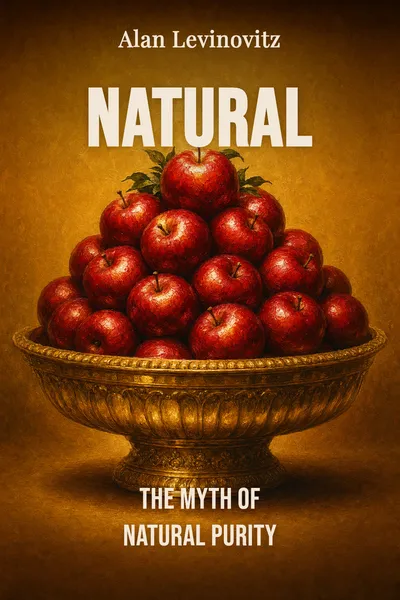
Natural
The myth of natural purity
Description
Walk down any supermarket aisle and the word is everywhere, printed on egg cartons, shampoo bottles, chicken breasts, and mineral water. It carries no legal definition worth the ink in most of these places, and yet it moves us. We reach for the natural yogurt over the one beside it, pay more for the natural cleaning spray, feel a small flicker of virtue doing so. Alan Levinovitz, a scholar of religion who teaches at James Madison University, noticed that flicker and asked a simple question: what exactly are we buying when we buy natural, and why does the word feel less like a description than a blessing?
His answer, laid out in his book Natural, is that the word rarely tells us anything about the physical world. Uranium is natural. Arsenic is natural. Childbirth without pain relief is natural and so is dying in it. Vaccines are not, and neither is the roof over our heads. Once you start testing the word against actual things, its promise of safety and goodness dissolves almost immediately. What remains is something older and stranger — a feeling that certain things are pure and certain things are corrupt, and that we can sort the world along that line.
Levinovitz is not out to defend pesticides or dismiss anyone who prefers a garden tomato. His target is the reflex itself, the way natural has quietly become a stand-in for good, healthy, and right, closing arguments before they begin. He treats it the way a religion scholar would treat any sacred word — with curiosity about where it came from and what it lets us avoid saying out loud.
The question we’re asking : Why does the word natural feel like proof of goodness when it describes nothing reliable about the physical world?What we’ll see : How a religion scholar traces our faith in the natural, and what that faith quietly costs us.
Table of contents
01 Chapter 1 — The word that ends the argument
Levinovitz opens with a philosophical embarrassment that has a name: the appeal to nature. It is the assumption that because something is natural it must be good, and because something is artificial it must be suspect. Philosophers have been pointing out the hole in this for centuries — David Hume noted that you cannot slide from what is to what ought to be, and the twentieth-century philosopher G. E. Moore called the move to define good in terms of any natural fact the naturalistic fallacy. The reasoning does not hold. And yet we lean on it constantly, because it does something no argument does: it ends the conversation.
That is the real work the word performs. When a product is labelled natural, we stop asking questions. We do not check whether the natural version is safer, or better tested, or kinder to the body; the label has already delivered the verdict. Levinovitz shows how marketers understood this long before the rest of us did. The natural claim is cheap to make, nearly impossible to police, and it reliably moves people to pay more. In the United States the label on most foods means close to nothing in regulatory terms, and everyone in the industry knows it.

02 Chapter 2 — A god by another name
This is where Levinovitz's training pays off. He argues that Nature, capital N, functions in modern secular life the way a deity functions in a religion. We may no longer believe in a designer who made the world good, but we have kept the feeling — that behind the mess of existence there is an order that is wise, benevolent, and worth obeying. Nature inherited the job. It became the thing that knows best, the authority we appeal to when we want something to be true without having to argue for it.
He traces the lineage carefully. The idea of a harmonious natural order runs from ancient thinkers through the Romantic poets who recoiled from factory smoke, and it hardens into a moral vision: the pristine wilderness as Eden, the machine and the chemical as the fall. The word purity does a lot of work here, and Levinovitz lingers on it, because purity is a religious concept before it is a chemical one. To call a food pure is to make a statement about its soul, not its molecules. Bottled water sold as pure is selling the absence of contamination the way a temple sells the absence of sin.
03 Chapter 3 — When natural turns cruel
The book turns darker when Levinovitz follows the faith into places where it hurts people. The most searching chapters concern childbirth. The natural-birth movement grew, understandably, as a reaction against decades of over-medicalized delivery, and it recovered something real — that labour is not a disease and women are not passive patients. But Levinovitz shows how the ideal curdles. When a natural birth becomes the only virtuous birth, a woman who needs an epidural or a cesarean can be made to feel she has failed a moral test, that she has let something artificial defile a sacred event. The pursuit of purity turns pain into a badge and intervention into shame.
He is careful and fair here. He is not against unmedicated birth, and he honours the women who choose it. What he objects to is the ranking, the quiet insistence that the less intervention, the more authentic the experience, as if suffering were the proof of the real. That logic, followed far enough, has cost lives, when the refusal of medical help becomes a point of principle rather than a weighing of risks.
04 Chapter 4 — The label that hides the choice
Step back from the yogurt and the birth plan, and a single pattern comes into focus. The word natural lets us make a value judgment while pretending we are only reporting a fact. When we say a food is natural and therefore better, we sound like we are describing the world. We are actually announcing what we care about — simplicity, tradition, distrust of industry, a longing for a world that feels less engineered. Those are real values, and Levinovitz has no quarrel with them. His quarrel is with the disguise.
Because the disguise costs us the argument we most need to have. If natural settled every question, we would never have to weigh a tomato's flavour against a farmworker's wages, or a home birth's intimacy against a hospital's safety net, or the comfort of an old remedy against the evidence for a new drug. These are genuine trade-offs, and they deserve to be reasoned through in the open. The natural label lets us skip them. It hands us a verdict so we never have to sit with the difficulty of choosing.
05 Conclusion
We began at the supermarket shelf, reaching for the word without noticing we were reaching for a blessing. Levinovitz does not want to take the tomato out of our hands. He wants us to know what we are doing when we choose it — to see that the label promising purity is telling us a story about goodness, not a fact about safety, and that the story came from somewhere with a long human history behind it.
Related books