Mysticism Sacred and Profane
Sacred and profane worlds
Description
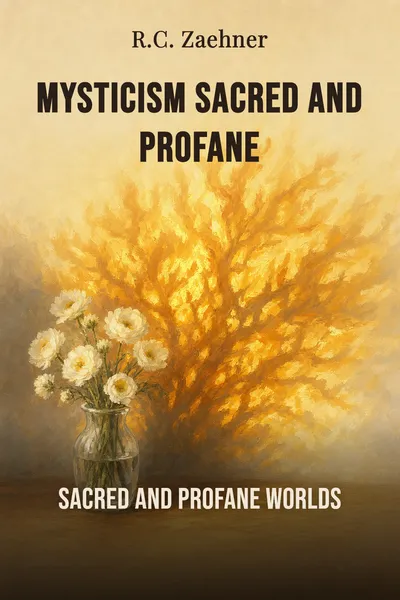
In 1953, the writer Aldous Huxley swallowed four-tenths of a gram of mescaline in a house in Los Angeles, watched a vase of flowers become the burning bush, and concluded he had touched what the mystics touched. He wrote it up in a slim, dazzling book called The Doors of Perception, and it landed like a manifesto: the visionary states of the great contemplatives, Huxley suggested, were on the same spectrum as the ones a chemist could hand you in an afternoon. Saints and psychonauts were drinking from the same well.
One reader took this personally. R.C. Zaehner was an Oxford scholar of Persian and comparative religion, a convert to Catholicism, and — as it happens — someone who had taken mescaline himself before writing a word against Huxley. His response, published in 1957 as Mysticism Sacred and Profane, is not a pious dismissal. It concedes that the drug does something, that the experiences are real, that they resemble certain famous accounts. Then it asks the harder question Huxley skipped: resemble is not the same as are. Do all these states point to one summit, or are we lumping together things that only look alike from a distance?
Zaehner's answer is a sorting operation — patient, sometimes combative, drawn from Hindu, Muslim, Christian and clinical sources. He wanted to break the comfortable modern assumption that mysticism is a single, universal experience wearing different local costumes. What if, instead, there were several genuinely different things going on under the one word?
The question we’re asking : When people across religions and centuries report "union with the all," are they describing the same experience — or several very different ones we've carelessly filed together?What we’ll see : How one scholar, mescaline in his own bloodstream, took the modern idea of a single universal mysticism apart and put three rival things in its place.
Table of contents
01 Chapter 1 — A drug, a book, and a quarrel
The quarrel that produced the book is worth getting right, because it is not the one people assume. Zaehner does not argue that Huxley's mescaline experience was fake, shallow, or merely chemical noise. He takes it seriously enough to reproduce it: before writing, he arranged to be given mescaline himself, under observation, and recorded what happened. The results were, by his own account, less transcendent than farcical — he found the whole thing veering toward the comic and the trivial rather than the divine. But he refused to make that personal letdown the argument. One man's dud trip proves nothing about another man's revelation.
The real objection is about logic, not chemistry. Huxley had assumed that because the mescaline state resembles the descriptions left by contemplatives — the sense of infinite significance, the dissolving of ordinary boundaries, the conviction that this is realer than real — the two must be the same kind of thing, tapping the same reality. Zaehner calls this a category mistake dressed as open-mindedness. Similar language does not guarantee an identical experience, any more than two people saying "I love you" are feeling the same thing.

02 Chapter 2 — Nature-mysticism: when the self dissolves into the world
The first kind Zaehner names is the one Huxley actually had, and it is old, real, and widely attested. He calls it nature-mysticism, or pan-en-hen-ism — "all-in-one-ism," the sense that everything is one and that one is somehow you. Here the wall between the self and the world simply gives way. A person feels themselves flowing out into the trees, the light, the traffic, the totality of things, with no remainder and no observer left over to be separate. It arrives unbidden — in childhood, in illness, on a walk, or, yes, on mescaline.
Zaehner reaches for literary witnesses rather than doctrine, because this is a state that happens to people who have no theology to file it under. He draws on the nature-poets and on figures like Richard Jefferies and Rimbaud, and on the disquieting cases too — Proust's involuntary memory, and the more unsettling testimony of people for whom the dissolution of the self was less bliss than a loss of ordinary human bearings. The experience is not moral. It does not make anyone better. It simply overwhelms.
03 Chapter 3 — The soul turned inward, and the God who answers
The second kind turns in the opposite direction. Instead of pouring the self outward into the world, the contemplative withdraws inward, peeling away sensation, memory and thought until something bare and deathless is reached at the centre. Zaehner finds this monism most sharply in the Indian traditions — in the Samkhya-Yoga discipline of isolating the pure self, and in the strand of Advaita Vedanta that identifies that inmost self, the atman, with the absolute, Brahman. The soul discovers it was never really a person at all; it was the timeless One, briefly forgetting itself.
This isolation of the immortal self is a genuine achievement and a coherent goal, and Zaehner respects it. But he insists it is not the theistic experience, and he spends much of the book keeping the two apart. In the monist ideal there is finally no relationship — nothing left over to love or be loved by, only the solitary self resting in its own eternity. The self is the goal. There is no meeting because there is, in the end, only one party present.
04 Chapter 4 — Three kinds of one, and why the difference matters
Step back and the book's real target comes into view. It was never mescaline. Mescaline was just the clean case that exposed a lazy habit of thought — the modern conviction, comforting and ecumenical, that all mystics everywhere are climbing the same mountain by different paths and that the differences between religions are, at the summit, dissolved. Zaehner's typology is a demolition of that idea. If nature-mysticism, monist self-isolation, and theistic love-union are three distinct experiences, then "the mystics all agree" is not a discovery. It is a failure to look closely.
The stakes are larger than tidiness. When every intense inner state is filed under one word, the word stops meaning anything, and with it goes our ability to tell a genuine encounter from a psychiatric episode, a chemical flood, or a self-hypnosis. Zaehner's willingness to put the poet, the yogi, the saint and the manic patient in the same discussion is not cynicism; it is the refusal to let the warmth of an experience vouch for its truth. Feeling infinite is not evidence of touching the infinite.
05 Conclusion
Zaehner began with a man and a vase of flowers in Los Angeles, and ended by taking the whole modern grammar of mysticism apart. The mescaline that convinced Huxley he had joined the company of the saints turns out, on this reading, to open one door among several — the nature-facing one, where the self spills into the totality of things. Real, but not the only room, and not the room where a personal God waits. The scandal of the book was never that drugs do nothing. It was that resemblance had been mistaken for identity, and a whole conversation had grown comfortable on the error.
Related books