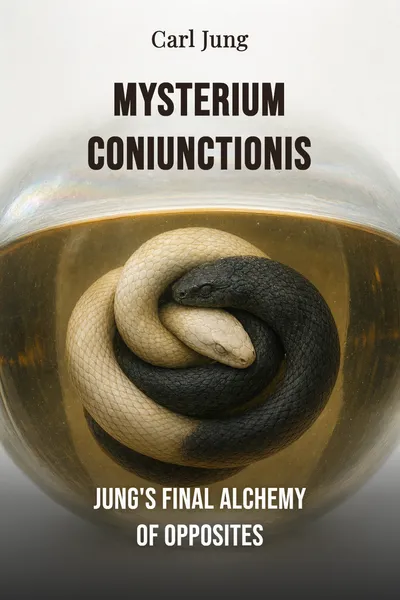
Mysterium Coniunctionis
Jung's final alchemy of opposites
Description
In 1955 and 1956, in the town of Küsnacht on the shore of Lake Zurich, an old man in his early eighties was finishing a book almost nobody had asked for. Carl Jung was by then the most famous psychologist alive after Freud, and he had chosen to spend the last great effort of his working life on alchemy — the discredited medieval attempt to turn base metal into gold, complete with its dragons, its hermaphrodites, its kings drowning in fountains. He had been reading these crumbling Latin treatises for decades. The result, published in 1955–56, ran to hundreds of dense pages and carried a Latin title: Mysterium Coniunctionis, the mystery of the conjunction.
To most readers it looked like the eccentric hobby of a great mind gone slightly to seed. Chemistry had long since buried alchemy. Why would the man who mapped the collective unconscious devote his final decade to sulphur, mercury and salt? Jung's answer was that the alchemists had not really been chemists at all. Bent over their furnaces, half-dreaming, they had projected the drama of their own souls onto the matter in the flask — and in doing so left an extraordinary record of an inner process he believed he was watching, daily, in his patients.
The book was his summa, the place where a lifetime of ideas about the psyche came to rest on a single image: two opposites, joined. Not fused into mush, not one defeating the other, but married while remaining themselves. It is a strange, difficult, sometimes exasperating book — and it is the closest thing we have to Jung's last word on what a human life is for.
The question we’re asking : Why did Jung spend his final years decoding a dead pseudo-science, and what did he think the alchemists were really describing?What we’ll see : How an old man read the union of opposites in the alchemists' furnace, and turned it into his last account of what it means to become whole.
Table of contents
01 Chapter 1 — An old man and a dead science
By the time Jung sat down to finish Mysterium Coniunctionis, he had been living with alchemy for the better part of thirty years. It had come to him, characteristically, through a dream and then through a book — a Taoist alchemical text a friend sent him in the late 1920s, which he found spoke uncannily to images his patients kept producing. He began collecting the old European treatises: Latin, German, obscure, printed in the sixteenth and seventeenth centuries by men with names like Gerhard Dorn and Michael Maier. Most libraries treated them as curiosities. Jung read them as case files.
The strangeness is worth sitting with. This was the founder of analytical psychology, a doctor trained in a Swiss asylum, staking his final and largest work on a science that Lavoisier had rendered obsolete two centuries earlier. The alchemists had failed at their stated goal — nobody ever made gold from lead — and their language was a fog of allegory: green lions, celestial dew, a stone that was not a stone. To a chemist it was noise. Jung's wager was that the noise was signal, aimed at the wrong target.

02 Chapter 2 — The two who are one
The word that gives the book its title is coniunctio — conjunction, joining, marriage. It was, for the alchemists, the pivotal event of the whole opus: the moment two contrary substances came together and produced something new. They pictured it, again and again, as a wedding. A King and a Queen, Sol and Luna, the red man and the white woman, entering a bath or a bed and merging. Sometimes the image was frankly sexual; sometimes the pair died in the embrace and lay together in the flask as a single corpse before rising transformed. Jung took these unnerving pictures completely seriously.
What the alchemists were staging, he argued, was the union of opposites — and opposition, for Jung, is the basic condition of the psyche. We are built out of pairs held in tension: conscious and unconscious, masculine and feminine, light and shadow, the person we show and the person we deny. A mind is not a smooth unity but a field of these contraries pulling against each other. The King and Queen were not decorative. They were the two halves of a divided self, and their marriage was the image of those halves finally coming to terms.
03 Chapter 3 — The work of turning lead into self
Behind the imagery sits a purpose, and Jung named it individuation — the lifelong process of becoming the particular, whole person one actually is, rather than the tidy fiction the ego prefers. The alchemists called the goal the Philosophers' Stone, or simply the Self: the incorruptible thing produced at the end of the work, often drawn as a divine child, a stone, or a figure both male and female at once. Jung's move was to read that final product not as a lump of matter but as a psychological achievement — the reconciliation of the warring opposites into a functioning centre.
The alchemists knew this could not be rushed, and neither did Jung. Their opus unfolded through stages — the blackening, the whitening, the reddening — each with its own ordeals, and they warned constantly against the impatient adept who wanted the gold without the labour. Jung heard in this the truth of his clinical experience. You cannot argue someone into wholeness or reach it by an act of will over a weekend. It comes, if it comes, through a slow, often circular process of confronting what you have disowned, and it takes, tellingly, most of a life. He was doing this work himself as he wrote, in his ninth decade.
04 Chapter 4 — When the psyche eats its own tail
Step back from the sulphur and the kings, and Mysterium Coniunctionis makes a large and unfashionable claim about where meaning and healing actually come from. The dominant modern instinct is to resolve tension — to fix the problem, cure the symptom, pick a side and be done. Jung's whole reading of alchemy pushes the other way. The gold is made not by eliminating the opposition but by holding it, consciously, until it yields a third thing. The health he describes is not the absence of inner conflict but the capacity to contain it without splitting apart or picking a winner.
That has an edge to it that is easy to miss under the medieval decoration. It means the shadow — the greed, cruelty, cowardice we locate in other people — is not to be exorcised but acknowledged as one's own, because a self that has amputated its dark half is not whole, only half-lit and dangerous. Jung had watched a continent do exactly that, projecting its collective shadow onto scapegoats with catastrophic results. His alchemy is, quietly, a psychology of not doing that: of the harder maturity that carries its own contradictions rather than dumping them on someone else.
05 Conclusion
Jung finished Mysterium Coniunctionis around his eighty-first year, and it was the last of his great systematic works; he died in 1961, a few years later, on the same lake shore where he had spent his life. The book closes a circle he had opened decades earlier with a dream and a borrowed alchemical text. What had looked to outsiders like an old man's antiquarian detour turns out to be the summing-up: everything he had learned about the psyche, gathered under a single medieval image of two figures joined in a flask.
Related books