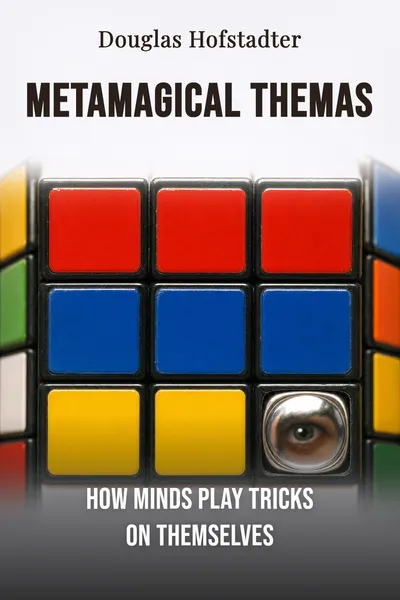
Metamagical Themas
How minds play tricks on themselves
Description
In January 1981, Douglas Hofstadter took over the mathematical-games column that Martin Gardner had run in Scientific American for a quarter of a century. Gardner had made the column a monthly pilgrimage for the curious — puzzles, paradoxes, tilings, magic squares. Hofstadter kept the slot but bent it toward his own preoccupations, and he renamed it with an anagram of Gardner's title: Metamagical Themas, the same letters as Mathematical Games, rearranged. The joke was also a manifesto. Reshuffle the pieces, watch the pattern flip into something new, and pay attention to the flipping itself.
He wrote the column monthly for about two and a half years, then gathered the pieces — with long postscripts, corrections, and second thoughts added — into a fat book published in 1985. On paper it looks like a grab bag. There are essays on the Rubik's Cube, on the genetic code, on Chopin, on Lisp programming, on chaos, on nuclear strategy, on sexist language, on why a chain letter works. A reader could be forgiven for thinking Hofstadter simply wrote about whatever caught his eye that month.
But the pieces are not random, and the anagram in the title is the clue. Underneath the variety runs one steady current: an interest in how minds handle patterns, and how they tangle themselves up when the pattern turns back on itself. Analogy, self-reference, the strange feeling of a system that describes itself — these keep surfacing, essay after essay, whatever the surface topic happens to be.
The question we’re asking : What holds together a collection that jumps from Rubik's Cube to nuclear deterrence — and why did Hofstadter keep circling the same theme?What we’ll see : How a playful magazine column, read as one long argument, turns out to be a sustained study of a mind watching itself think.
Table of contents
01 Chapter 1 — The column that answered to no one
Taking over from Martin Gardner was a strange inheritance. For twenty-five years Gardner's readers had come for clean puzzles with clean answers — recreational mathematics done impeccably. Hofstadter, then a young professor with one celebrated book behind him, could have kept the format and coasted. Instead he treated the column as a place to think out loud about whatever was gnawing at him, and what was gnawing at him rarely resolved into a tidy solution.
The anagram set the tone. Metamagical Themas rearranges the letters of Mathematical Games, and Hofstadter meant the wordplay to signal a shift of altitude. The old column was about games; the new one would be meta — about the games behind the games, the rules behind the rules, the odd sensation of a system that includes a description of itself. He was less interested in solving a puzzle than in noticing what the puzzle revealed about the mind trying to solve it.

02 Chapter 2 — Loops, tangles, and the mind watching itself
The most Hofstadterian move in the book is the self-referential sentence, and he built a whole essay around it. 'This sentence contains threee erors' — where the third error is that there are only two, unless you count the miscount, at which point your head begins to spin. He collected these self-swallowing constructions the way other people collect stamps, because each one stages, in miniature, the thing he cared about most: a system that points at itself and produces a small explosion of paradox.
This is not idle wordplay. It runs straight back to his earlier work on Kurt Gödel, the logician who showed in 1931 that any sufficiently rich formal system can produce a statement that says, in effect, 'this statement cannot be proved.' Gödel's trick was to make mathematics talk about itself, and Hofstadter had spent years arguing that this loop — a system encoding a description of its own workings — is not a curiosity but the very thing that makes minds feel like minds.
03 Chapter 3 — When a thousand people reach for the same coin
Halfway through the book the tone darkens. Hofstadter turns from playful loops to a genuinely unsettling one: the way rational individuals, each acting sensibly, produce a collective result nobody wanted. His recurring example is the Prisoner's Dilemma, the scenario where two people each do better by betraying the other, so both betray, so both end up worse off than if they had cooperated. It looks like a puzzle in game theory. Hofstadter treats it as a puzzle about how minds reason about other minds.
His own contribution was the idea of what he called superrationality. If two thinkers are genuinely alike, he argued, each should reason that whatever conclusion it reaches, the other will reach the same one — so the only stable, symmetric choice is to cooperate. To test this he ran an experiment through the column itself: he invited twenty readers to send in either 'cooperate' or 'defect,' with a real payoff that depended on how everyone else answered. The results, he reported later, mostly disappointed the superrational hope. People defected.
04 Chapter 4 — The pattern behind the patterns
Step back from the individual essays and the collection resolves into a single question, asked over and over in different costumes. Whether Hofstadter is writing about a self-miscounting sentence, a strand of DNA, a defecting crowd, or a fugue by Bach, he keeps returning to the moment when a system folds back on itself — when the thing doing the describing becomes the thing being described. That fold, he argues across the book, is the deep structure of thought.
The claim is bolder than it first appears. Most of us treat perception as a window: the mind looks out, the world comes in. Hofstadter insists the interesting action is on the inside surface of the glass — in the loops the mind runs to recognize an 'A,' to feel the pull of an analogy, to catch a paradox, to model what another mind is about to do. The tricks the mind plays on itself are not malfunctions to be corrected. They are the same machinery that lets it mean anything at all.
05 Conclusion
The column ran for only a couple of years, and by the time the book appeared in 1985 Hofstadter had already moved on to the research on analogy and fluid concepts that would occupy the rest of his career. The anagram he chose as a title turned out to describe the whole project better than any straightforward name could have: take a familiar set of pieces, rearrange them, and let the reader watch the shape shift. Mathematical Games became Metamagical Themas, and a puzzle column became a long, roundabout inquiry into how minds work.
Related books