Meditation Station
Pause, breathe, find calm
Description
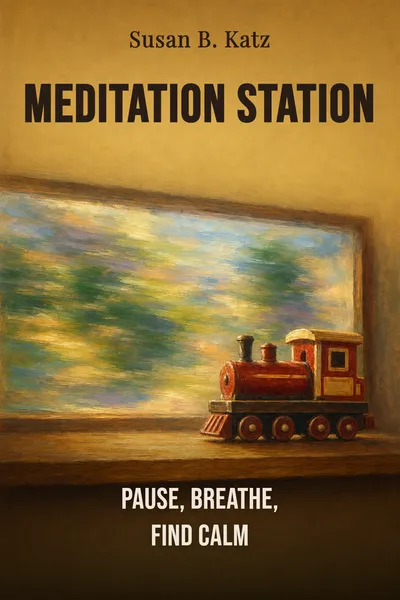
Susan B. Katz opens Meditation Station with an image a small child can hold in both hands: a train. Not a train that hurtles toward somewhere, though — a train that pulls into a station and simply rests. The engine slows, the wheels stop, the noise settles. For a book aimed at readers who can barely sit through a bath, this is a bold first move. Katz, a former teacher and prolific author of picture books, takes one of the least kid-friendly ideas around — sit still and pay attention to nothing in particular — and hands it over in a shape that fits a lap and a bedtime.
The bet underneath the book is a serious one, even if the pages are soft and rhyming. Meditation and mindfulness spent most of the last century filed under adult concerns: stress, therapy, spiritual retreats, the corporate wellness memo. Katz writes as if none of that is the natural home of the practice. She writes as if a four-year-old, given the right words and a friendly picture, can learn to notice a breath and feel a little calmer for it. The whole book is built to test whether that's true.
What's striking is how little Katz asks the reader to believe. There's no doctrine, no posture chart, no promise that anything will be fixed. There's a train, a breath, and an invitation to stop for a moment. The book trusts that stopping, for a child, is itself the lesson worth teaching first.
The question we’re asking : Can a practice built for restless adult minds actually be handed to a four-year-old — and what does it look like when someone tries?What we’ll see : How Katz turns stillness into something a small child can picture, hold, and come back to on their own.
Table of contents
01 Chapter 1 — A train that goes nowhere on purpose
The central image of Meditation Station is the station itself. A train, Katz suggests, spends most of its life rushing — and a child recognizes that immediately, because a child's day is mostly rushing too, from breakfast to the door to the car to the next thing. But a train also stops. It pulls in, settles, and waits before it moves again. Katz builds the whole practice on that pause. The station isn't a failure of the train; it's a necessary part of how a train works. The same, she implies gently, is true of a person.
This is a smart piece of translation. Adults are usually sold meditation as an escape from busyness, a thing you carve out against the grain of your life. Katz doesn't frame it as opposition. She frames it as rhythm — motion, then rest, then motion again — which is far easier for a young reader to accept, because they already live inside that rhythm without a name for it. Nobody has to be convinced that a train stops. It just does.

02 Chapter 2 — Breath as the ticket in
Once the train has stopped, Katz moves to the one tool every meditation tradition eventually lands on: the breath. For adults, breathing exercises come wrapped in counts, techniques, and the vague suspicion that we're doing it wrong. Katz strips all of that away. She asks the child to notice that they are breathing, to feel the air come in and go out, and that is more or less the entire instruction. The breath is always there, it costs nothing, and — the quiet genius of using it with children — it requires no equipment and no permission.
There's a reason breath sits at the center rather than, say, a mantra or a visualization. A young child's attention is famously slippery; it darts. Katz doesn't fight that. She offers the breath as something to come back to, again and again, rather than something to hold onto without moving. The implicit lesson is that attention wanders and returns, wanders and returns — which happens to be exactly what experienced meditators say the practice actually is. Katz teaches the real thing, just without the vocabulary.
03 Chapter 3 — Naming the weather inside
The third thing Katz introduces is awareness — not just of the breath, but of what's going on inside. Feelings, in the book, are treated as things a child can notice rather than things that simply happen to them. This is the step where the book quietly does the most, because noticing a feeling instead of being swept away by it is a skill many adults never fully acquire. Katz plants the seed early, in language a preschooler can follow: you can feel something, and you can also notice that you're feeling it. Those are two different acts.
The move is gentle by design. Katz doesn't ask the child to fix or banish anything. There's no instruction to stop being sad or to calm down — which children hear as a demand and resist. Instead the book models a kind of friendly observation: here's what's happening inside right now, and it's okay that it's happening. The calm Katz is after isn't the absence of feeling. It's a bit of space around the feeling, enough room that the child isn't entirely at its mercy.
04 Chapter 4 — When a picture book does grown-up work
Step back from the train and the breath, and Meditation Station sits at an interesting cultural moment. For most of its Western history, mindfulness arrived late in life, often as a repair job — something people reached for after stress, burnout, or therapy had already made the case. The idea that you'd introduce it to a four-year-old, before anything has gone wrong, is genuinely recent. Katz's book is one small artifact of a larger shift: attention and inner calm are increasingly treated not as adult medicine but as a basic childhood skill, taught alongside sharing and tying shoes.
That shift says something about how we've come to see attention itself. In a world engineered to fragment focus — screens, notifications, the constant next thing — the ability to stop and breathe has quietly been reclassified as something you have to actively teach, because the environment no longer teaches it by default. Katz doesn't argue any of this on the page; a board book can't. But the mere existence of a meditation primer for preschoolers is the argument. Someone decided this couldn't wait until adulthood.
05 Conclusion
By the last page, the train is still at the station, and Katz has asked for nothing more than that. No transformation, no graduation, no sign that the child is now officially calm. The book ends where it began — with a stop, a breath, and permission to rest for a moment before moving again. What it has quietly done is give a very young reader a handful of tools they can carry alone: an image to return to, a breath to notice, a way of watching their own feelings without drowning in them.
Related books